Kirjojen hintavertailu. Mukana 12 390 323 kirjaa ja 12 kauppaa.

Kirjailija

Jan McArthur

Kirjat ja teokset yhdessä paikassa: 8 kirjaa, julkaisuja vuosilta 2012-2026, suosituimpien joukossa Reflective Teaching in Higher Education. Vertaile teosten hintoja ja tarkista saatavuus suomalaisista kirjakaupoista.

8 kirjaa

Kirjojen julkaisuhaarukka 2012-2026.

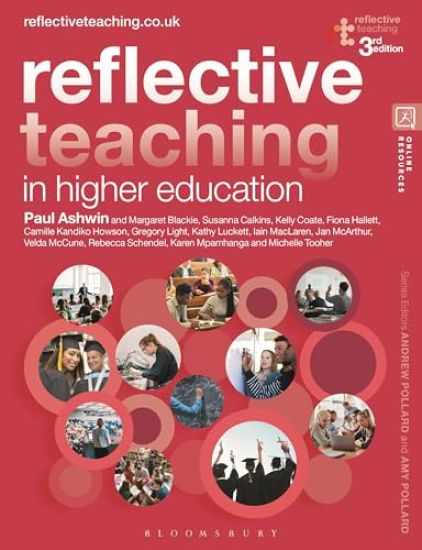
Reflective Teaching in Higher Education

Reflective Teaching in Higher Education

Paul Ashwin; Margaret Blackie; Susanna Calkins; Kelly Coate; Fiona Hallett; Camille Kandiko Howson; Gregory Light; Kathy Luckett; Iain MacLaren; Jan McArthur; Velda McCune; Rebecca Schendel; Karen Mpamhanga; Michelle Tooher

BLOOMSBURY PUBLISHING PLC
2025
sidottu
Reflective Teaching in Higher Education is the definitive textbook for reflective teachers in higher education. Informed by the latest research in this area, the book offers extensive support for those at the start of an academic career and career-long professionalism. Written by an international collaborative author team of higher education experts led by Paul Ashwin, Reflective Teaching in Higher Education offers two levels of support:- practical guidance for day-to-day teaching, covering key issues such as strategies for improving learning, teaching and assessment, curriculum design, relationships, communication, and inclusion.- evidence-informed 'principles to aid understanding of how theories can effectively inform teaching practices, offering ways to develop a deeper understanding of teaching and learning.This new edition gives greater coverage of contemporary topics, including: the climate and nature emergency; Generative Artificial Intelligence (GenAI) including ChatGPT; the use of digital education and digital capabilities following the global pandemic; consideration of the intended outcomes of higher education for students. This edition features a greater diversity of students, teachers, institutional and disciplinary contexts, and national/international settings. It includes updated case studies, reflective activities, and research briefings, drawing on literature from a broader range of countries.reflectiveteaching.co.uk provides a treasure trove of additional support. It includes supplementary sector specific material to support for considering questions around society’s educational aims, and much more besides.
Reflective Teaching in Higher Education

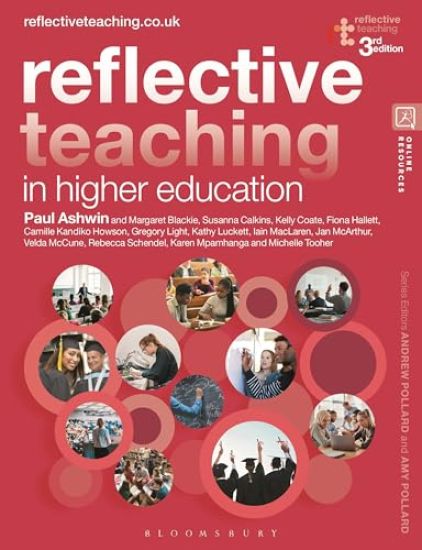
Reflective Teaching in Higher Education

Paul Ashwin; Margaret Blackie; Susanna Calkins; Kelly Coate; Fiona Hallett; Camille Kandiko Howson; Gregory Light; Kathy Luckett; Iain MacLaren; Jan McArthur; Velda McCune; Rebecca Schendel; Karen Mpamhanga; Michelle Tooher

BLOOMSBURY PUBLISHING PLC
2025
nidottu
Reflective Teaching in Higher Education is the definitive textbook for reflective teachers in higher education. Informed by the latest research in this area, the book offers extensive support for those at the start of an academic career and career-long professionalism. Written by an international collaborative author team of higher education experts led by Paul Ashwin, Reflective Teaching in Higher Education offers two levels of support:- practical guidance for day-to-day teaching, covering key issues such as strategies for improving learning, teaching and assessment, curriculum design, relationships, communication, and inclusion.- evidence-informed 'principles to aid understanding of how theories can effectively inform teaching practices, offering ways to develop a deeper understanding of teaching and learning.This new edition gives greater coverage of contemporary topics, including: the climate and nature emergency; Generative Artificial Intelligence (GenAI) including ChatGPT; the use of digital education and digital capabilities following the global pandemic; consideration of the intended outcomes of higher education for students. This edition features a greater diversity of students, teachers, institutional and disciplinary contexts, and national/international settings. It includes updated case studies, reflective activities, and research briefings, drawing on literature from a broader range of countries.reflectiveteaching.co.uk provides a treasure trove of additional support. It includes supplementary sector specific material to support for considering questions around society’s educational aims, and much more besides.
Reflective Teaching in Higher Education

Reflective Teaching in Higher Education

Paul Ashwin; David Boud; Susanna Calkins; Kelly Coate; Fiona Hallett; Gregory Light; Kathy Luckett; Iain MacLaren; Katarina Mårtensson; Jan McArthur; Velda McCune; Monica McLean; Michelle Tooher

Bloomsbury Academic
2020
nidottu
Reflective Teaching in Higher Education is the definitive textbook for those wanting to excel at teaching in the sector. Informed by the latest research in this area, the book offers extensive support for those at the start of an academic career and career-long professionalism for those teaching in higher education. Written by an international collaborative author team of experts led by Paul Ashwin, Reflective Teaching in Higher Education offers two levels of support: - practical guidance for day-to-day teaching, covering key issues such as strategies for improving learning, teaching and assessment, curriculum design, relationships, communication, and inclusion - evidence-informed 'principle's to aid understanding of how theories can effectively inform teaching practices, offering ways to develop a deeper understanding of teaching and learning in higher education In addition to new case studies from a wider variety of countries than ever before, this new edition includes discussion of:- What is meant by 'agency'- Gender, ethnicity, disability and university teaching- Digital learning spaces and social media- Teaching career development for academics- Decolonising the curriculum- Assessment and feedback practices- Teaching excellence and 'learning gain'- 2015 UN General Assembly 2030 Agenda for Sustainable Developmentreflectiveteaching.co.uk provides a treasure trove of additional support. It includes supplementary sector specific material to support for considering questions around society’s educational aims, and much more besides.
Realising the Educational Potential of Mass Higher Education

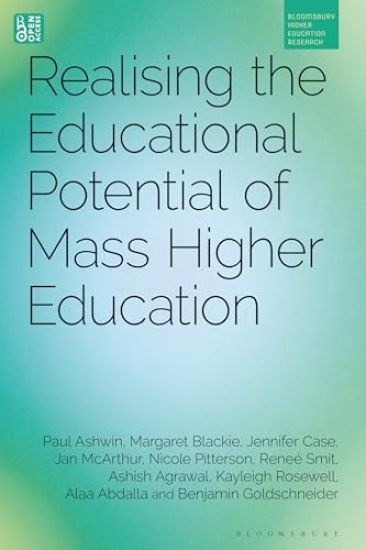
Realising the Educational Potential of Mass Higher Education

Paul Ashwin; Margaret Blackie; Jennifer Case; Jan McArthur; Nicole Pitterson; Reneé Smit; Ashish Agrawal; Kayleigh Rosewell; Alaa Abdalla; Benjamin Goldschneider

BLOOMSBURY PUBLISHING PLC
2026
sidottu
This open access book addresses the current disillusionment with mass higher education and argues that it is based on a profound misunderstanding of its educational potential. The authors analyse a seven-year longitudinal research project that tracked participants who studied chemistry or chemical engineering from their first year of university until up to three years after they graduated. Drawing on over 700 interviews with students/graduates from two English, two South African and two American universities, the book explores the educational intentions of their degree programmes, what participants wanted to get out of going to university and studying for a degree, how their views of knowledge and the world changed, and what they felt they had gained from going to university. The book argues that the educational potential of higher education lies, not in graduate salaries or employability, but in the ways in which engaging with structured bodies of knowledge changes students’ understanding of the world and what they can do in it. The authors consider the implications of this argument for how the educational role of higher education is understood by students, graduates, universities, and policymakers and how this understanding might be drawn upon to counter the damaging disillusionment with mass higher education that appears to be growing in many countries. The ebook editions of this book are available open access under a CC BY-NC-ND 4.0 licence on bloomsburycollections.com. Open access was funded by UKRI.
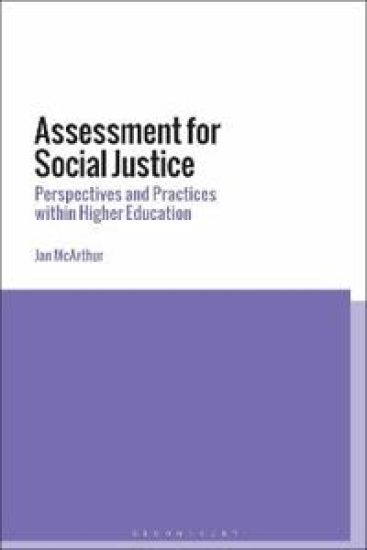
Assessment for Social Justice

Assessment for Social Justice

Jan McArthur

Bloomsbury Academic
2019
nidottu
Assessment for Social Justice takes the established idea of ‘assessment for learning’ and extends it to consider how assessment contributes to social justice within and through higher education. Jan McArthur invites the reader to rethink familiar positions on assessment and fairness and seeks to explore the full complexity of a critical theory-inspired notion of social justice. She positions her work in contrast to more procedural approaches to social justice, such as John Rawls’s influential theorisation of social justice. In contrast, McArthur draws on the work of third generation critical theorist, Axel Honneth, and takes inspiration from Honneth’s three realms of mutual recognition in order to reconsider the nature of assessment relationships and practices. A further theoretical strand is introduced in the form of social practice theory, and particularly the work of Theodore Shatzki. McArthur provides a theoretically rigorous understanding of assessment as a social practice, and as a vehicle both for and against social justice. Together with critical theory, this work enables a realizable vision of an alternative approach to assessment in higher education, where the underlying aim is greater social justice. McArthur argues that students must be nurtured to recognise the social contribution that they can make as a result of engaging with knowledge in higher education, rather than defining their achievements in terms of a mark, grade or degree classification.
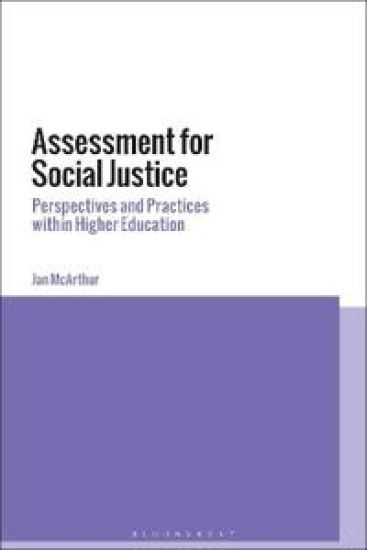
Assessment for Social Justice

Assessment for Social Justice

Jan McArthur

Bloomsbury Academic
2018
sidottu
Assessment for Social Justice takes the established idea of ‘assessment for learning’ and extends it to consider how assessment contributes to social justice within and through higher education. Jan McArthur invites the reader to rethink familiar positions on assessment and fairness and seeks to explore the full complexity of a critical theory-inspired notion of social justice. She positions her work in contrast to more procedural approaches to social justice, such as John Rawls’s influential theorisation of social justice. In contrast, McArthur draws on the work of third generation critical theorist, Axel Honneth, and takes inspiration from Honneth’s three realms of mutual recognition in order to reconsider the nature of assessment relationships and practices. A further theoretical strand is introduced in the form of social practice theory, and particularly the work of Theodore Shatzki. McArthur provides a theoretically rigorous understanding of assessment as a social practice, and as a vehicle both for and against social justice. Together with critical theory, this work enables a realizable vision of an alternative approach to assessment in higher education, where the underlying aim is greater social justice. McArthur argues that students must be nurtured to recognise the social contribution that they can make as a result of engaging with knowledge in higher education, rather than defining their achievements in terms of a mark, grade or degree classification.
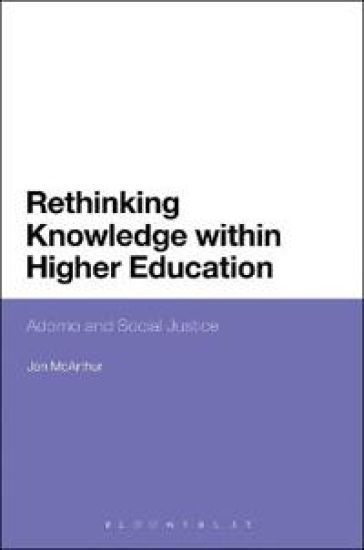
Rethinking Knowledge within Higher Education

Rethinking Knowledge within Higher Education

Jan McArthur

Bloomsbury Academic
2014
nidottu
Rethinking Knowledge within Higher Education argues for a higher education that is neither a romantic idyll of learning for its own sake nor an instrumental institution designed to train a willing workforce for the prevailing economic system. Instead, using analysis informed by critical theorist Theodor Adorno, this book argues that higher education should have social and economic roles at its heart, and that these should encompass the needs of all society. The key to achieving this purpose without privilege lies in the ways in which knowledge is understood and engaged with in higher education. Higher education has a special role in society as a place in which complex, contested and dynamic knowledge is engaged with, challenged and created. The realization of this purpose challenges traditional dichotomies between economic and social purposes, liberal and vocational education, and theory and practice. Jan McArthur shows that by interpreting and adapting some of Adorno's most complex ideas, the nature of knowledge and the pursuit of social justice within higher education is feasible and aspirational.
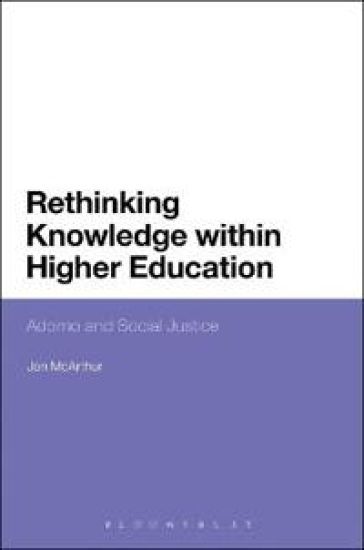
Rethinking Knowledge within Higher Education

Rethinking Knowledge within Higher Education

Jan McArthur

Bloomsbury Academic USA
2012
sidottu
Rethinking Knowledge within Higher Education argues for a higher education that is neither a romantic idyll of learning for its own sake nor an instrumental institution designed to train a willing workforce for the prevailing economic system. Instead, using analysis informed by critical theorist Theodor Adorno, this book argues that higher education should have social and economic roles at its heart, and that these should encompass the needs of all society. The key to achieving this purpose without privilege lies in the ways in which knowledge is understood and engaged with in higher education. Higher education has a special role in society as a place in which complex, contested and dynamic knowledge is engaged with, challenged and created. The realization of this purpose challenges traditional dichotomies between economic and social purposes, liberal and vocational education, and theory and practice. Jan McArthur shows that by interpreting and adapting some of Adorno's most complex ideas, the nature of knowledge and the pursuit of social justice within higher education is feasible and aspirational.