Kirjojen hintavertailu. Mukana 12 453 320 kirjaa ja 12 kauppaa.

Kirjailija

Jan Narveson

Kirjat ja teokset yhdessä paikassa: 9 kirjaa, julkaisuja vuosilta 1994-2020, suosituimpien joukossa The Libertarian Idea. Vertaile teosten hintoja ja tarkista saatavuus suomalaisista kirjakaupoista.

9 kirjaa

Kirjojen julkaisuhaarukka 1994-2020.

Morality and Utility

Morality and Utility

Jan Narveson

Johns Hopkins University Press
2020
pokkari
Originally published in 1967. In the past half-century, Utilitarianism has fallen out of favor among professional philosophers, except in such "amended" forms as "Ideal" and "Rule" Utilitarianism. Professor Narveson contends that amendments and qualifications are unnecessary and misguided, and that a careful interpretation and application of the original theory, as advocated by Bentham, the Mills, and Sidgwick, obviates any need for modification. Drawing on the analytical work of such influential recent thinkers as Stevenson, Toulmin, Hare, Nowell-Smith, and Baier, the author attempts to draw a more careful and detailed picture than has previously been offered of the logical status and workings of the Principle of Utility. He then turns to the traditional objections to the theory as developed by such respected thinkers as Ross, Frankena, Hart, and Rawls and attempts to show how Utilitarianism can account for our undoubted obligations in the areas of punishment, promising, distributive justice, and the other principal moral convictions of mankind. He contends that the Principle of Utility implies whatever is recognized to be clearly true in these convictions and that it leaves room to doubt whatever is doubtful in them. Narveson concludes with a rationally forceful proof of the Principle of Utility. In the course of this argument, which draws on the most widely accepted recent findings in analytical ethics, Narveson discovers an essential identity between the ethical outlooks of Kant and of Mill, which are traditionally held to be antithetical. Both thinkers, he shows, center on the principle that the interests of others are to be regarded as equal in value to one's own. A new view of Mill's celebrated "proof of utilitarianism" is developed in the course of the discussion.

Are Liberty and Equality Compatible?

Are Liberty and Equality Compatible?

Jan Narveson; James P. Sterba

Cambridge University Press
2012
pokkari
Are the political ideals of liberty and equality compatible? This question is of central and continuing importance in political philosophy, moral philosophy, and welfare economics. In this book, two distinguished philosophers take up the debate. Jan Narveson argues that a political ideal of negative liberty is incompatible with any substantive ideal of equality, while James P. Sterba argues that Narveson's own ideal of negative liberty is compatible, and in fact leads to the requirements of a substantive ideal of equality. Of course, they cannot both be right. Thus, the details of their arguments about the political ideal of negative liberty and its requirements will determine which of them is right. Engagingly and accessibly written, their debate will be of value to all who are interested in the central issue of what are the practical requirements of a political ideal of liberty.
This Is Ethical Theory

This Is Ethical Theory

Jan Narveson

Cricket Books, a division of Carus Publishing Co
2010
pokkari
Ethical questions lie at the very heart of all philosophy, and no one is better equipped to untangle the many facets of ethical theory than respected thinker and professor Jan Narveson. Drawing from theoretical notions as well as everyday applications, Narveson simplifies these nuanced ideas for any beginning ethicist. Discussing theoretical elements ranging from intuitionism to naturalism, emotivism to metaethics, Narveson’s approach to this complex topic is one that any reader will find accessible.
You and the State

You and the State

Jan Narveson

Rowman Littlefield Publishers
2008
sidottu
Jan Narveson asks the provocative, philosophical question: is the state necessary? In this unusual introduction to political philosophy, Narveson draws on the history of political philosophy and discusses its main theories_classic liberal, democratic, socialist, radical_with reference to how each sees the place of the individual in the political order. Narveson's critique is situated within issues of freedom, authority, economic welfare, international relations and others to explore how and whether the state is necessary. His argument is ultimately anti-statist and takes seriously the question of whether and how some version of anarchism might make sense.
You and the State

You and the State

Jan Narveson

Rowman Littlefield Publishers
2008
nidottu
Jan Narveson asks the provocative, philosophical question: is the state necessary? In this unusual introduction to political philosophy, Narveson draws on the history of political philosophy and discusses its main theories_classic liberal, democratic, socialist, radical_with reference to how each sees the place of the individual in the political order. Narveson's critique is situated within issues of freedom, authority, economic welfare, international relations and others to explore how and whether the state is necessary. His argument is ultimately anti-statist and takes seriously the question of whether and how some version of anarchism might make sense.
Respecting Persons in Theory and Practice

Respecting Persons in Theory and Practice

Jan Narveson

Rowman Littlefield Publishers
2002
nidottu
Respecting Persons in Theory and Practice is a collection of essays of the moral and political philosophy of Jan Narveson. The essays in this collection share a consistent theme running through much of Narveson's moral and political philosophy, namely that politics and morals stem from the interests of individual people, and have no antecedent authority over us. Rather, the source of such authority lies in the way people are related to one another, and most especially, in the exigencies of cooperation. Humans have plenty of problems, Narveson argues, but we are perhaps unique among animals in that our worst enemies, often enough, are other humans. The rules of morals and the devices of politics, in the view Narveson holds, deal with these problems by identifying the potential for gain from cooperation, and loss from the reverse. The essays express a collective antipathy for the ways in which modern political and moral philosophy has ridden roughshod over sane and efficient social restrictions, leaving us with a social scene devoted mainly to satisfying the cravings for power of the politically ambitious. Politics, Narveson argues with distress, has subverted morals. The essays in this collection, in various ways and as applied to various aspects of the scene, detail these charges, arguing that the ultimate and true point of politics and morals is to enable us to make our lives better, according to our varied senses of what that might mean.
The Libertarian Idea

The Libertarian Idea

Jan Narveson

Broadview Press Ltd
2001
pokkari
Libertarianism is both a philosophy and a political view. The key concepts defining Libertarianism are: Individual Rights as inherent to human beings, not granted by government; a Spontaneous Order through which people conduct their daily interactions and through which society is organized independent of central (government) direction; the Rule of Law which dictates that everyone is free to do as they please so long as they do not infringe upon the rights of others; a Divided and Limited Government, checked by written constitution; Free Markets in which price and exchange is agreed upon mutually by individuals; Virtue of Production whereby the productive labour of the individual and any translation of that labour into earnings belongs, by right, to the individual who should not have to sacrifice those earnings to taxes; and Peace which has, throughout history, most commonly been disrupted by the interests of the ruling class or centralized government.
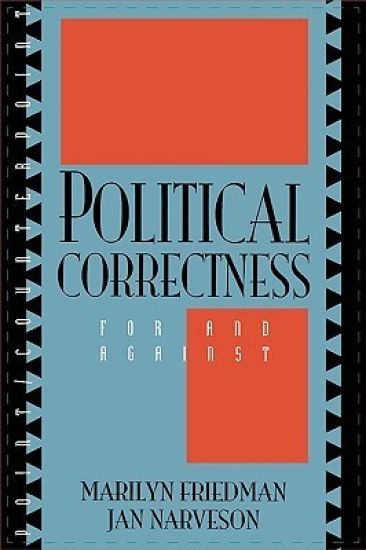
Political Correctness

Political Correctness

Marilyn Friedman; Jan Narveson

Rowman Littlefield
1995
sidottu
Two prominent philosophers here engage in a forthright debate over some of the centrally disputed topics in the political correctness controversy now taking place on college campuses across the nation, including feminism, campus speech codes, the western canon, and the nature of truth. Friedman and Narveson conclude the volume with direct replies to each other's positions.
Political Correctness

Political Correctness

Marilyn Friedman; Jan Narveson

Rowman Littlefield
1994
nidottu
Two prominent philosophers here engage in a forthright debate over some of the centrally disputed topics in the political correctness controversy now taking place on college campuses across the nation, including feminism, campus speech codes, the western canon, and the nature of truth. Friedman and Narveson conclude the volume with direct replies to each other's positions.