Kirjojen hintavertailu. Mukana 12 595 353 kirjaa ja 12 kauppaa.

Kirjailija

Jan Slovak

Kirjat ja teokset yhdessä paikassa: 4 kirjaa, julkaisuja vuosilta 1993-2024, suosituimpien joukossa Natural Operations in Differential Geometry. Vertaile teosten hintoja ja tarkista saatavuus suomalaisista kirjakaupoista.

4 kirjaa

Kirjojen julkaisuhaarukka 1993-2024.

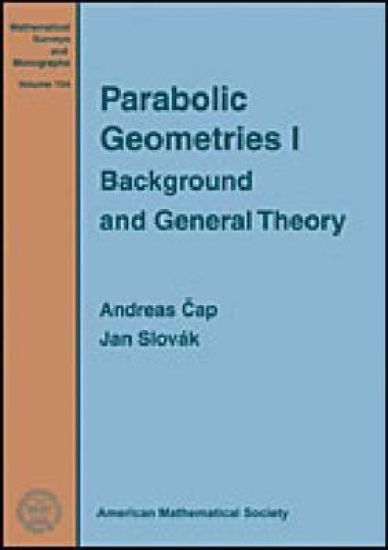
Parabolic Geometries I

Parabolic Geometries I

Andreas Cap; Jan Slovak

AMERICAN MATHEMATICAL SOCIETY
2024
nidottu
Parabolic geometries encompass a very diverse class of geometric structures, including such important examples as conformal, projective, and almost quaternionic structures, hypersurface type CR-structures and various types of generic distributions. The characteristic feature of parabolic geometries is an equivalent description by a Cartan geometry modeled on a generalized flag manifold (the quotient of a semisimple Lie group by a parabolic subgroup). Background on differential geometry, with a view towards Cartan connections, and on semisimple Lie algebras and their representations, which play a crucial role in the theory, is collected in two introductory chapters. The main part discusses the equivalence between Cartan connections and underlying structures, including a complete proof of Kostant's version of the Bott-Borel-Weil theorem, which is used as an important tool. For many examples, the complete description of the geometry and its basic invariants is worked out in detail. The constructions of correspondence spaces and twistor spaces and analogs of the Fefferman construction are presented both in general and in several examples. The last chapter studies Weyl structures, which provide classes of distinguished connections as well as an equivalent description of the Cartan connection in terms of data associated to the underlying geometry. Several applications are discussed throughout the text.

Natural Operations in Differential Geometry

Natural Operations in Differential Geometry

Ivan Kolar; Peter W. Michor; Jan Slovak

Springer-Verlag Berlin and Heidelberg GmbH Co. K
2010
nidottu
The aim of this work is threefold: First it should be a monographical work on natural bundles and natural op­ erators in differential geometry. This is a field which every differential geometer has met several times, but which is not treated in detail in one place. Let us explain a little, what we mean by naturality. Exterior derivative commutes with the pullback of differential forms. In the background of this statement are the following general concepts. The vector bundle A kT* M is in fact the value of a functor, which associates a bundle over M to each manifold M and a vector bundle homomorphism over f to each local diffeomorphism f between manifolds of the same dimension. This is a simple example of the concept of a natural bundle. The fact that exterior derivative d transforms sections of A kT* M into sections of A k+1T* M for every manifold M can be expressed by saying that d is an operator from A kT* M into A k+1T* M.
Natural Operations in Differential Geometry

Natural Operations in Differential Geometry

Ivan Kolar; Peter W. Michor; Jan Slovak

Springer-Verlag Berlin and Heidelberg GmbH Co. K
1993
sidottu
The aim of this work is threefold: First it should be a monographical work on natural bundles and natural op­ erators in differential geometry. This is a field which every differential geometer has met several times, but which is not treated in detail in one place. Let us explain a little, what we mean by naturality. Exterior derivative commutes with the pullback of differential forms. In the background of this statement are the following general concepts. The vector bundle A kT* M is in fact the value of a functor, which associates a bundle over M to each manifold M and a vector bundle homomorphism over f to each local diffeomorphism f between manifolds of the same dimension. This is a simple example of the concept of a natural bundle. The fact that exterior derivative d transforms sections of A kT* M into sections of A k+1T* M for every manifold M can be expressed by saying that d is an operator from A kT* M into A k+1T* M.