Kirjojen hintavertailu. Mukana 12 390 323 kirjaa ja 12 kauppaa.

Kirjailija

Jaroslav Pelikan

Kirjat ja teokset yhdessä paikassa: 30 kirjaa, julkaisuja vuosilta 1950-2021, suosituimpien joukossa Bach Among the Theologians. Vertaile teosten hintoja ja tarkista saatavuus suomalaisista kirjakaupoista.

30 kirjaa

Kirjojen julkaisuhaarukka 1950-2021.

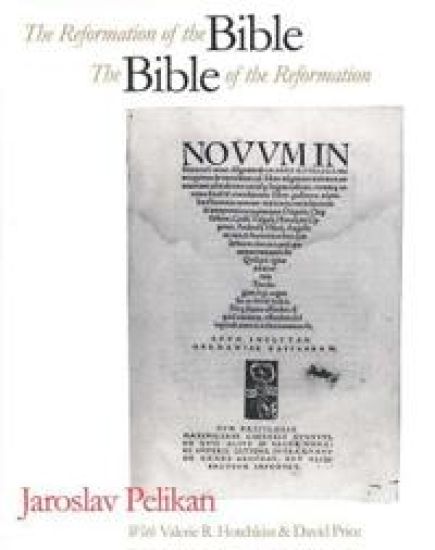
The Reformation of the Bible/The Bible of the Reformation
It is equally true that the Reformation was inspired and defined by the Bible and that the Bible was reshaped by the intellectual, political, and cultural forces of the Reformation. In this book, a distinguished scholar—whose contributions to the field of religious studies have won him wide renown—explores this relationship, examining both the role of the Bible in the Reformation and the effect of the Reformation on the text of the Bible, Biblical studies, preaching and exegesis, and European culture in general. Jaroslav Pelikan begins by discussing the philological foundations of the "reformation" of the Biblical text, focusing on the revival of Greek and Hebrew language study and the important contributions to textual criticism by humanist scholars. He then examines the changing patterns of interpretation and communication of the Biblical text, the proliferation of vernacular versions of scripture and their impact on various national cultures, and the impact of the Reformation Bible on art, music, and literature of the period. The book is richly illustrated with examples of early printed editions of Bibles, commentaries, sermons, vernacular translations, and other works with Biblical themes, all of which are identified and discussed.The book serves as the catalog for a major exhibition of early Bibles and Reformation texts that has been organized at Bridwell Library, Perkins School of Theology, Southern Methodist University, and will also be shown at the Yale Center for British Art, the Houghton Library and the Widener Library at Harvard University, and the Rare Book and Manuscript Library at Columbia University.Copublished with the Bridwell Library, Southern Methodist University
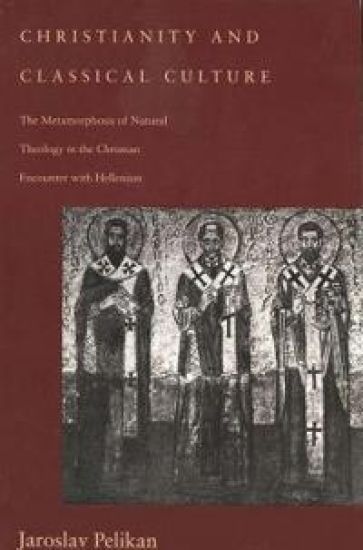
Christianity and Classical Culture

Christianity and Classical Culture

Jaroslav Pelikan

Yale University Press
1995
pokkari
The momentous encounter between Christian thought and Greek philosophy reached a high point in fourth-century Byzantium, and the principal actors were four Greek-speaking Christian thinkers whose collective influence on the Eastern Church was comparable to that of Augustine on Western Latin Christendom. In this erudite and informative book, a distinguished scholar provides the first coherent account of the lives and writings of these so-called Cappadocians (named for a region in what is now eastern Turkey), showing how they managed to be Greek and Christian at the same time. Jaroslav Pelikan describes the four Cappadocians—Gregory of Nazianzus, Basil of Caesarea, Gregory of Nyssa, and Macrina, sister and teacher of the last two—who were trained in Classical culture, philosophy, and rhetoric but who were also defenders and expositors of Christian orthodoxy. On one issue of faith and life after another—the nature of religious language, the ways of knowing, the existence of God, the universe as cosmos, time, and space, free will and immortality, the nature of the good life, the purpose of the universe—they challenged and debated the validity of the Greek philosophical tradition in interpreting Scripture. Because the way they resolved these issues became the very definition of normative Christian belief, says Pelikan, their system is still a key to our understanding not only of Christianity's diverse religious traditions but also of its intellectual and philosophical traditions. This book is based on the prestigious Gifford Lectures, presented by Jaroslav Pelikan at the University of Aberdeen in 1992 and 1993.
The Idea of the University

The Idea of the University

Jaroslav Pelikan

Yale University Press
1994
pokkari
The crisis in university education has been the subject of vigorous debate in recent years. In this eloquent and deeply personal book, a distinguished scholar reflects on the character and aims of the university, assessing its guiding principles, its practical functions, and its role in society. Jaroslav Pelikan provides a unique perspective on the university today by reexamining it in light of John Henry Cardinal Newman’s 150-year old classic The Idea of a University and showing how Cardinal Newman’s ideas both illuminate and differ from current problems facing higher education. Pelikan begins by affirming the validity of Newman’s first principle: that knowledge must be an end in itself. He goes on to make the case for the inseparability of research and teaching on both intellectual and practical grounds, stressing the virtues—free inquiry, scholarly honesty, civility in discourse, toleration of diverse beliefs and values, and trust in rationality and public verifiability—that must be practiced and taught by the university. He discusses the business of the university—the advancement of knowledge through research, the extension and interpretation of knowledge through undergraduate and graduate teaching, the preservation of knowledge in libraries, museums, and galleries, and the diffusion of knowledge through scholarly publishing. And he argues that be performing these tasks, by developing closer ties with other schools at all levels, and by involving the community in lifelong education, the university will make its greatest contribution to society.
The Christian Tradition: A History of the Develo – Christian Doctrine and Modern Culture (since 1700)
Jaroslav Pelikan begins this volume with the crisis of orthodoxy that confronted all Christian denominations by the beginning of the eighteenth century and continues through the twentieth century in its particular concerns with ecumenism. The modern period in the history of Christian doctrine, Pelikan demonstrates, may be defined as the time when doctrines that had been assumed more than debated for most of Christian history were themselves called into question: the idea of revelation, the uniqueness of Christ, the authority of Scripture, the expectation of life after death, even the very transcendence of God. "Knowledge of the immense intellectual effort invested in the construction of the edifice of Christian doctrine by the best minds of each successive generation is worth having. And there can hardly be a more lucid, readable and genial guide to it than this marvellous work."—Economist"This volume, like the series which it brings to a triumphant conclusion, may be unreservedly recommended as the best one-stop introduction currently available to its subject."—Alister E. McGrath, Times Higher Education Supplement "Professor Pelikan's series marks a significant departure, and in him we have at last a master teacher."—Marjorie O'Rourke Boyle, Commonweal"Pelikan's book marks not only the end of a dazzling scholarly effort but the end of an era as well. There is reason to suppose that nothing quite like it will be tried again."—Harvey Cox, Washington Post Book World
The Christian Tradition: A History of the Development of Doctrine, Volume 3
"A magnificent history of doctrine."—New York Review of Books"In this volume Jaroslav Pelikan continues the splendid work he has done thus far in his projected five-volume history of the development of Christian doctrine, defined as 'what the Church believes, teaches, and confesses on the basis of the word of God.' The entire work will become an indispensable resource not only for the history of doctrine but also for its reformulation today. Copious documentation in the margins and careful indexing add to its immense usefulness."—E. Glenn Hinson, Christian Century"This book is based on a most meticulous examination of medieval authorities and the growth of medieval theology is essentially told in their own words. What is more important, however, then the astounding number of primary sources the author has consulted or his sovereign familiarity with modern studies on his subject, is his ability to discern form and direction in the bewildering growth of medieval Christian doctrine, and, by thoughtful emphasis and selection, to show the pattern of that development in a lucid and persuasive narrative. No one interested in the history of Christianity or theology and no medievalist, whatever the field of specialization, will be able to ignore this magnificent synthesis."—Bernhard W. Scholz, History"The series is obviously the indispensable text for graduate theological study in the development of doctrine, and an important reference for scholars of religious and intellectual history as well. . . . Professor Pelikan's series marks a significant departure, and in him we have at last a master teacher."—Marjorie O'Rourke Boyle, Commonweal
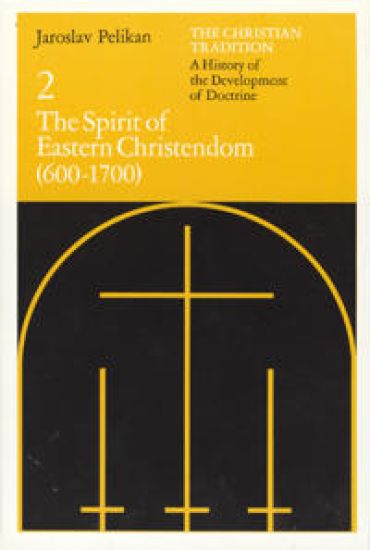
The Christian Tradition: A History of the Development of Doctrine, Volume 2
The line that separated Eastern Christendom from Western on the medieval map is similar to the "iron curtain" of recent times. Linguistic barriers, political divisions, and liturgical differences combined to isolate the two cultures from each other. Except for such episodes as the schism between East and West or the Crusades, the development of non-Western Christendom has been largely ignored by church historians. In The Spirit of Eastern Christendom, Jaroslav Pelikan explains the divisions between Eastern and Western Christendom, and identifies and describes the development of the distinctive forms taken by Christian doctrine in its Greek, Syriac, and early Slavic expression. "It is a pleasure to salute this masterpiece of exposition. . . . The book flows like a great river, slipping easily past landscapes of the utmost diversity—the great Christological controversies of the seventh century, the debate on icons in the eighth and ninth, attitudes to Jews, to Muslims, to the dualistic heresies of the high Middle Ages, to the post-Reformation churches of Western Europe. . . . His book succeeds in being a study of the Eastern Christian religion as a whole."—Peter Brown and Sabine MacCormack, New York Review of Books"The second volume of Professor Pelikan's monumental work on The Christian Tradition is the most comprehensive historical treatment of Eastern Christian thought from 600 to 1700, written in recent years. . . . Pelikan's reinterpretation is a major scholarly and ecumenical event."—John Meyendorff "Displays the same mastery of ancient and modern theological literature, the same penetrating analytical clarity and balanced presentation of conflicting contentions, that made its predecessor such an intellectual treat."—Virgina Quarterly Review
Development of Christian Doctrine

Development of Christian Doctrine

Jaroslav Pelikan

Yale University Press
1969
pokkari
The problem of change has assumed great prominence in much of the current ferment in theology, and many of the issues in question can best be interpreted as relating to the validity and limits of doctrinal development. The questions cannot be faced constructively, however, until the development of doctrine has been clearly charted, a historical as well as a theological assignment. In this unique introductory survey—more modest in scope but more scholarly in method than Cardinal Newman’s great programmatic essay of 1845—Mr. Pelikan presents three case histories of the particular doctrines that have crucial points of division among Christians. His cogent analyses of Cyprian on Original Sin, Athanasius on the Virgin Mary, and Hilary on the Holy Spirit demonstrate the interaction between the sacramental life of the Church and the intellectual work of the theologian that consistently marked the development of doctrine by the early Fathers. Thus they clarify some central aspects of the continuing theological and ecumenical debates. Mr. Pelikan, Titus Street Professor of Ecclesiastical History at Yale University, is the author of many books and articles, including a forthcoming full-scale history of the development of doctrine.