Kirjojen hintavertailu. Mukana 12 595 353 kirjaa ja 12 kauppaa.

Kirjailija

Jaroslav Ramík

Kirjat ja teokset yhdessä paikassa: 6 kirjaa, julkaisuja vuosilta 2001-2020, suosituimpien joukossa Linear Optimization Problems with Inexact Data. Vertaile teosten hintoja ja tarkista saatavuus suomalaisista kirjakaupoista.

Mukana myös kirjoitusasut: Jaroslav Ramik

6 kirjaa

Kirjojen julkaisuhaarukka 2001-2020.

Linear Optimization Problems with Inexact Data

Linear Optimization Problems with Inexact Data

Miroslav Fiedler; Josef Nedoma; Jaroslav Ramik; Jiri Rohn; Karel Zimmermann

Springer-Verlag New York Inc.
2010
nidottu
Linear programming attracted the interest of mathematicians during and after World War II when the first computers were constructed and methods for solving large linear programming problems were sought in connection with specific practical problems—for example, providing logistical support for the U.S. Armed Forces or modeling national economies. Early attempts to apply linear programming methods to solve practical problems failed to satisfy expectations. There were various reasons for the failure. One of them, which is the central topic of this book, was the inexactness of the data used to create the models. This phenomenon, inherent in most pratical problems, has been dealt with in several ways. At first, linear programming models used "average" values of inherently vague coefficients, but the optimal solutions of these models were not always optimal for the original problem itself. Later researchers developed the stochastic linear programming approach, but this too has its limitations. Recently, interest has been given to linear programming problems with data given as intervals, convex sets and/or fuzzy sets. The individual results of these studies have been promising, but the literature has not presented a unified theory. Linear Optimization Problems with Inexact Data attempts to present a comprehensive treatment of linear optimization with inexact data, summarizing existing results and presenting new ones within a unifying framework.
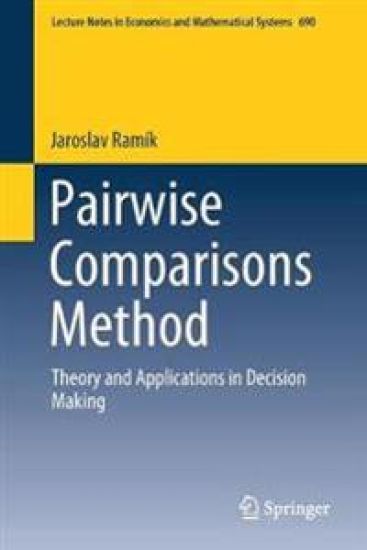
Pairwise Comparisons Method

Pairwise Comparisons Method

Jaroslav Ramík

Springer Nature Switzerland AG
2020
nidottu
This book examines relationships between pairwise comparisons matrices. It first provides an overview of the latest theories of pairwise comparisons in decision making, discussing the pairwise comparison matrix, a fundamental tool for further investigation, as a deterministic matrix with given elements. Subsequent chapters then investigate these matrices under uncertainty, as a matrix with vague elements (fuzzy and/or intuitionistic fuzzy ones), and also as random elements. The second part of the book describes the application of the theoretical results in the three most popular multicriteria decision-making methods: the Analytic Hierarchy Process (AHP), PROMETHEE and TOPSIS. This book appeals to scholars in areas such as decision theory, operations research, optimization theory, algebra, interval analysis and fuzzy sets.
Decision Making and Optimization

Decision Making and Optimization

Martin Gavalec; Jaroslav Ramík; Karel Zimmermann

Springer International Publishing AG
2014
nidottu
The book is a benefit for graduate and postgraduate students in the areas of operations research, decision theory, optimization theory, linear algebra, interval analysis and fuzzy sets. The book will also be useful for the researchers in the respective areas. The first part of the book deals with decision making problems and procedures that have been established to combine opinions about alternatives related to different points of view. Procedures based on pairwise comparisons are thoroughly investigated. In the second part we investigate optimization problems where objective functions and constraints are characterized by extremal operators such as maximum, minimum or various triangular norms (t-norms). Matrices in max-min algebra are useful in applications such as automata theory, design of switching circuits, logic of binary relations, medical diagnosis, Markov chains, social choice, models of organizations, information systems, political systems and clustering. The input data in real problems are usually not exact and can be characterized by interval values.
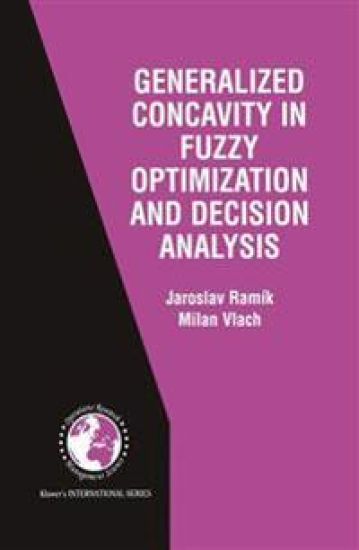
Generalized Concavity in Fuzzy Optimization and Decision Analysis

Generalized Concavity in Fuzzy Optimization and Decision Analysis

Jaroslav Ramík; Milan Vlach

Springer-Verlag New York Inc.
2012
nidottu
Convexity of sets in linear spaces, and concavity and convexity of functions, lie at the root of beautiful theoretical results that are at the same time extremely useful in the analysis and solution of optimization problems, including problems of either single objective or multiple objectives. Not all of these results rely necessarily on convexity and concavity; some of the results can guarantee that each local optimum is also a global optimum, giving these methods broader application to a wider class of problems. Hence, the focus of the first part of the book is concerned with several types of generalized convex sets and generalized concave functions. In addition to their applicability to nonconvex optimization, these convex sets and generalized concave functions are used in the book's second part, where decision-making and optimization problems under uncertainty are investigated. Uncertainty in the problem data often cannot be avoided when dealing with practical problems. Errors occur in real-world data for a host of reasons. However, over the last thirty years, the fuzzy set approach has proved to be useful in these situations. It is this approach to optimization under uncertainty that is extensively used and studied in the second part of this book. Typically, the membership functions of fuzzy sets involved in such problems are neither concave nor convex. They are, however, often quasiconcave or concave in some generalized sense. This opens possibilities for application of results on generalized concavity to fuzzy optimization. Despite this obvious relation, applying the interface of these two areas has been limited to date. It is hoped that the combination of ideas and results from the field of generalized concavity on the one hand and fuzzy optimization on the other hand outlined and discussed in Generalized Concavity in Fuzzy Optimization and Decision Analysis will be of interest to both communities. Our aimis to broaden the classes of problems that the combination of these two areas can satisfactorily address and solve.
Linear Optimization Problems with Inexact Data

Linear Optimization Problems with Inexact Data

Miroslav Fiedler; Josef Nedoma; Jaroslav Ramik; Jiri Rohn; Karel Zimmermann

Springer-Verlag New York Inc.
2006
sidottu
Linear programming attracted the interest of mathematicians during and after World War II when the first computers were constructed and methods for solving large linear programming problems were sought in connection with specific practical problems—for example, providing logistical support for the U.S. Armed Forces or modeling national economies. Early attempts to apply linear programming methods to solve practical problems failed to satisfy expectations. There were various reasons for the failure. One of them, which is the central topic of this book, was the inexactness of the data used to create the models. This phenomenon, inherent in most pratical problems, has been dealt with in several ways. At first, linear programming models used "average" values of inherently vague coefficients, but the optimal solutions of these models were not always optimal for the original problem itself. Later researchers developed the stochastic linear programming approach, but this too has its limitations. Recently, interest has been given to linear programming problems with data given as intervals, convex sets and/or fuzzy sets. The individual results of these studies have been promising, but the literature has not presented a unified theory. Linear Optimization Problems with Inexact Data attempts to present a comprehensive treatment of linear optimization with inexact data, summarizing existing results and presenting new ones within a unifying framework.
Generalized Concavity in Fuzzy Optimization and Decision Analysis
Convexity of sets in linear spaces, and concavity and convexity of functions, lie at the root of beautiful theoretical results that are at the same time extremely useful in the analysis and solution of optimization problems, including problems of either single objective or multiple objectives. Not all of these results rely necessarily on convexity and concavity; some of the results can guarantee that each local optimum is also a global optimum, giving these methods broader application to a wider class of problems. Hence, the focus of the first part of the book is concerned with several types of generalized convex sets and generalized concave functions. In addition to their applicability to nonconvex optimization, these convex sets and generalized concave functions are used in the book's second part, where decision-making and optimization problems under uncertainty are investigated. Uncertainty in the problem data often cannot be avoided when dealing with practical problems. Errors occur in real-world data for a host of reasons. However, over the last thirty years, the fuzzy set approach has proved to be useful in these situations. It is this approach to optimization under uncertainty that is extensively used and studied in the second part of this book. Typically, the membership functions of fuzzy sets involved in such problems are neither concave nor convex. They are, however, often quasiconcave or concave in some generalized sense. This opens possibilities for application of results on generalized concavity to fuzzy optimization. Despite this obvious relation, applying the interface of these two areas has been limited to date. It is hoped that the combination of ideas and results from the field of generalized concavity on the one hand and fuzzy optimization on the other hand outlined and discussed in Generalized Concavity in Fuzzy Optimization and Decision Analysis will be of interest to both communities. Our aimis to broaden the classes of problems that the combination of these two areas can satisfactorily address and solve.