Kirjojen hintavertailu. Mukana 12 390 323 kirjaa ja 12 kauppaa.

Kirjailija

Jason A. Whitlark

Kirjat ja teokset yhdessä paikassa: 5 kirjaa, julkaisuja vuosilta 2009-2018, suosituimpien joukossa Resisting Empire. Vertaile teosten hintoja ja tarkista saatavuus suomalaisista kirjakaupoista.

5 kirjaa

Kirjojen julkaisuhaarukka 2009-2018.

Inventing Hebrews

Inventing Hebrews

Michael Wade Martin; Jason A. Whitlark

Cambridge University Press
2018
sidottu
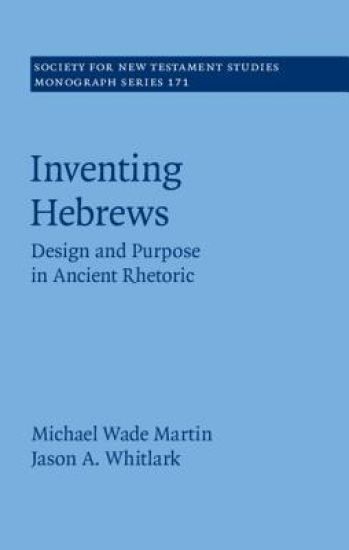
Inventing Hebrews examines a perennial topic in the study of the Letter to the Hebrews, its structure and purpose. Michael Wade Martin and Jason A. Whitlark undertake at thorough synthesis of the ancient theory of invention and arrangement, providing a new account of Hebrews' design. The key to the speech's outline, the authors argue, is in its use of 'disjointed' arrangement, a template ubiquitous in antiquity but little discussed in modern biblical studies. This method of arrangement accounts for the long-observed pattern of alternating epideictic and deliberative units in Hebrews as blocks of narratio and argumentatiorespectively. Thus the 'letter' may be seen as a conventional speech arranged according to the expectations of ancient rhetoric (exordium, narratio, argumentatio, peroratio), with epideictic comparisons of old and new covenant representatives (narratio) repeatedly enlisted in amplification of what may be viewed as the central argument of the speech (argumentatio), the recurring deliberative summons for perseverance. Resolving a long-standing conundrum, this volume offers a hermeneutical tool necessary for interpreting Hebrews, as well as countless other speeches from Greco-Roman antiquity.
Resisting Empire

Resisting Empire

Jason A. Whitlark

T. T.Clark Ltd
2016
nidottu
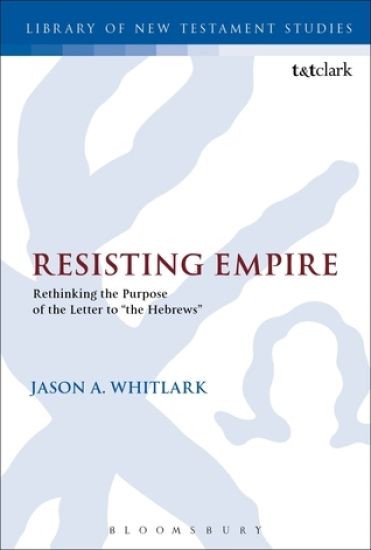
This book offers a fresh reading about the purpose for which Hebrews was written. In this book Whitlark argues that Hebrews engages both the negative pressures (persecution) and positive attractions (honor/prosperity) of its audience’s Roman imperial context. Consequently, the audience of Hebrews appears to be in danger of defecting to the pagan imperial context. Due to the imperial nature of these pressures, Hebrews obliquely critiques the imperial script according to the rhetorical expectations in the first-century Mediterranean world—namely, through the use of figured speech. This critique is the primary focus of Whitlark's project. Whitlark examines Hebrews’s figured response to the imperial hopes boasted by Rome along with Rome’s claim to eternal rule, to the power of life and death, and to be led by the true, victorious ruler. Whitlark also makes a case for discerning Hebrews’s response to the challenges of Flavian triumph. Whitlark concludes his study by suggesting that Hebrews functions much like Revelation, that is, to resist the draw of the Christians' Roman imperial context. This is done, in part, by providing a covert opposition to Roman imperial discourse. He also offers evaluation of relapse theories for Hebrews, of Hebrews’s place among early Christian martyrdom, and of the nature of the resistance that Hebrews promotes.
Resisting Empire

Resisting Empire

Jason A. Whitlark

T. T.Clark Ltd
2014
sidottu
This book offers a fresh reading about the purpose for which Hebrews was written. In this book Whitlark argues that Hebrews engages both the negative pressures (persecution) and positive attractions (honor/prosperity) of its audience’s Roman imperial context. Consequently, the audience of Hebrews appears to be in danger of defecting to the pagan imperial context. Due to the imperial nature of these pressures, Hebrews obliquely critiques the imperial script according to the rhetorical expectations in the first-century Mediterranean world—namely, through the use of figured speech. This critique is the primary focus of Whitlark's project. Whitlark examines Hebrews’s figured response to the imperial hopes boasted by Rome along with Rome’s claim to eternal rule, to the power of life and death, and to be led by the true, victorious ruler. Whitlark also makes a case for discerning Hebrews’s response to the challenges of Flavian triumph. Whitlark concludes his study by suggesting that Hebrews functions much like Revelation, that is, to resist the draw of the Christians' Roman imperial context. This is done, in part, by providing a covert opposition to Roman imperial discourse. He also offers evaluation of relapse theories for Hebrews, of Hebrews’s place among early Christian martyrdom, and of the nature of the resistance that Hebrews promotes.
Enabling Fidelity to God

Enabling Fidelity to God

Jason a. Whitlark

Wipf Stock Publishers
2009
nidottu
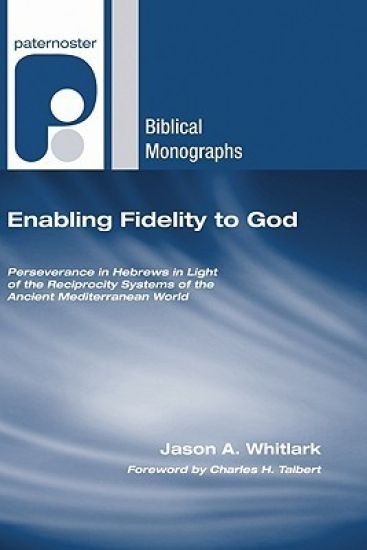
The primary focus of this book is to demonstrate how Hebrews represents, in view of its historical and religious context, human fidelity to God. Thus, the basic thesis is twofold. First, with regard to the divine-human relationship in the ancient Mediterranean world, the belief in the reciprocity rationale was one primary dynamic for establishing fidelity to a relationship and has been applied by some scholars, such as David deSilva, to Hebrews as the way to understand its strategy for creating perseverance. A major problem with the application of this dynamic is that a common optimistic anthropological assumption is associated with the various reciprocity systems in the ancient world, both Jewish and pagan. This assumption is required if reciprocity is to be effective for establishing ongoing fidelity. Second, there was, however, a middle Judaic stream that can be traced from the period of the exile which held to a pessimistic anthropology. This anthropological assumption crippled the perceived success of reciprocity to secure fidelity. Thus, the solution to God's people's inability to remain faithful was an act of God that transformed the human condition and enabled faithfulness to the relationship. The argument of this book is that Hebrews, with its emphasis upon the inauguration of the new covenant by Jesus' high priestly ministry, belongs to this latter stream of thought in understanding how fidelity is secured between God and his people. Hebrews, thus, implicitly rejects the rationale of reciprocity for fidelity. The implications of this offers a fresh perspective on the soteriology of Hebrews.