Kirjojen hintavertailu. Mukana 12 499 575 kirjaa ja 12 kauppaa.

Kirjailija

Jason Peacey

Kirjat ja teokset yhdessä paikassa: 5 kirjaa, julkaisuja vuosilta 2004-2022, suosituimpien joukossa Breaking News. Vertaile teosten hintoja ja tarkista saatavuus suomalaisista kirjakaupoista.

5 kirjaa

Kirjojen julkaisuhaarukka 2004-2022.

The Madman and the Churchrobber

The Madman and the Churchrobber

Jason Peacey

Oxford University Press
2022
sidottu
This microhistory reconstructs and analyses a protracted legal dispute over a small parcel of land called Warrens Court in Nibley, Gloucestershire, which was contested between successive generations of two families from the mid-sixteenth century to the early eighteenth century. Employing a rich cache of archival material, Jason Peacey traces legal contestation over time and through a range of different courts, as well as in Parliament and the public domain, and contends that a microhistorical approach makes it possible to shed valuable light upon the legal and political culture of early modern England, not least by comprehending how certain disputes became protracted and increasingly bitter, and why they fascinated contemporaries. This involves recognising the dynamic of litigation, in terms of how disputes changed over time, and how those involved in myriad lawsuits found legal reasons for prolonging contestation. It also involves exploring litigants' strategies and practices, as well as competing claims about the way in which adversaries behaved, and incompatible expectations of the legal system. Finally, it involves teasing out the structural issues in play, in terms of the social, cultural, and ideological identities of successive generations. Ultimately, this dispute is employed to address important historiographical debates surrounding the nature of civil litigation in early modern England, and to provide new ways of appreciating the nature, severity, and visibility of political and religious conflict in the decades before and after the English Revolution.
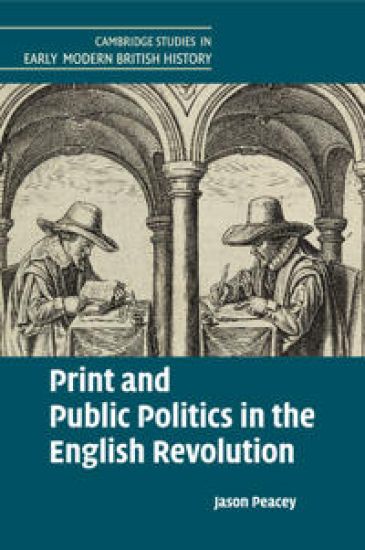
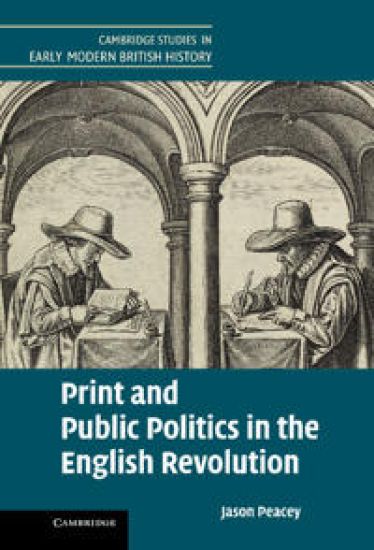
Print and Public Politics in the English Revolution

Print and Public Politics in the English Revolution

Jason Peacey

Cambridge University Press
2016
pokkari
This is a major reassessment of the communications revolution of the seventeenth century. Using a wealth of archival evidence and the considerable output of the press, Jason Peacey demonstrates how new media - from ballads to pamphlets and newspapers - transformed the English public's ability to understand and participate in national political life. He analyses how contemporaries responded to political events as consumers of print; explores what they were able to learn about national politics; and examines how they developed the ability to appropriate a variety of print genres in order to participate in novel ways. Amid structural change and conjunctural upheaval, he argues that there occurred a dramatic re-shaping of the political nation, as citizens from all walks of life developed new habits and practices for engaging in daily political life, and for protecting and advancing their interests. This ultimately involved experience-led attempts to rethink the nature of representation and accountability.
Print and Public Politics in the English Revolution

Print and Public Politics in the English Revolution

Jason Peacey

Cambridge University Press
2013
sidottu
This is a major reassessment of the communications revolution of the seventeenth century. Using a wealth of archival evidence and the considerable output of the press, Jason Peacey demonstrates how new media - from ballads to pamphlets and newspapers - transformed the English public's ability to understand and participate in national political life. He analyses how contemporaries responded to political events as consumers of print; explores what they were able to learn about national politics; and examines how they developed the ability to appropriate a variety of print genres in order to participate in novel ways. Amid structural change and conjunctural upheaval, he argues that there occurred a dramatic re-shaping of the political nation, as citizens from all walks of life developed new habits and practices for engaging in daily political life, and for protecting and advancing their interests. This ultimately involved experience-led attempts to rethink the nature of representation and accountability.
Breaking News

Breaking News

Chris R. Kyle; Jason Peacey

University of Washington Press
2008
pokkari
The first newspaper arrived in England in 1620 and sparked a huge demand for up-to-the minute reports on domestic and world events. Men and women in Renaissance England were addicted to news, whether from the battlefields of Europe, or the scandal-filled salons of its courtiers. Newspapers commented on politics, crime, omens, bad weather, natural disasters, and strange apparitions.Breaking News traces the development of the newspaper in England, from its origins in manuscript letters and imported corantos in Shakespeare's England, to the introduction of daily newspapers, regional journals, and specialist magazines around 1700, as well as the first stirrings of American journalism. The examples of early journalism illustrated here reveal the indelible mark the early English newspaper has left on modern news culture.
Politicians and Pamphleteers

Politicians and Pamphleteers

Jason Peacey

Ashgate Publishing Limited
2004
sidottu
The English civil wars radically altered many aspects of mid-seventeenth century life, simultaneously creating a period of intense uncertainty and unheralded opportunity. Nowhere was this more apparent than in the printing and publishing industry, which between 1640 and 1660 produced a vast number of tracts and pamphlets on a bewildering variety of subjects. Many of these where of a highly political nature, the publication of which would have been unthinkable just a few years before. Whilst scholars have long recognised the importance of these publications, and have studied in depth what was written in them, much less work has been done on why they were produced. In this book Dr Peacey first highlights the different dynamics at work in the conception, publication and distribution of polemical works, and then pulls the strands together to study them against the wider political context. In so doing he provides a more complete understanding of the relationship between political events and literary and intellectual prose in an era of unrest and upheaval. By incorporating into the political history of the period some of the approaches utilized by scholars of book history, this study reveals the heightened importance of print in both the lives of members of the political nation and the minds of the political elite in the civil wars and Interregnum. Furthermore, it demonstrates both the existence and prevalence of print propaganda with which politicians became associated, and traces the processes by which it came to be produced, the means of detecting its existence, the ways in which politicians involved themselves in its production, the uses to which it was put, and the relationships between politicians and propagandists.