Kirjojen hintavertailu. Mukana 12 390 323 kirjaa ja 12 kauppaa.

Kirjailija

Jean Baudrillard

Kirjat ja teokset yhdessä paikassa: 80 kirjaa, julkaisuja vuosilta 1983-2026, suosituimpien joukossa The Jean Baudrillard Reader. Vertaile teosten hintoja ja tarkista saatavuus suomalaisista kirjakaupoista.

80 kirjaa

Kirjojen julkaisuhaarukka 1983-2026.

Fatal Strategies

Fatal Strategies

Jean Baudrillard

Semiotext (E)
2008
nidottu
When Fatal Strategies was first published in French in 1983, it represented a turning point for Jean Baudrillard: an utterly original, and for many readers, utterly bizarre book that offered a theory as proliferative, ecstatic, and hallucinatory as the postmodern world it endeavored to describe. Arguing against the predetermined outcomes of dialectical thought with his renowned, wry, ambivalent passion, with this volume Jean Baudrillard mounted an attack against the "false problems" posed by Western philosophy. If his Marxist days were firmly behind him, Baudrillard here indicated that metaphysics had also gone the way of sociology and politics: the contemporary world demanded nothing less than Pataphysics, Alfred Jarry's absurdist philosphy that described the laws of the universe supplementary to this one. In effect, with Fatal Strategies, Baudrillard became Baudrillard. In his extrapolationist manner, Baudrillard sought to replace Western philosophy's circular arguments with a ritualistic Theater of Cruelty.Using this line of thought developed in Fatal Strategies, Baudrillard went on, throughout the 1980s, to find new and shatteringly accurate ways of discussing American corporatocracy, arms build-up, and hostage taking. Fatal Strategies asserts a profound critique of American politics, and it is an important step towards his examination of evil.Jean Baudrillard (1929-2007) was a philosopher, sociologist, cultural critic, and theorist of postmodernity who challenged all existing theories of contemporary society with humor and precision. An outsider in the French intellectual establishment, he was internationally renowned as a twenty-first century visionary, reporter, and provocateur. His Simulations (1983) instantly became a cult classic and made him a controversial voice in the world of politics and art.

Big Brother og andre virkelighetsillusjoner

Big Brother og andre virkelighetsillusjoner

Jean Baudrillard

Cappelen Damm akademisk
2008
nidottu
Big Brother gir inntrykk av å vise sannheten om mennesket som sosialt vesen. TV-serien fremstår som et slags frivillig laboratorieforsøk som skal avdekke hvordan mennesker samhandler når de isoleres fra omverdenen. Men serien viser fremfor alt tomhet. Likevel har den skyhøye seertall. Omtrent slik betrakter Jean Baudrillard (1929-2007) realityfenomenet i denne boken. Samtidig setter han også pornografien under lupen. Både reality og porno er like lite virkelige og sier like lite om virkeligheten, hevder Baudrillard. De illustrerer tvert om at virkeligheten ikke lenger finnes i vår mediedominerte verden: Virkeligheten er blitt hyperreell, den er selv blitt en del av illusjonen. De to essayene i denne boken, Telemorfose og Den radikale tenkning, viser at Baudrillard var mer opptatt av vår aktuelle samfunnsvirkelighet enn av abstrakte begreper og resonnementer. Han får godt frem at to tilsynelatende banale og trivielle fenomener, realityserier og pornografi, forteller mer om vår kulturtilstand enn de fleste av oss liker å tenke på. Oversettelse, noter og etterord er ved Per Buvik, professor i allmenn litteraturvitenskap ved Universitetet i Bergen. Han har tidligere også oversatt Baudrillards I skyggen av de tause majoriteter i serien Cappelens upopulære skrifter. Nr. 56 i Cappelens upopulære skrifter.
The Perfect Crime

The Perfect Crime

Jean Baudrillard

Verso Books
2008
nidottu
In his new book, perhaps the most cogent expression of his mature thought, Jean Baudrillard turns detective in order to investigate a crime which he hopes may yet be solved: the "murder" of reality. To solve the crime would be to unravel the social and technological processes by which reality has quite simply vanished under the deadly glare of media "real time."But Baudrillard is not merely intending to lament the disappearance of the real, an occurrence he recently described as "the most important event of modern history," nor even to meditate upon the paradoxes of reality and illusion, truth and its masks. The Perfect Crime is also the work of a great moraliste: a penetrating examination of vital aspects of the social, political and cultural life of the "advanced democracies" in the (very) late twentieth century. Where critics like McLuhan once exposed the alienating consequences of "the medium," Baudrillard lays bare the depredatory effects of an oppressive transparency on our social lives, of a relentless positivity on our critical faculties, and of a withering 'high definition' on our very sense of reality.
Exiles from Dialogue

Exiles from Dialogue

Jean Baudrillard; Enrique Valiente Noailles

Polity Press
2007
sidottu
Not long ago, two friends Jean Baudrillard and Enrique Valiente Noailles the one having come from Buenos Aires, the other from nowhere, met in Paris. They had a long discussion without any precise aim. It was, rather, a way of rubbing up against metaphysics without risk of contagion. They called it Exiles from Dialogue as a mirrored homage to Bertolt Brecht and shortly afterwards they parted company and went their separate ways. In this remarkable new book based on this gnomic meeting, Baudrillard and Noailles range over the entirety of philosophy and thought underpinning Baudrillards unique work, from In the Shadow of the Silent Majorities (1983) to his recent writings on 9/11. Philosophically, the book takes in its breadth Heraclitus to Wittgenstein by way of Plato, Aristotle, Kant, Hegel, Kierkegaard and Nietzche. Its literary sources are diverse: Gracian and Saul Bellow, Hlderlin and Stanislaw Lec; and the theories of Fukuyama, Barthes and Kristeva are weighed, considered and analysed. With his usual incandescent brilliance, Baudrillard discusses the central themes of his writing: thought as (non-prophetic) anticipation; tragic acceptance of the world; the disappearance of the world into simulation; the death of the social (and with it the Left). Vitally, Baudrillard corrects some of the misconceptions that plague his work (about his fatal strategies, for example), qualifies some of his bolder pronouncements (notably softening his position on the question of the virtual) and pushes other lines of thinking further than ever before. Razor-sharp, volatile and capacious, this book will be essential reading for students and scholars of Baudrillard and those interested in the theories and philosophies that currently abound and rebound in the social sciences and humanities.
Exiles from Dialogue

Exiles from Dialogue

Jean Baudrillard; Enrique Valiente Noailles

Polity Press
2007
nidottu
Not long ago, two friends Jean Baudrillard and Enrique Valiente Noailles the one having come from Buenos Aires, the other from nowhere, met in Paris. They had a long discussion without any precise aim. It was, rather, a way of rubbing up against metaphysics without risk of contagion. They called it Exiles from Dialogue as a mirrored homage to Bertolt Brecht and shortly afterwards they parted company and went their separate ways. In this remarkable new book based on this gnomic meeting, Baudrillard and Noailles range over the entirety of philosophy and thought underpinning Baudrillards unique work, from In the Shadow of the Silent Majorities (1983) to his recent writings on 9/11. Philosophically, the book takes in its breadth Heraclitus to Wittgenstein by way of Plato, Aristotle, Kant, Hegel, Kierkegaard and Nietzche. Its literary sources are diverse: Gracian and Saul Bellow, Hlderlin and Stanislaw Lec; and the theories of Fukuyama, Barthes and Kristeva are weighed, considered and analysed. With his usual incandescent brilliance, Baudrillard discusses the central themes of his writing: thought as (non-prophetic) anticipation; tragic acceptance of the world; the disappearance of the world into simulation; the death of the social (and with it the Left). Vitally, Baudrillard corrects some of the misconceptions that plague his work (about his fatal strategies, for example), qualifies some of his bolder pronouncements (notably softening his position on the question of the virtual) and pushes other lines of thinking further than ever before. Razor-sharp, volatile and capacious, this book will be essential reading for students and scholars of Baudrillard and those interested in the theories and philosophies that currently abound and rebound in the social sciences and humanities.
In the Shadow of the Silent Majorities

In the Shadow of the Silent Majorities

Jean Baudrillard

Semiotext (E)
2007
pokkari
Baudrillard's remarkably prescient meditation on terrorism throws light on post-9/11 delusional fears and political simulations.Published one year after Forget Foucault, In the Shadow of the Silent Majorities (1978) may be the most important sociopolitical manifesto of the twentieth century: it calls for nothing less than the end of both sociology and politics. Disenfranchised revolutionaries (the Red Brigades, the Baader-Meinhof Gang) hoped to reach the masses directly through spectacular actions, but their message merely played into the hands of the media and the state. In a media society meaning has no meaning anymore; communication merely communicates itself. Jean Baudrillard uses this last outburst of ideological terrorism in Europe to showcase the end of the "Social." Once invoked by Marx as the motor of history, the masses no longer have sociological reality. In the electronic media society, all the masses can do-and all they will do-is enjoy the spectacle. In the Shadow of the Silent Majorities takes to its ultimate conclusion the "end of ideologies" experienced in Europe after the Soviet invasion of Hungary and the death of revolutionary illusions after May 1968. Ideological terrorism doesn't represent anything anymore, writes Baudrillard, not even itself. It is just the last hysterical reaction to discredited political illusions.
Forget Foucault

Forget Foucault

Jean Baudrillard

Semiotext (E)
2007
pokkari
Characterizing it as a "mythic discourse," Jean Baudrillard proceeds, in this brilliant essay, to dismantle the powerful, seductive figure of Michel Foucault.In 1976, Jean Baudrillard sent this essay to the French magazine Critique, where Michel Foucault was an editor. Foucault was asked to reply, but remained silent. Forget Foucault (1977) made Baudrillard instantly infamous in France. It was a devastating revisitation of Foucault's recent History of Sexuality-and of his entire oeuvre-and also an attack on those philosophers, like Gilles Deleuze and Felix Guattari, who believed that desire could be revolutionary. In Baudrillard's eyes, desire and power were interchangeable, so desire had no place in Foucault's work. There is no better introduction to Baudrillard's polemical approach to culture than these pages, in which Baudrillard dares Foucault to meet the challenge of his own thought. This Semiotext(e) edition of Forget Foucault is accompanied by a dialogue with Sylvere Lotringer, "Forget Baudrillard," a reevaluation by Baudrillard of his lesser-known early works as a post-Marxian thinker. Lotringer presses Baudrillard to explain how he arrived at his infamous extrapolationist theories from his roots in the nineteenth and early twentieth century social and anthropological works of Karl Marx, Marcel Mauss, and Emil Durkheim.
Fragments

Fragments

Jean Baudrillard

Verso Books
2007
nidottu
This third book in the Cool Memories series is culled from Baudrillard's notebooks in the period when he was composing The Illusion of the End and The Perfect Crime. In it, he resumes his investigation of the meta-metaphysics of objects. Like its predecessors, the book is a work of brief meditations, of poetic musings: in a word, of fragments.
I skyggen av de tause majoritetet

I skyggen av de tause majoritetet

Jean Baudrillard

Cappelen
2007
nidottu
Baudrillard fremhever det destruktive ved massenes taushet og paniske konformisme. Massene karakteriseres ved deres anonymitet, terrorismen ved dens angrep på den anonyme - sammen danner de en felles benektelse av den sosiale orden Oversatt av Per Buvik Baudrillard fremhever det destruktive ved massenes taushet og paniske konformisme. Massene har ingen historie å skrive, ingen kraft å forløse, ingen begjær å innfri; deres kraft er aktuell, den er fullstendig til stede, den er deres taushet. Massene karakteriseres ved deres anonymitet, terrorismen ved dens angrep på den anonyme - sammen danner de en felles benektelse av den sosiale orden. Oversatt av Per Buvik. Nr. 2 i Cappelens upopulære skrifter.
Utopia Deferred

Utopia Deferred

Jean Baudrillard

Semiotext (E)
2006
pokkari
Seminal essays written by Baudrillard for a journal devoted to a radical leftist critique of architecture, urbanism, and everyday life.The Utopie group was born in 1966 at Henri Lefebvre's house in the Pyrenees. The eponymous journal edited by Hubert Tonka brought together sociologists Jean Baudrillard, Rene Lourau, and Catherine Cot, architects Jean Aubert, Jean-Paul Jungmann, Antoine Stinco, and landscape architect Isabelle Auricoste. Over the next decade, both in theory and in practice, the group articulated a radical ultra-leftist critique of architecture, urbanism, and everyday life. Utopia Deferred collects all of the essays Jean Baudrillard published in Utopie as well as recent interviews with Jean Baudrillard and Hubert Tonka.Utopie served as a workshop for Baudrillard's thought. Many of the essays he first published in Utopie were seminal for some of his most shockingly original books: For a Critique of the Political Economy of the Sign, The Mirror of Production, Simulations, Symbolic Exchange and Death, and In the Shadow of the Silent Majorities. But Utopie was also a topical journal and a political one; the topics of these essays are often torn from the headlines of the tumultuous decade following the uprisings of May 1968.
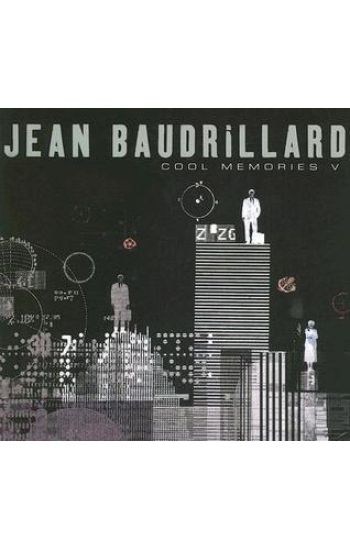
Cool Memories V

Cool Memories V

Jean Baudrillard

Polity Press
2006
nidottu
Prophet of the apocalypse, hysterical lyric poet, obsessive recounter of the desolation of the postmodern scene and currently the hottest property on the New York intellectual circuit. The Guardian A sharp-shooting lone-ranger from the post-Marxist left. New York Times The most important French thinker of the past twenty years. J. G. Ballard "Theory is never so fine as when it takes the form of a fiction or a fable," writes Baudrillard in Cool Memories V – the latest in a series of aphoristic journals that covers the period 2000-2004. During these years Baudrillard re-emerged strongly in the international arena with his trenchant and controversial essay Spirit of Terrorism, developed his work as a photographer and developed cancer. As his attack on the inanities of "hyperreality" has grown more radical, Baudrillard has come to display an ever more marked penchant for the aphoristic style he has so long admired in such writers as Canetti, Lichtenberg and Nietzsche. "'Aphorizein'", he writes, "from which we get the word ‘aphorism', means to retreat to such a distance that a horizon of thought is formed which never again closes on itself. " Cool Memories are carnets, notebooks, but these are notes for keeping the horizon of thought open within a daunting sphere of ideas that is no less than "a jungle, a nature red in tooth and claw. " "Mentally and affectively," he writes, "we have remained hunters. At every moment, in thought and writing, there is a prey and a predator. And survival is a miracle. " Jean Baudrillard was born in Reims in 1929 and now lives in Paris. From 1966 to1987 he taught sociology at the University of Paris X (Nanterre). Among his works translated into English are Simulations and Simulacra, Fatal Strategies, Seduction, America, Cool Memories I- IV, The Illusion of the End and The Spirit of Terrorism
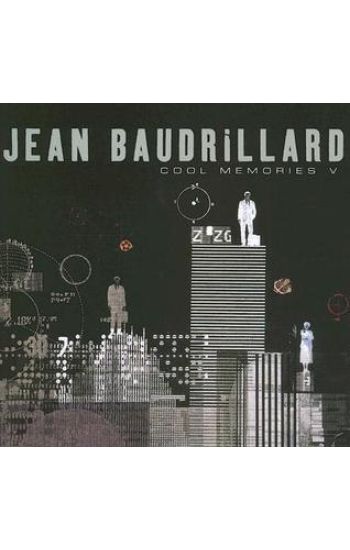
Cool Memories V

Cool Memories V

Jean Baudrillard

Polity Press
2006
sidottu
Prophet of the apocalypse, hysterical lyric poet, obsessive recounter of the desolation of the postmodern scene and currently the hottest property on the New York intellectual circuit. The Guardian A sharp-shooting lone-ranger from the post-Marxist left. New York Times The most important French thinker of the past twenty years. J. G. Ballard "Theory is never so fine as when it takes the form of a fiction or a fable," writes Baudrillard in Cool Memories V – the latest in a series of aphoristic journals that covers the period 2000-2004. During these years Baudrillard re-emerged strongly in the international arena with his trenchant and controversial essay Spirit of Terrorism, developed his work as a photographer and developed cancer. As his attack on the inanities of "hyperreality" has grown more radical, Baudrillard has come to display an ever more marked penchant for the aphoristic style he has so long admired in such writers as Canetti, Lichtenberg and Nietzsche. "'Aphorizein'", he writes, "from which we get the word ‘aphorism', means to retreat to such a distance that a horizon of thought is formed which never again closes on itself. " Cool Memories are carnets, notebooks, but these are notes for keeping the horizon of thought open within a daunting sphere of ideas that is no less than "a jungle, a nature red in tooth and claw. " "Mentally and affectively," he writes, "we have remained hunters. At every moment, in thought and writing, there is a prey and a predator. And survival is a miracle. " Jean Baudrillard was born in Reims in 1929 and now lives in Paris. From 1966 to1987 he taught sociology at the University of Paris X (Nanterre). Among his works translated into English are Simulations and Simulacra, Fatal Strategies, Seduction, America, Cool Memories I- IV, The Illusion of the End and The Spirit of Terrorism
The Singular Objects of Architecture

The Singular Objects of Architecture

Jean Baudrillard

University of Minnesota Press
2005
nidottu
What is a singular object? An idea, a building, a color, a sentiment, a human being. Each in turn comes under scrutiny in this exhilarating dialogue between two of the most interesting thinkers working in philosophy and architecture today. From such singular objects, Jean Baudrillard and Jean Nouvel move on to fundamental problems of politics, identity, and aesthetics as their exchange becomes an imaginative exploration of the possibilities of modern architecture and the future of modern life. Among the topics the two speakers take up are the city of tomorrow and the ideal of transparency, the gentrification of New York City and Frank Gehry's surprising Guggenheim Museum in Bilbao. As Nouvel prompts Baudrillard to reflect on some of his signature concepts (the virtual, transparency, fatal strategies, oblivion, and seduction, among others), the confrontation between such philosophical concerns and the specificity of architecture gives rise to novel and striking formulations—and a new way of establishing and understanding the connections between the practitioner and the philosopher, the object and the idea. This wide-ranging conversation builds a bridge between the fields of architecture and philosophy. At the same time it offers readers an intimate view of the meeting of objects and ideas in which the imagined, constructed, and inhabited environment is endlessly changing, forever evolving. Jean Baudrillard is one of the most influential thinkers of his generation and author of The Vital Illusion (2001). Jean Nouvel has designed buildings throughout the world, including the new Guthrie Theater in Minneapolis, and is a recipient of France's Grand Prix d'Architecture. Robert Bononno, a translator and teacher, lives in New York City.
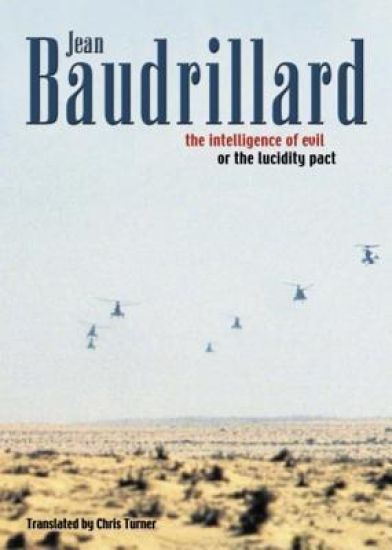
The Intelligence of Evil or the Lucidity Pact

The Intelligence of Evil or the Lucidity Pact

Jean Baudrillard

Berg Publishers
2005
sidottu
We are at war. Human cultures are divided into two basic types, two antagonistic forces, one based on symbolic exchange, which is dual and reciprocal, and one based on money and sign exchange, which is totalising. Non-western societies can create genuinely symbolic, durable cultures. But the western world-system, based on a logic of empire, is designed to create an integrated and sealed reality, to snap tight around the world and its image. If the first is indestructible and the second is irresistible, who can win and what will victory look like? The answer may lie in the capacity for violence in the world-system itself, threatening that system from within with the purest of symbolic forms, the challenge of resistance. The Intelligence of Evil or the Lucidity Pact is the summation of Baudrillard's work over twenty years. It is the essential analysis of the fundamental conflict of our time.
The Conspiracy of Art

The Conspiracy of Art

Jean Baudrillard

Semiotext (E)
2005
pokkari
Cutting-edge theorist Jean Baudrillard on the complicitous dance of art, politics, economics, and media; includes "War Porn," on Abu Ghraib as a new genre of reality TV.The images from Abu Ghraib are as murderous for America as those of the World Trade Center in flames. The whole West is contained in the burst of sadistic laughter of the American soldiers, as it is behind the construction of the Israeli wall. This is where the truth of these images lies. Truth, but not veracity. As virtual as the war itself, their specific violence adds to the specific violence of the war. In The Conspiracy of Art, Baudrillard questions the privilege attached to art by its practitioners. Art has lost all desire for illusion: feeding back endlessly into itself, it has turned its own vanishment into an art unto itself. Far from lamenting the "end of art," Baudrillard celebrates art's new function within the process of insider-trading. Spiraling from aesthetic nullity to commercial frenzy, art has become transaesthetic, like society as a whole. Conceived and edited by life-long Baudrillard collaborator Sylvere Lotringer, The Conspiracy of Art presents Baudrillard's writings on art in a complicitous dance with politics, economics, and media. Culminating with "War Porn," a scathing analysis of the spectacular images from Abu Ghraib prison as a new genre of reality TV, the book folds back on itself to question the very nature of radical thought.
Amerika

Amerika

Jean Baudrillard

Matthes Seitz Verlag
2004
nidottu
"Jean Baudrillard lässt sich auf seiner Reise durch das Land wie seine geistigen Vorfahren Cr?vecSur und Tocqueville von den gewaltigen Stadt- und Naturlandschaften zu philosophischen Reflexionen anregen. Auch bei ihm geht es um ihren Symbolwert für Amerika als verwirklichte Utopie. Doch stellt sich dieses Problem heute anders als vor zweihundert Jahren: Einst ging es um pursuit of happiness, um das optimistische Streben nach Glück innerhalb einer idealen Staatsform. Am Ende des zwanzigsten Jahrhunderts sind in Amerika die politischen, materiellen und sexuellen Dimensionen der Freiheit in geradezu obszönem Ausmaß realisiert, so dass die Frage nunmehr lautet: "What are you doing after the orgy?"" Jean Baudrillard, 1929 geboren, zählt zu den einflussreichsten französischen Theoretikern der letzten zwanzig Jahre"
Einzigartige Objekte

Einzigartige Objekte

Jean Baudrillard; Jean Nouvel

Passagen Verlag Ges.M.B.H
2004
nidottu
Was ist ein einzigartiges Objekt? Ein seltsames Ding, ein Meteorit, ein sich auf einen einzigen Punkt zuspitzendes Absolutes, das mit nichts anderem austauschbar ist. Vielleicht auch eine Idee, ein Bauwerk, eine Farbe, ein Gefühl, ein menschliches Wesen. Immer ist es seine Einzigartigkeit, die es in Gefahr bringt. Wo lassen sich angesichts der Mediatisierung und Globalisierung der Kultur, der Nivellierung der Werte und Generalisierung eines Denkens, das bloß aus Meinungen besteht, noch einzigartige Objekte finden? Wie lassen sie sich definieren, schaffen, beschützen und erkennen? Der Philosoph Jean Baudrillard und der Architekt Jean Nouvel spinnen ihren Dialog um diese Themen herum und schneiden damit grundlegende Probleme an, die uns in den nächsten Jahren beschäftigen werden. Sie stellen sich vor, wie die Stadt von morgen aussehen könnte. Fragen sich, warum das Ideal der Transparenz nach und nach alle Bereiche durchdringt. Und sprechen schließlich auch von der Schwierigkeit, frei zu sein. Ein Versuch über die Einzigartigkeit, die beider Werk und Forschung beseelt. Ein Text, der sich leidenschaftlich mit den großen Wandlungen unserer Zeit auseinandersetzt.
Cool Memories IV

Cool Memories IV

Jean Baudrillard

Verso Books
2003
nidottu
Baudrillard's work of the last two decades has downplayed the position of the critical subject and gone over to the standpoint of the object. Nowhere is this objective (non-)critique which results so clearly played out as in the Cool Memories series.Here again, in this fourth collection of fragments and sketches, Baudrillard's stance is less that of the interventionist intellectual analysing the world as critical subject than of the barely participant observer, an object among objects, an 'internal exile', watching the world 'world itself' with such fierce insistence, yet registering with acuity our general deficit of reality and meaning.