Kirjojen hintavertailu. Mukana 12 595 353 kirjaa ja 12 kauppaa.

Kirjailija

Jean-Claude Falmagne

Kirjat ja teokset yhdessä paikassa: 10 kirjaa, julkaisuja vuosilta 1998-2017, suosituimpien joukossa Elements of Psychophysical Theory. Vertaile teosten hintoja ja tarkista saatavuus suomalaisista kirjakaupoista.

10 kirjaa

Kirjojen julkaisuhaarukka 1998-2017.

The Elements of Mathematics from a Modern Viewpoint II: The Problems and their Solutions

The Elements of Mathematics from a Modern Viewpoint II: The Problems and their Solutions

Jean-Claude Falmagne

Createspace Independent Publishing Platform
2017
nidottu
This book is the companion volume of "The Elements of Mathematics from a Modern Viewpoint I", which contains about 1000 problems on the various subjects. Volume II recalls these problems and provides detailed solutions of most of them. As in Volume I, the problems are presented here in yellow frames. The most difficult problems, intended for the "very curious students" are given in green frames surrounded by a wiggly border. The wiggly border is intended for the color blind students. This volume also recalls some of the definitions which are critical to the solutions of the problems. There is an appendix, which reviews the units of length, mass, capacity, and time because those concepts are used in the statement of the problems.
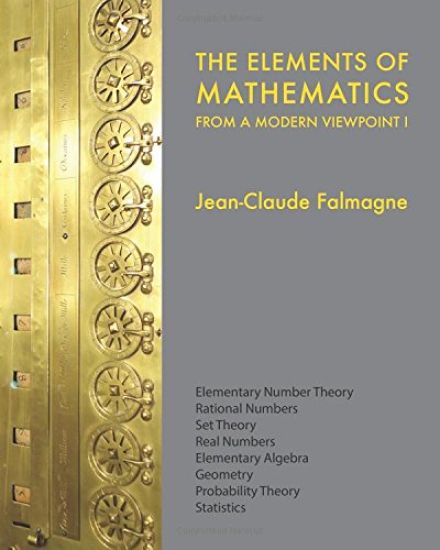
The Elements of Mathematics from a Modern Viewpoint I: Elementary number theory, Rational numbers, Set Theory, Basic algebra, Geometry, Probability Th
This book covers all the mathematics taught in the US, from grade 4 to the end of high school, starting with Elementary Number Theory to Probability Theory and Statistics. The topics are listed on the front cover. Set Theory is taught early: in chapter 5 of the 14 chapters. It is then used systematically as the basic mathematical language. At the end of the nineteenth century, mathematics underwent a profound change, due to the advent of set theory, which was promoted by the German mathematician Georg Cantor. This change was essential. But Cantor's ideas were not readily accepted. In fact, they were opposed by prominent mathematicians of the time, such as Henri Poincare and Leopold Kronecker. Gradually, however, set theory became the fundamental language of practically all of mathematics. Set theory is useful even at the most elementary level, such as what you find in the pre-algebra books used in the U.S. But in many current elementary algebra books written for the schools, set theory is either ignored, or treated as a supplementary subject, without logical connection with other subjects. These books often seem to be written under the conception that they have to mention certain topics and briefly talk about them, so that the student would have encountered them at least once. The likely outcome of such a policy is that at least some of the students may quickly decide that mathematics is not something that can be understood. In addition, the succession of topics is typically haphazard, without any consideration of their difficulty or of the fact that a deep understanding of some topics is essential to understand other topics. You just have to remember those strange names and you are fine if you can solve the problems. The trouble with that policy is that because there is no discernible structure on which to hang the concepts, they are easily forgotten. Obviously, set theory should not be taught as a beginning subject. The right time to introduce the concepts of set theory is when they may help understanding fundamental mathematical concepts, such as: equivalence relations, order relations, functions, the coordinate plane, or the graphs of linear and other functions. Volume II of this book contains the solutions for most of the about 1000 problems proposed here.
On Meaningful Scientific Laws

On Meaningful Scientific Laws

Jean-Claude Falmagne; Christopher Doble

Springer-Verlag Berlin and Heidelberg GmbH Co. K
2016
nidottu
The authors describe systematic methods for uncovering scientific laws a priori, on the basis of intuition, or “Gedanken Experiments”. Mathematical expressions of scientific laws are, by convention, constrained by the rule that their form must be invariant with changes of the units of their variables. This constraint makes it possible to narrow down the possible forms of the laws. It is closely related to, but different from, dimensional analysis. It is a mathematical book, largely based on solving functional equations. In fact, one chapter is an introduction to the theory of functional equations.
On Meaningful Scientific Laws

On Meaningful Scientific Laws

Jean-Claude Falmagne; Christopher Doble

Springer-Verlag Berlin and Heidelberg GmbH Co. K
2015
sidottu
The authors describe systematic methods for uncovering scientific laws a priori, on the basis of intuition, or “Gedanken Experiments”. Mathematical expressions of scientific laws are, by convention, constrained by the rule that their form must be invariant with changes of the units of their variables. This constraint makes it possible to narrow down the possible forms of the laws. It is closely related to, but different from, dimensional analysis. It is a mathematical book, largely based on solving functional equations. In fact, one chapter is an introduction to the theory of functional equations.
Learning Spaces

Learning Spaces

Jean-Claude Falmagne; Jean-Paul Doignon

Springer-Verlag Berlin and Heidelberg GmbH Co. K
2014
nidottu
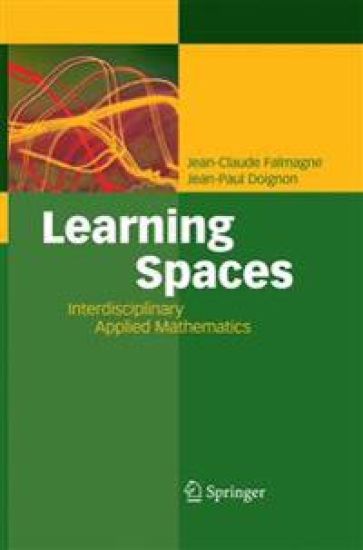
Learning spaces offer a rigorous mathematical foundation for practical systems of educational technology. Learning spaces generalize partially ordered sets and are special cases of knowledge spaces. The various structures are investigated from the standpoints of combinatorial properties and stochastic processes. Leaning spaces have become the essential structures to be used in assessing students' competence of various topics. A practical example is offered by ALEKS, a Web-based, artificially intelligent assessment and learning system in mathematics and other scholarly fields. At the heart of ALEKS is an artificial intelligence engine that assesses each student individually and continously. The book is of interest to mathematically oriented readers in education, computer science, engineering, and combinatorics at research and graduate levels. Numerous examples and exercises are included, together with an extensive bibliography.
Media Theory

Media Theory

David Eppstein; Jean-Claude Falmagne; Sergei Ovchinnikov

Springer-Verlag Berlin and Heidelberg GmbH Co. K
2010
nidottu
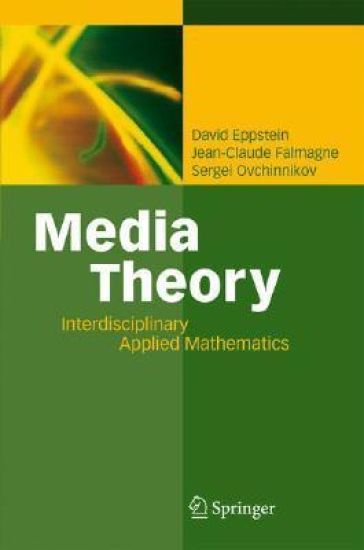
The focus of this book is a mathematical structure modeling a physical or biological system that can be in any of a number of ‘states. ’ Each state is characterized by a set of binary features, and di?ers from some other nei- bor state or states by just one of those features. In some situations, what distinguishes a state S from a neighbor state T is that S has a particular f- ture that T does not have. A familiar example is a partial solution of a jigsaw puzzle, with adjoining pieces. Such a state can be transformed into another state, that is, another partial solution or the ?nal solution, just by adding a single adjoining piece. This is the ?rst example discussed in Chapter 1. In other situations, the di?erence between a state S and a neighbor state T may reside in their location in a space, as in our second example, in which in which S and T are regions located on di?erent sides of some common border. We formalize the mathematical structure as a semigroup of ‘messages’ transforming states into other states. Each of these messages is produced by the concatenation of elementary transformations called ‘tokens (of infor- tion). ’ The structure is speci?ed by two constraining axioms. One states that any state can be produced from any other state by an appropriate kind of message. The other axiom guarantees that such a production of states from other states satis?es a consistency requirement.
Learning Spaces

Learning Spaces

Jean-Claude Falmagne; Jean-Paul Doignon

Springer-Verlag Berlin and Heidelberg GmbH Co. K
2010
sidottu
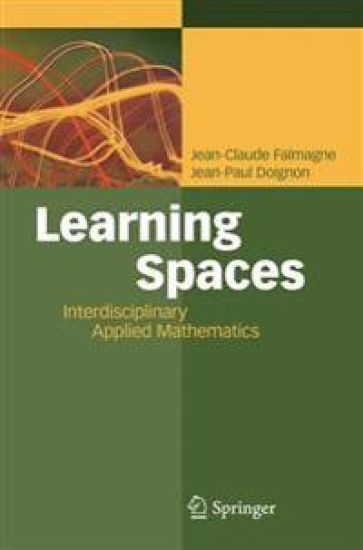
Learning spaces offer a rigorous mathematical foundation for practical systems of educational technology. Learning spaces generalize partially ordered sets and are special cases of knowledge spaces. The various structures are investigated from the standpoints of combinatorial properties and stochastic processes. Leaning spaces have become the essential structures to be used in assessing students' competence of various topics. A practical example is offered by ALEKS, a Web-based, artificially intelligent assessment and learning system in mathematics and other scholarly fields. At the heart of ALEKS is an artificial intelligence engine that assesses each student individually and continously. The book is of interest to mathematically oriented readers in education, computer science, engineering, and combinatorics at research and graduate levels. Numerous examples and exercises are included, together with an extensive bibliography.
Media Theory

Media Theory

David Eppstein; Jean-Claude Falmagne; Sergei Ovchinnikov

Springer-Verlag Berlin and Heidelberg GmbH Co. K
2007
sidottu
The focus of this book is a mathematical structure modeling a physical or biological system that can be in any of a number of ‘states. ’ Each state is characterized by a set of binary features, and di?ers from some other nei- bor state or states by just one of those features. In some situations, what distinguishes a state S from a neighbor state T is that S has a particular f- ture that T does not have. A familiar example is a partial solution of a jigsaw puzzle, with adjoining pieces. Such a state can be transformed into another state, that is, another partial solution or the ?nal solution, just by adding a single adjoining piece. This is the ?rst example discussed in Chapter 1. In other situations, the di?erence between a state S and a neighbor state T may reside in their location in a space, as in our second example, in which in which S and T are regions located on di?erent sides of some common border. We formalize the mathematical structure as a semigroup of ‘messages’ transforming states into other states. Each of these messages is produced by the concatenation of elementary transformations called ‘tokens (of infor- tion). ’ The structure is speci?ed by two constraining axioms. One states that any state can be produced from any other state by an appropriate kind of message. The other axiom guarantees that such a production of states from other states satis?es a consistency requirement.
Elements of Psychophysical Theory

Elements of Psychophysical Theory

Jean-Claude Falmagne

Oxford University Press Inc
2002
nidottu
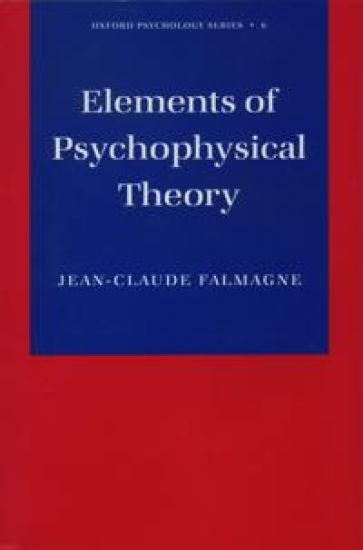
This book presents the basic concepts of classical psychophysics, derived from Gustav Fechner, as seen from the perspective of modern measurement theory. The theoretical discussion is elucidated with examples and numerous problems, and solutions to one-quarter of the problems are provided in the text.
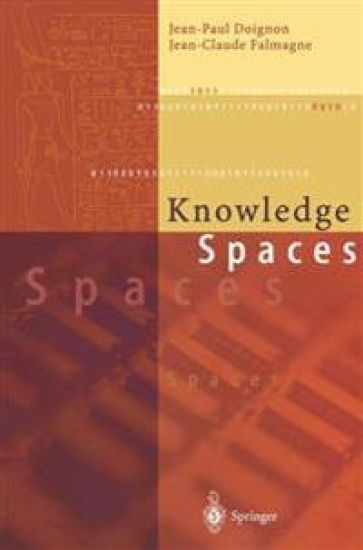
Knowledge Spaces

Knowledge Spaces

Jean-Paul Doignon; Jean-Claude Falmagne

Springer-Verlag Berlin and Heidelberg GmbH Co. K
1998
nidottu
Knowledge spaces offer a rigorous mathematical foundation for various practical systems of knowledge assessment. An example is offered by the ALEKS system (Assessment and LEarning in Knowledge Spaces), a software for the assessment of mathematical knowledge. From a mathematical standpoint, knowledge spaces generalize partially ordered sets. They are investigated both from a combinatorial and a stochastic viewpoint. The results are applied to real and simulated data. The book gives a systematic presentation of research and extends the results to new situations. It is of interest to mathematically oriented readers in education, computer science and combinatorics at research and graduate levels. The text contains numerous examples and exercises and an extensive bibliography.