Kirjojen hintavertailu. Mukana 12 595 353 kirjaa ja 12 kauppaa.

Kirjailija

Jean-Claude Milner

Kirjat ja teokset yhdessä paikassa: 3 kirjaa, julkaisuja vuosilta 2014-2020, suosituimpien joukossa A Search for Clarity. Vertaile teosten hintoja ja tarkista saatavuus suomalaisista kirjakaupoista.

3 kirjaa

Kirjojen julkaisuhaarukka 2014-2020.

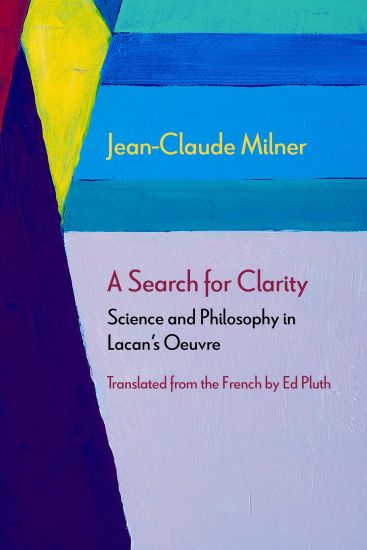
A Search for Clarity

A Search for Clarity

Jean-Claude Milner

Northwestern University Press
2020
nidottu
In A Search for Clarity: Science and Philosophy in Lacan's Oeuvre, Jean-Claude Milner argues that although Jacques Lacan's writing is notoriously obscure his oeuvre is entirely clear. In a discussion that considers the difference between the esoteric and exoteric works of Plato and Aristotle, Milner argues that Lacan's oeuvre is to be found in his published writings alone, not his transcribed seminars, and that these published writings contain his official doctrine. This means that Lacan's oeuvre is already complete, even though many of his seminars remain unpublished.According to Milner, Lacan's fundamental idea is that the subject psychoanalysis works on is the subject of science. Milner suggests that this is a supplement to Alexandre Koyré's and Alexandre Kojève's accounts of modern science, for which mathematization and a break from the ancient episteme were key. A Search for Clarity is the definitive statement on how Lacan viewed the relationship between psychoanalysis and science, and on how Lacan's thinking evolved as he struggled to draw out the consequences of the equation he posited between psychoanalysis and science.In an afterword written specifically for this translation, Milner discusses how his views on the late Lacan have shifted since the writing of A Search for Clarity, especially regarding the significance of James Joyce, lalangue, and homophony. Milner's work on Lacan has been essential reading in French for decades. This English translation will make Milner's unique and illuminating work accessible to a broader audience.

Controversies

Controversies

Alain Badiou; Jean-Claude Milner

Polity Press
2014
sidottu
Alain Badiou was born in 1937 in Rabat and Jean-Claude Milner in 1941 in Paris. They were both involved in the "Red Years" at the end of the Sixties and both were Maoists, but while Badiou was focusing all his attention on China, Milner was already taking his distance from it. Over the years, that original dispute over the destiny of gauchisme was fueled by deep, new differences between them concerning the role of philosophy and politics. In this wide-ranging and compelling dialogue, these two great thinkers explore the role of politics in today's world and consider the need for a formal theory of communist political organization. Whether they are addressing the era of revolutions, and in particular the Paris Commune and the Chinese Cultural Revolution, or discussing the infinite, the universal, the name "Jew", violence, capitalism, the left, or Europe, Jean-Claude Milner's dyed-in-the-wool skepticism constantly runs up against Alain Badiou's doctrinal passion.This extraordinary debate ultimately leads to new areas of interrogation and shows that there is no better remedy for the crushing power of media-influenced thinking than the revival of the great disputes of the mind.
Controversies

Controversies

Alain Badiou; Jean-Claude Milner

Polity Press
2014
nidottu
Alain Badiou was born in 1937 in Rabat and Jean-Claude Milner in 1941 in Paris. They were both involved in the "Red Years" at the end of the Sixties and both were Maoists, but while Badiou was focusing all his attention on China, Milner was already taking his distance from it. Over the years, that original dispute over the destiny of gauchisme was fueled by deep, new differences between them concerning the role of philosophy and politics. In this wide-ranging and compelling dialogue, these two great thinkers explore the role of politics in today's world and consider the need for a formal theory of communist political organization. Whether they are addressing the era of revolutions, and in particular the Paris Commune and the Chinese Cultural Revolution, or discussing the infinite, the universal, the name "Jew", violence, capitalism, the left, or Europe, Jean-Claude Milner's dyed-in-the-wool skepticism constantly runs up against Alain Badiou's doctrinal passion.This extraordinary debate ultimately leads to new areas of interrogation and shows that there is no better remedy for the crushing power of media-influenced thinking than the revival of the great disputes of the mind.