Kirjojen hintavertailu. Mukana 12 657 676 kirjaa ja 12 kauppaa.

Kirjailija

Jean Daudelin

Kirjat ja teokset yhdessä paikassa: 7 kirjaa, julkaisuja vuosilta 1995-2018, suosituimpien joukossa Illegal Markets, Violence, and Inequality. Vertaile teosten hintoja ja tarkista saatavuus suomalaisista kirjakaupoista.

7 kirjaa

Kirjojen julkaisuhaarukka 1995-2018.

Illegal Markets, Violence, and Inequality

Illegal Markets, Violence, and Inequality

Jean Daudelin; José Luiz Ratton

Springer International Publishing AG
2018
sidottu
This book challenges the quasi-consensus that Latin American countries dominate global homicide rankings mainly due to the illegal nature of drug production and trafficking. Building on US scholarship that looks at the role of social exclusion and discriminatory policing in drug violence, the authors of this volume show that the association between illegality and violence cannot be divorced from the inequality that prevails in those countries. This book looks in detail at the functioning of drug markets in Recife, the largest metropolitan area in Brazil’s North-East and, over the last 25 years, the heart of the country’s most violent metropolitan area. Building on extensive interviews and field work, the authors map out the city’s drug markets and explore the reasons why some of those markets are violent, and others are not. The analysis focuses on the micromechanics of each market, looking at consumption patterns and at the workings of retail sales and distribution. Such a systematic micro-level comparative analysis of the workings of Latin American drug markets is simply not available elsewhere in current literature. These findings point to significant gaps in current understandings of the link between illegal markets and violence, and they illuminate the need to factor in the way in which those markets are nested in exclusionary social contexts.
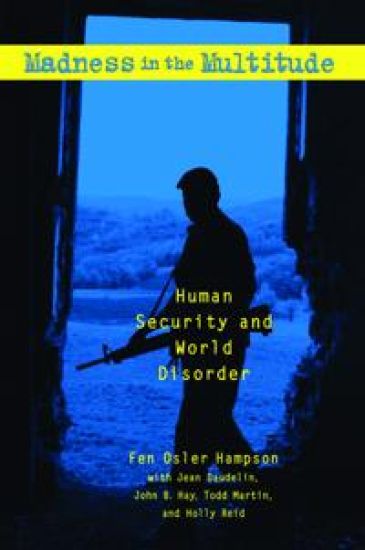
Madness in the Multitude

Madness in the Multitude

Fen Osler Hampson; Jean Daudelin; John Hay; Holly Reid; Todd Martin

Oxford University Press, Canada
2001
sidottu
Madness in the Multitude explores the nature of human security in the contemporary world. At one level, human security is about "freedom from fear" and alleviating the plight of innocent victims of armed conflict. Civil strife in many corners of the globe--East Timor, Bosnia, Kosovo, Rwanda, Burundi, Sudan, Georgia, Tajikistan--have witnessed extraordinary violence directed at civilians, especially the most vulnerable citizens in society such as women and children. International efforts to curb the production and use of anti-personnel landmines, half the proliferation and spread of small arms, and strengthen international prohibitions against the most egregious violations of human rights through the establishment of an International Criminal Court are directed at augmenting human security. But at another level, the concept of human security addresses a much wider set of concerns. There are those who argue that human security is not just about "freedom from fear" but also "freedom from want" and other kinds of deprivation. These advocates point to the adverse affects of globalization on human development and the problems of achieving social justice in a world where the forces of globalization have unequal impacts on the distribution of wealth and income. According to this view, the widening gap between the world's richest and poorest countries is a major cause for concern as are a wide range of nonmilitary threats to human health and survival such as AIDS, water and air-borne pollutants, and the general deterioration of the biosphere. In a wide-ranging theoretical and empirical analysis, Madness in the Multitude examines the different meanings and understanding of the concept of human security and how the concept of human security has evolved over the past two centuries. Through case studies of the International Criminal Court, the Anti-personnel Landmines Treaty, international efforts to control small arms, military intervention in Kosovo and elsewhere, and the work of international development agencies and lending institutions, this book asks whether there is a new human security "paradigm" of international politics and what the implications of this paradigm for international order are. The volume suggests that human security constitutes a new kind of global public good whose provision challenges our traditional conceptions about the purpose and function of international institutions, the role of civil society, and the nature of power in international politics. This book explores how our conceptions of human security have evolved in the latter half of the twentieth century, analyzing the debate about how best to promote and advance human security.
Beyond Mexico

Beyond Mexico

Jean Daudelin; Dosman

Carleton University Press,Canada
1995
nidottu
As a result of the North American Free Trade Agreement Canada's relations with Mexico and Latin America have reached a turning point both politically and economically. Beyond Mexico is a timely assessment of the dynamic state and the prospects of Canada's relations with Latin America. Every day, trade developments under nafta are redefining political, economic and social connections between Canada, Mexico and the United States. In this well-documented, policy-relevant and eminently accessible study, specialists address the challenges raised by non-governmental organizations, security and human rights issues, inter-municipal exchange programs, Canada's membership in the Organization of American States, and by successive crises in Haiti. This collection looks beyond NAFTA to explore the range and realities of Canada's involvement in the entire hemisphere.
Beyond Mexico

Beyond Mexico

Jean Daudelin; Dosman

Carleton University Press,Canada
1995
sidottu
As a result of the North American Free Trade Agreement Canada's relations with Mexico and Latin America have reached a turning point both politically and economically. Beyond Mexico is a timely assessment of the dynamic state and the prospects of Canada's relations with Latin America. Every day, trade developments under nafta are redefining political, economic and social connections between Canada, Mexico and the United States. In this well-documented, policy-relevant and eminently accessible study, specialists address the challenges raised by non-governmental organizations, security and human rights issues, inter-municipal exchange programs, Canada's membership in the Organization of American States, and by successive crises in Haiti. This collection looks beyond NAFTA to explore the range and realities of Canada's involvement in the entire hemisphere.