Kirjojen hintavertailu. Mukana 12 390 323 kirjaa ja 12 kauppaa.

Kirjailija

Jean Drèze

Kirjat ja teokset yhdessä paikassa: 12 kirjaa, julkaisuja vuosilta 1991-2020, suosituimpien joukossa An Uncertain Glory. Vertaile teosten hintoja ja tarkista saatavuus suomalaisista kirjakaupoista.

Mukana myös kirjoitusasut: Jean Dreze

12 kirjaa

Kirjojen julkaisuhaarukka 1991-2020.

An Uncertain Glory

An Uncertain Glory

Jean Drèze; Amartya Sen

Penguin Books Ltd
2020
pokkari
UPDATED WITH A NEW INTRODUCTION'Magnificent ... a major work by two of the world's most perceptive and intelligent India-watchers writing today' William Dalrymple, New Statesman From two of India's leading economists, Jean Drèze and Nobel Prize-winner Amartya Sen, An Uncertain Glory is a passionate, considered argument for the need for a greater understanding of inequalities in India.When India regained independence from colonial rule in 1947, it immediately adopted a firmly democratic political system, with multiple parties, freedom of speech and extensive political rights. The famines of the British era disappeared, and steady economic growth replaced stagnation, accelerating further over the last three decades to make India's growth the second fastest among large economies. Despite a recent dip, it is still one of the highest in the world.Maintaining rapid yet environmentally sustainable growth remains an important and achieveable goal for India. Drèze and Sen argue that the country's main problems lie in the disregarding of the essential needs of the people. There have been major failures both to foster participatory growth and to make good use of the public resources generated by economic growth to enhance people's living conditions; social and physical services remain inadequate, from schooling and medical care to safe water, electricity, and sanitation. In the long run, even high economic growth is threatened by the underdevelopment of infrastructure and the neglect of human capabilities, in contrast with the holistic approach pioneered by Japan, South Korea and China.In a democracy, addressing these failures requires not only significant policy change, but also a clearer public understanding of the abysmal extent of deprivation in the country. Yet public discussion in India tends to be constricted to the lives and concerns of the relatively affluent. This book presents a powerful analysis not only of India's deprivations and inequalities, but also of the restraints on addressing them - and of the possibility of change through democratic practice.
Sense and Solidarity

Sense and Solidarity

Jean Drèze

Oxford University Press
2019
sidottu
This is an open access title available under the terms of a CC BY-NC-ND 4.0 licence. It is free to read at Oxford Scholarship Online and offered as a free PDF download from OUP and selected open access locations. Jean Drèze has a rare and distinctive understanding of the Indian economy and its relationship with the social life of ordinary people. He has travelled widely in rural India and done fieldwork of a kind that few economists have attempted. In Sense and Solidarity Drèze offers unique insight on issues of hunger, inequality, conflict, and the evolution of social policy in India over roughly the past two decades. Historic legislations and initiatives of the period, relating for instance to the right to food and the right to work, are all scrutinised and explained, as are the fierce debates that often accompanied them. "Jholawala" has become a disparaging term for activists in the Indian business media. This book affirms the learning value of collective action combined with sound economic analysis. In his detailed introduction, the author argues for an approach to development economics where research and action are complementary and interconnected.Sense and Solidarity spans the gamut of critical social policies, from education and health to poverty, nutrition, child care, corruption, employment, and social security. There are also less predictable topics such as the caste system, corporate power, nuclear disarmament, the Gujarat model, the Kashmir conflict, and universal basic income. Sense and Solidarity enlarges the boundaries of social development towards a broad concern with the sort of society we want to create.
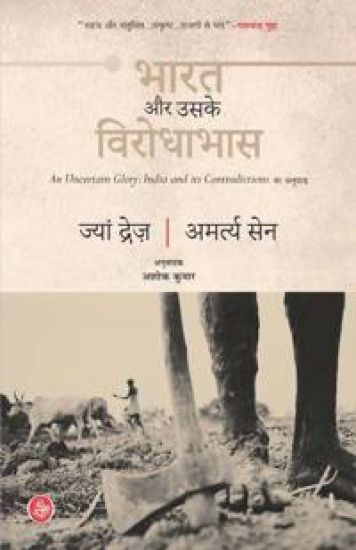
Bharat Aur Uske Virodhabhas

Bharat Aur Uske Virodhabhas

Jean Dreze; Amartya Sen

Rajkamal Prakashan Pvt. Ltd
2018
sidottu
नब्बे के बाद भारतीय अर्थव्यवस्था ने सकल घरेलू उत्पाद में वृद्धि के लिहाज़ से अच्छी प्रगति की है। उपनिवेशवादी शासन तले जो देश सदियों तक एक निम्न आय अर्थव्यवस्था के रूप में गतिरोध का शिकार बना रहा और आज़ादी के बाद भी कई दशकों तक बेहद धीमी रफ्तार से आगे बढ़ा, उसके लिए यह निश्चित ही एक बड़ी उपलब्धि है।लेकिन ऊँची और टिकाऊ वृद्धि दर को हासिल करने में सफलता अन्तत इसी बात से आँकी जाएगी कि इस आर्थिक वृद्धि का लोगों के जीवन तथा उनकी स्वाधीनताओं पर क्या प्रभाव पड़ा है। भारत आर्थिक वृद्धि दर की सीढ़ियाँ तेज़ी से तो चढ़ता गया है लेकिन जीवन-स्तर के सामाजिक संकेतकों के पैमाने पर वह पिछड़ गया है-यहाँ तक कि उन देशों के मुकाबले भी जिनसे वह आर्थिक वृद्धि के मामले में आगे बढ़ा है।दुनिया में आर्थिक वृद्धि के इतिहास में ऐसे कुछ ही उदाहरण मिलते हैं कि कोई देश इतने लम्बे समय तक तेज़ आर्थिक वृद्धि करता रहा हो और मानव विकास के मामले में उसकी उपलब्धियाँ इतनी सीमित रही हों। इसे देखते हुए भारत में आर्थिक वृद्धि और सामाजिक प्रगति के बीच जो सम्बन्ध है उसका गहरा विश्लेषण लम्बे अरसे से अपेक्षित है। यह पुस्तक बताती है कि इन पारस्परिक सम्बन्धों के बारे में समझदारी का प्रभावी उपयोग किस तरह किया जा सकता है। जीवन-स्तर में सुधार तथा उनकी बेहतरी की दिशा में प्रगति और अन्तत आर्थिक वृद्धि भी इसी पर निर्भर है।- 'शिष्ट और नियंत्रित... उत्कृष्ट... नवीन।' -रामचन्द्र गुहा, फाइनेंशियल टाइम्स - 'बेहतरीन... दुनिया के दो सबसे अनुभवी और बौद्धिक प्रत्यक्षदर्शियों की कलम से।' -विलियम डेलरिम्पल, न्यू स्टेट्समैन - 'प्रोफेसर अमर्त्य सेन और ज्यां द्रेज़ अपनी किताब से आपको सोचने पर मजबूर कर देते हैं... भारत के लिए सबसे बड़ी चिन्ता की बात आज के समाज में बढ़ती हुई असमानताएँ होनी चाहिए।' -र
Bharat Aur Uske Virodhabhas

Bharat Aur Uske Virodhabhas

Jean Dreze; Amartya Sen

Rajkamal Prakashan Pvt. Ltd
2018
nidottu
Reading books is a kind of enjoyment. Reading books is a good habit. We bring you a different kinds of books. You can carry this book where ever you want. It is easy to carry. It can be an ideal gift to yourself and to your loved ones. Care instruction keep away from fire.
An Uncertain Glory: India and Its Contradictions

An Uncertain Glory: India and Its Contradictions

Jean Drèze; Amartya Sen

PRINCETON UNIVERSITY PRESS
2015
nidottu
Why India's problems won't be solved by rapid economic growth alone When India became independent in 1947 after two centuries of colonial rule, it immediately adopted a firmly democratic political system, with multiple parties, freedom of speech, and extensive political rights. The famines of the British era disappeared, and steady economic growth replaced the economic stagnation of the Raj. The growth of the Indian economy quickened further over the last three decades and became the second fastest among large economies. Despite a recent dip, it is still one of the highest in the world. Maintaining rapid as well as environmentally sustainable growth remains an important and achievable goal for India. In An Uncertain Glory, two of India's leading economists argue that the country's main problems lie in the lack of attention paid to the essential needs of the people, especially of the poor, and often of women. There have been major failures both to foster participatory growth and to make good use of the public resources generated by economic growth to enhance people's living conditions. There is also a continued inadequacy of social services such as schooling and medical care as well as of physical services such as safe water, electricity, drainage, transportation, and sanitation. In the long run, even the feasibility of high economic growth is threatened by the underdevelopment of social and physical infrastructure and the neglect of human capabilities, in contrast with the Asian approach of simultaneous pursuit of economic growth and human development, as pioneered by Japan, South Korea, and China. In a democratic system, which India has great reason to value, addressing these failures requires not only significant policy rethinking by the government, but also a clearer public understanding of the abysmal extent of social and economic deprivations in the country. The deep inequalities in Indian society tend to constrict public discussion, confining it largely to the lives and concerns of the relatively affluent. Dr ze and Sen present a powerful analysis of these deprivations and inequalities as well as the possibility of change through democratic practice.
India

India

Jean Drèze; Amartya Sen

Oxford University Press
2002
nidottu
This book explores the role of public action in eliminating deprivation and expanding human freedoms in India. The analysis is based on a broad and integrated view of development, which focuses on well-being and freedom rather than the standard indicators of economic growth.
India

India

Jean Drèze; Amartya Sen

Clarendon Press
1999
nidottu
This book presents analysis of endemic deprivation in India and the role of public action in addressing the problem. The analysis is based on a broad view of economic development, focusing on human well-being and 'social opportunity' rather than the standard indicators of economic growth. India's success in reducing deprivation since Independence has been limited. Recent diagnoses of this failure of policy have concentrated on the counterproductive role of government regulation, and on the need for economic incentives to accelerate the economy. Professors Drèze and Sen argue that an assessment of India's failure to eliminate basic deprivations has to go beyond this limited focus, and to take note of the role played in that failure by inadequate public involvement in the provision of basic education, health care, social security, and related fields. Even the fostering of fast and participatory economic growth requires some basic social change, which is not addressed by liberalization and economic incentives. The authors also discuss the historical antecedents of these political and social neglects, including the distortion of policy priorities arising from inequalities of political power. Following on from this, the book considers the scope for public action to address these earlier biases and achieve a transformation of policy priorities. ` ... a fine account of India's achievements and failures ... written throughout in a fine style ... it will be a starting-point of subsequent discussions on social life in India.' Partha Dasgupta, Times Higher Education Supplement
India: Economic Development and Social Opportunity

India: Economic Development and Social Opportunity

Jean Drèze; Amartya Sen

Clarendon Press
1996
sidottu
An analysis of endemic deprivation in India and of the role of public action in addressing that problem. The analysis is based on a broad view of economic development, focusing on human well-being and `social opportunity' rather than on the standard indicators of economic growth. India's success in reducing endemic deprivation since Independence has been quite limited. Recent diagnoses of this failure of policy have concentrated on the counterproductive role of government regulation, and on the need for economic incentives to accelerate the growth of the economy. This book argues that an assessment of India's failure to eliminate basic deprivations has to go beyond this limited focus, and to take note of the role played in that failure by inadequate public involvement in the provision of basic education, health care, social security, and related fields, Even the fostering of fast and participatory economic growth requires some basic social change, which is not addressed by liberalization and economic incentives. The authors also discuss the historical antecedents of these political and social neglects, including the distortion of policy priorities arising from inequalities of political power. Following on from this, the book considers the scope for public action to address these earlier biases and achieve a transformation of policy priorities. The introductory chapter presents the motivation, focus, and approach of the book. Chapter 2 discusses the respective roles of the market mechanism and government action in economic development and discusses the particular role of public involvement in the fields of health and education. In chapters 3 and 4, international comparisons of development experiences are brought to bear on the diagnosis of India's successes and failures. These two chapters also discuss the lessons to be learnt from the contrasting development experiences of different states within India, with particular attention to Kerala's outstanding success in social fields. Chapter 5 considers the role of public action and political organization in promoting social opportunities. Attention is drawn, in particular, to the part played by widespread illiteracy in suppressing that process and perpetuating social inequalities. The issue of basic education is further examined in chapter 6, which includes a critical assessment of public policy in this field. Chapter 7 discusses the specific problem on gender inequality, and the role of women's agency in the expansion of social opportunities for both women and men. The concluding chapter consolidates the argument and discusses the policy implication of the analyses presented. A statistical appendix presents a comparative picture of India and other developing countries, and also the comparative performance of different states within India.
Hunger and Public Action

Hunger and Public Action

Jean Drèze; Amartya Sen

Clarendon Press
1991
nidottu
This is an open access publication, available online and distributed under the terms of the Creative Commons Attribution-Non Commercial-Share Alike 3.0 IGO licence (CC BY-NC-ND 3.0 IGO). It is free to read at Oxford Scholarship Online and offered as a free PDF download from OUP and selected open access locations. This study was well-received and widely discussed when it appeared in hardback in 1990. It is devoted to analysis of the enduring problem of hunger in the modern world, and of the role that public action can play in countering it. The book is divided into four parts. The first attempts to provide a coherent perspective on the complex nutritional, economic, social and political issues involved in the causation of hunger and deprivation. The second deals with famine prevention, paying special attention to Africa and India. The third focuses on chronic undernourishment and related deprivations. Parts two and three include a number of case studies of successful public action for the prevention of hunger and famines in various parts of the world. The fourth part of the book draws together the main themes and concerns of the earlier chapters, and provides an integrated view of the role of public action in eliminating hunger.