Kirjailija
Jean-Francois Lyotard
Kirjat ja teokset yhdessä paikassa: 46 kirjaa, julkaisuja vuosilta 1984-2026, suosituimpien joukossa Der Widerstreit. Vertaile teosten hintoja ja tarkista saatavuus suomalaisista kirjakaupoista.
Mukana myös kirjoitusasut: Jean-François Lyotard
46 kirjaa
Kirjojen julkaisuhaarukka 1984-2026.
With contributions selected from the last fifteen years of his life, this second volume of Jean-François Lyotard’s interviews and debates includes hard-to-find and previously untranslated material. Taking place between 1984 and 1997 they follow in the wake of Lyotard’s most notable publications, including The Postmodern Condition (1979) and The Differend (1983). Whilst continuing to contest and reconfigure the claims of these writings, Lyotard and his interlocutors help to contextualise the questions raised within the fields of art, philosophy, literature and politics.Discussions in Paris and London include contributions from thinkers such as Philippe Lacoue-Labarthe; Christine Buci-Glucksmann and Alain Badiou whilst significant interviews elsewhere in Europe, North and South America elucidate the consequences of the varied reception given to his work. The importance of Kant, Freud and Wittgenstein is readily apparent as are the themes now closely associated with Lyotard: the inhuman, infancy and resistance to ‘the system’. These interviews and debates record an evident delight in the activity of thinking which is not about rhetorical flourish or rehashing staid assumptions but of grappling with some of the most important questions confronting thought today.
Jean-François Lyotard (1924-1998) was one of the most important French philosophers of the Twentieth Century. His impact has been felt across many disciplines: sociology; cultural studies; art theory and politics. This volume presents a diverse selection of interviews, conversations and debates which relate to the five decades of his working life, both as a political militant, experimental philosopher and teacher. Including hard-to-find interviews and previously untranslated material, this is the first time that interviews with Lyotard have been presented as a collection.Key concepts from Lyotard’s thought – the differend, the postmodern, the immaterial – are debated and discussed across different time periods, prompted by specific contexts and provocations. In addition there are debates with other thinkers, including Emmanuel Levinas and Jacques Derrida, which may be less familiar to an Anglophone audience. These debates and interviews help to contextualise Lyotard, highlighting the importance of Marx, Freud, Kant and Wittgenstein, in addition to the Jewish thought which accompanies the questions of silence, justice and presence that pervades Lyotard’s thinking.
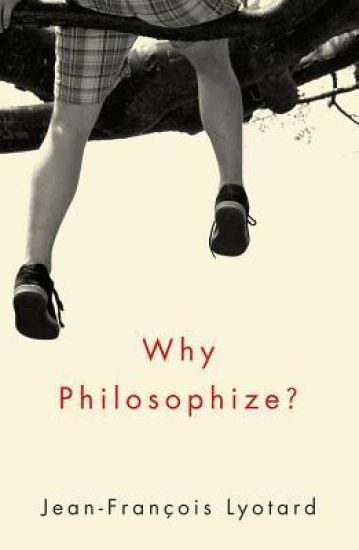
Why Philosophize? is a series of lectures given by Jean-François Lyotard to students at the Sorbonne embarking on their university studies. The circumstances obliged him to be both clear and concise: at the same time, his lectures offer a profound and far-reaching meditation on how essential it is to philosophize in a world where philosophy often seems irrelevant, outdated, or inconclusive. Lyotard begins by drawing on Plato, Proust and Lacan to show that philosophy is a never-ending desire - for wisdom, for the ‘other’. In the second lecture he draws on Heraclitus and Hegel to explore the close relation between philosophy and history: the same restlessness, the same longing for a precarious unity, drives both. In his third lecture, Lyotard examines how philosophy is a form of utterance, both communicative and indirect. Finally, he turns to Marx, exploring the extent to which philosophy can be a transformative action within the world. These wonderfully accessible lectures by one of the most influential philosophers of the last 50 years will attract a wide readership, since, as Lyotard says, ‘How can one not philosophize?’ They are also an excellent introduction to Lyotard’s mature thought, with its emphasis on the need for philosophy to bear witness, however obliquely, to a recalcitrant reality.
Lyotard is considered one of the most brilliant and influential of French post-structuralist thinkers. Published in 1974 by Minuit, Economie libidinale is, of all his work to date, the most creative in its mode of writing and in its theorizing: a stunning, dense, brilliant piece in which Lyotard, ranging from Marxist and Freudian theory to contemporary arts, argues that political economy is charged with passions and, reciprocally, that passions are infused with the political.
Jean-Francois Lyotard is one of Europe's leading philosophers, well known for his work The Postmodern Condition. In this important new study he develops his analysis of the phenomenon of postmodernity.In a wide-ranging discussion the author examines the philosophy of Kant, Heidegger, Adorno, and Derrida and looks at the works of modernist and postmodernist artists such as Cezanne, Debussy, and Boulez. Lyotard addresses issues such as time and memory, the sublime and the avant-garde, and the relationship between aesthetics and politics. Throughout his discussion he considers the close but problematic links between modernity, progress, and humanity, and the transition to postmodernity. Lyotard claims that it is the task of literature, philosophy, and the arts, to bear witness to and explain this difficult transition.This important contribution to aesthetic and philosophical debates will be of great interest to students in philosophy, literary, and cultural theory and politics.
Many definitions of postmodernism focus on its nature as the aftermath of the modern industrial age when technology developed dynamically. In The Postmodern Condition Jean-Francois Lyotard extends that analysis to postmodernism by looking at the status of science, technology, and the arts, the significance of technocracy, and the way the flow of information and knowledge are controlled in the Western world. Lyotard emphasized language; the world of postmodern knowledge can be represented as a game of language where speaking is participation in the game whose goal is the creation of new and ever-changing social linkages.
Libidinaalinen talous on ranskalaisen jälkimarxilaisen ajattelun keskeisimpiä teoksia ja yksi vuoden 1968 Pariisin kevään jälkeisen ajatteluilmapiirin kiehtovimmista ja omaperäisimmistä tuotoksista. Teos heijastaa aikakaudelle ominaista intoa ja tarvetta ajatella konventionaalisen poliittisen representaatioiden, ennalta määriteltyjen aatteiden sekä tavanomaisten filosofisten, psykologisten ja yhteiskuntatieteellisten mallien ulkopuolella. Lyotard pyrkii teoksessaan analysoimaan halun tuotannollisia, taloudellisia ja poliittisia ulottuvuuksia. Hänen mukaansa libido ei ole niinkään yksilöpsykologinen tekijä kuin koko yhteiskunnan lävistävä voimavirtaus, jota erilaiset representatiiviset järjestelmät ja rakenteet pyrkivät kanavoimaan, jähmettämään ja kiinteyttämään. Lyotard pyrkii teoksessaan hahmottamaan libidinaalista taloutta, joka perustuu intensiteetin ja representaation väliseen dynamiikkaan. ”Libidinaalisen taloustieteen” keinoin Lyotard pohtii, miten voitaisiin maksimoida halujen ilmentymien monimuotoisuus ja samalla minimoida kapitalismin rakenteiden tasapäistävyys. Kapitalismin vastustamisen ja siitä vapaiden alueiden etsinnän sijaan Lyotard pyrkii voimistamaan sitä, mikä kapitalismissa itsessään on kumouksellista ja arvaamatonta. Lyotard sanoutui myöhemmin itse irti Libidinaalisesta taloudesta ja kuvaili sitä katuvaisena ”häijyksi kirjakseen” ja hävyttömäksi provokaatioksi. Teos on kuitenkin saavuttanut eräänlaisen kulttiklassikon aseman ja se auttaa edelleen hahmottamaan, miten kaoottisuus ja kriisialttius ovat elimellinen osa kapitalisista järjestelmää itseään. Samalla teos kyseenalaistaa helpon jaottelun teoriaan ja käytäntöön, haastaa teoreettisen kielen vakavamielisyyden ja näennäisen eheyden ja kehottaa kysymään, millaisia latentteja voimia ja virtauksia teoreettisen ajattelun ja tiedontuotannon itsensä taustalla piilee.
‘Nobody knows how to write’. Thus opens this carefully nuanced and accessible collection of essays by one of the most important writer-philosophers of the 20th century, Jean-François Lyotard (1924-1998). First published in French in 1991 as Lectures d'enfance, these essays have never been printed as a collection in English. In them, Lyotard investigates his idea of infantia, or the infancy of thought that resists all forms of development, either human or technological.Each essay responds to works by writers and thinkers who are central to cultural modernism, such as James Joyce, Franz Kafka, Hannah Arendt, Jean-Paul Sartre, and Sigmund Freud. This volume – with a new introduction and afterword by Robert Harvey and Kiff Bamford – contextualises Lyotard’s thought and demonstrates his continued relevance today.
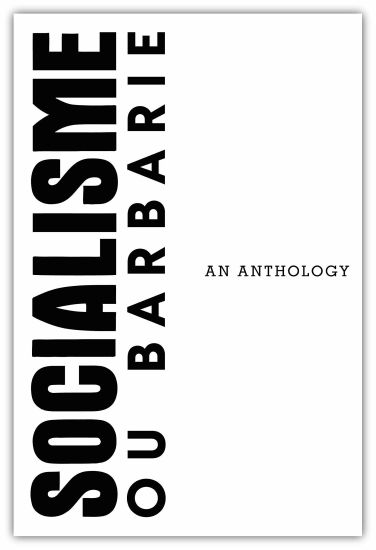
A Socialisme ou Barbarie Anthology
Cornelius Castoriadis; Jean-Francois Lyotard; Claude Lefort
Eris
2019
nidottu
Socialisme ou Barbarie (1948–67) was a revolutionary group whose members included such major figures such as Cornelius Castoriadis, Claude Lefort and Jean-François Lyotard. Its journal of the same name helped inspire France’s May ’68 student-worker rebellion and influenced generations of radicals worldwide. This Anthology, for the first time in print in the English language, restores the collective nature of the group’s adventure, where manual and intellectual workers creatively, and not without profound disagreements, reflected and acted together in anticipation of a non-hierarchical, self-governing society. The group radically reoriented critical revolutionary theory by affirming how social change emerges through ordinary people’s everyday lives and struggles. In a world divided into two competing bureaucratic-capitalist camps, the autonomous grassroots response to rationalized forms of outside control (State-corporation-trade union-political party) would be workers’ management—a conclusion stunningly confirmed, against traditional Left expectations, by the workers’ revolts of 1953 and 1956 in the East, and by increasingly widespread challenges to established organizational forms in the 1960s in the West.These texts not only examine the overall crisis of systems of domination, but explore their creative contestation in the workplace, in changing relations between the sexes and between generations, and in movements for national liberation (China, Algeria), to bring out “the positive content of socialism” while remaining clear-eyed about how bureaucratization may be reintroduced into emancipatory struggles.
Svar på frågan : vad var det postmoderna?
Fredric Jameson; Anders Burman; Sara Danius; Hans Ruin; Jean-François Lyotard
Axl Books
2016
nidottu
För drygt trettio år sedan publicerades Jean-François Lyotards La condition postmoderne, där frågan ställdes om innebörden i arvet från upplysningen. Ska det postmoderna förstås som ett brott med dess rationalitet och universalism, eller som en fortsättning och radikalisering av dess självkritik? Lyotards idé om ett postmodernt brott kom att kritiseras av bland andra Jürgen Habermas för vilken upplysningen var ett projekt som förvisso hade sin baksida, men som i grunden borde försvaras. Fredric Jameson utvecklade därefter begreppet postmodernism i en annan riktning – som ett uttryck för senkapitalismens kulturella logik. Debatten kom att röra sig från filosofi och politisk teori till bildkonst, litteratur, dans och arkitektur, från diskussioner om subjektet och språket till kultursociologiska analyser om skillnaden mellan högt och lågt inom kulturen. Vår egen samtid är på många sätt präglad av detta högst kontroversiella arv, men dess innebörd är likväl långt ifrån klar. Vad var det postmoderna? Vilka var debattens historiska förutsättningar? Kan vi idag formulera dessa problem så att de fortfarande är relevanta?
First published in 1974, Libidinal Economy is a major work of twentieth century continental philosophy. In it, Lyotard develops the idea of economies driven by libidinal ‘energies’ or ‘intensities’ which he claims flow through all structures, such as the human body and political or social events. He uses this idea to interpret a diverse range of subjects including political economy, Marxism, sexual politics, semiotics and psychoanalysis. Lyotard also carries out a broad critique of philosophies of desire, as expounded by Deleuze and Guattari, Nietzsche, Bataille, Foucault and de Sade.Translated by Iain Hamilton Grant.
Why Philosophize? is a series of lectures given by Jean-François Lyotard to students at the Sorbonne embarking on their university studies. The circumstances obliged him to be both clear and concise: at the same time, his lectures offer a profound and far-reaching meditation on how essential it is to philosophize in a world where philosophy often seems irrelevant, outdated, or inconclusive. Lyotard begins by drawing on Plato, Proust and Lacan to show that philosophy is a never-ending desire - for wisdom, for the ‘other’. In the second lecture he draws on Heraclitus and Hegel to explore the close relation between philosophy and history: the same restlessness, the same longing for a precarious unity, drives both. In his third lecture, Lyotard examines how philosophy is a form of utterance, both communicative and indirect. Finally, he turns to Marx, exploring the extent to which philosophy can be a transformative action within the world. These wonderfully accessible lectures by one of the most influential philosophers of the last 50 years will attract a wide readership, since, as Lyotard says, ‘How can one not philosophize?’ They are also an excellent introduction to Lyotard’s mature thought, with its emphasis on the need for philosophy to bear witness, however obliquely, to a recalcitrant reality.