Kirjojen hintavertailu. Mukana 12 595 353 kirjaa ja 12 kauppaa.

Kirjailija

Jean Hillier

Kirjat ja teokset yhdessä paikassa: 11 kirjaa, julkaisuja vuosilta 2002-2021, suosituimpien joukossa Shadows of Power. Vertaile teosten hintoja ja tarkista saatavuus suomalaisista kirjakaupoista.

11 kirjaa

Kirjojen julkaisuhaarukka 2002-2021.

Quiet Activism

Quiet Activism

Wendy Steele; Jean Hillier; Diana MacCallum; Jason Byrne; Donna Houston

Springer Nature Switzerland AG
2021
sidottu
This book focuses on the potential and possibilities for socially innovative responses to the climate emergency at the local scale. Climate change has intensified the need for communities to find creative and meaningful ways to address the sustainability of their environments. The authors focus on the creative and collaborative ways local- scale climate action reflects the extra-ordinary measures taken by ordinary people. This includes critical engagement with the ways in which novel social practices and partnerships emerge between people, organisations, institutions, governance arrangements and eco-systems. The book successfully highlights the transformative power of socially innovative activities and initiatives in response to the climate crisis; and critically explores how different individuals and groups undertake climate action as ‘quiet activism’ – the embodied acts of collective disruption, subversion, creativity and care at the local scale.
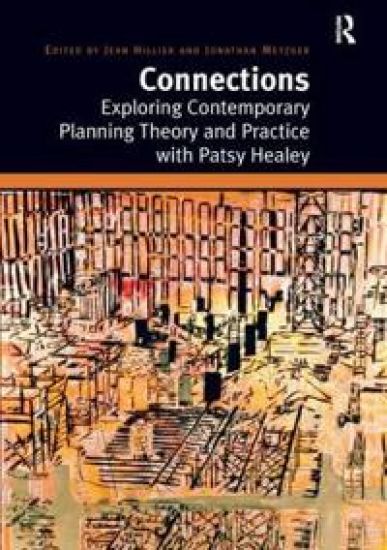
Connections

Connections

Jean Hillier; Jonathan Metzger

Routledge
2021
nidottu
The professional practice as well as the academic discipline of planning has been fundamentally re-invented all over the world in recent decades. In this astonishing transition, the thinking and scholarship of Patsy Healey appears as a constantly recurring influence and inspiration around the globe. The purpose of this book is to present, discuss and celebrate Healey’s seminal contributions to the development of the theory and practice of spatial planning. The volume contains a selection of 13 less readily available, but nevertheless, key texts by Healey, which have been selected to represent the trajectory of Patsy’s work across the several decades of her research career. 12 original chapters by a wide range of invited contributors take the ideas in the reprinted papers as points of departure for their own work, tracing out their continuing relevance for contemporary and future directions in planning scholarship. In doing so, these chapters tease out the themes and interests in Healey’s work which are still highly relevant to the planning project. The title - Connections - symbolises relationality, possibly the most outstanding element linking Patsy’s ideas. The book showcases the wide international influence of Patsy’s work and celebrates the whole trajectory of work to show how many of her ideas on for instance the role of theory in planning, processes of change, networking as a mode of governance, how ideas spread, and ways of thinking planning democratically were ahead of their time and are still of importance.
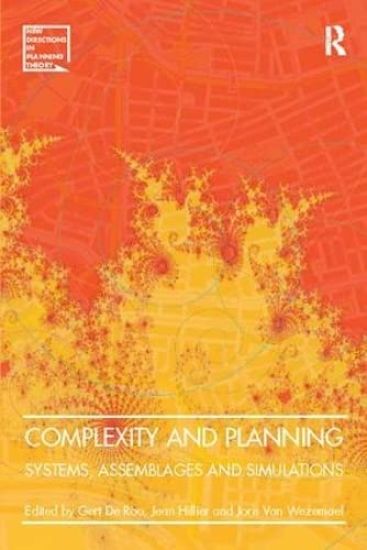
Complexity and Planning

Complexity and Planning

Gert de Roo; Jean Hillier

Routledge
2017
nidottu
Complexity, complex systems and complexity theories are becoming increasingly important within a variety disciplines. While these issues are less well known within the discipline of spatial planning, there has been a recent growing awareness and interest. As planners grapple with how to consider the vagaries of the real world when putting together proposals for future development, they question how complexity, complex systems and complexity theories might prove useful with regard to spatial planning and the physical environment. This book provides a readable overview, presenting and relating a range of understandings and characteristics of complexity and complex systems as they are relevant to planning. It recognizes multiple, relational approaches of dynamic complexity which enhance understandings of, and facilitate working with, contingencies of place, time and the various participants' behaviours. In doing so, it should contribute to a better understanding of processes with regard to our physical and social worlds.
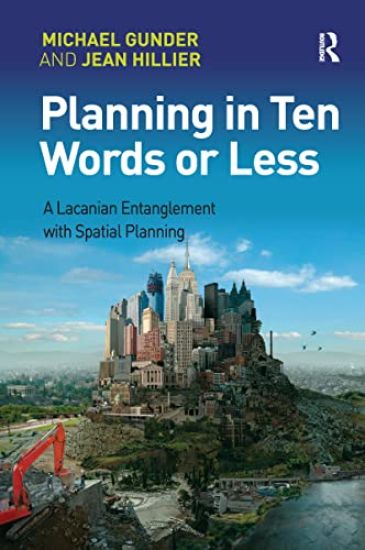
Planning in Ten Words or Less

Planning in Ten Words or Less

Michael Gunder; Jean Hillier

Routledge
2016
nidottu
This book takes a Lacanian, and related post-structuralist perspective to demythologize ten of the most heavily utilised terms in spatial planning: rationality, the good, certainty, risk, growth, globalization, multi-culturalism, sustainability, responsibility and 'planning' itself. It highlights that these terms, and others, are mere 'empty signifiers', meaning everything and nothing. Based on international examples of planning practice and process, Planning in Ten Words or Less suggests that spatial and urban planning is largely based on the construction and deployment of ideological knowledge claims.
Stretching Beyond the Horizon

Stretching Beyond the Horizon

Jean Hillier

Routledge
2016
nidottu
In this innovative work Jean Hillier develops a new theory for students and researchers of spatial planning and governance which is grounded primarily in the work of Gilles Deleuze. The theory recognizes the complex interrelation between place qualities and the multiple space-time relational dynamics of spatial governance. Using empirical examples from England and Australia, Hillier identifies the power of networks and trajectories through which various actors territorialize space and explores the social and political responsibilities of spatial managers and decision-makers. She considers what spatial planning and urban management practices could look like if they were to be developed along Deleuzean lines, and suggests alternative framings for spatial practice: broad trajectories or 'visions' of the longer-term future and shorter-term, location-specific detailed plans and projects with collaboratively determined tangible goals.
Connections

Connections

Jean Hillier; Jonathan Metzger

Routledge
2015
sidottu
The professional practice as well as the academic discipline of planning has been fundamentally re-invented all over the world in recent decades. In this astonishing transition, the thinking and scholarship of Patsy Healey appears as a constantly recurring influence and inspiration around the globe. The purpose of this book is to present, discuss and celebrate Healey’s seminal contributions to the development of the theory and practice of spatial planning. The volume contains a selection of 13 less readily available, but nevertheless, key texts by Healey, which have been selected to represent the trajectory of Patsy’s work across the several decades of her research career. 12 original chapters by a wide range of invited contributors take the ideas in the reprinted papers as points of departure for their own work, tracing out their continuing relevance for contemporary and future directions in planning scholarship. In doing so, these chapters tease out the themes and interests in Healey’s work which are still highly relevant to the planning project. The title - Connections - symbolises relationality, possibly the most outstanding element linking Patsy’s ideas. The book showcases the wide international influence of Patsy’s work and celebrates the whole trajectory of work to show how many of her ideas on for instance the role of theory in planning, processes of change, networking as a mode of governance, how ideas spread, and ways of thinking planning democratically were ahead of their time and are still of importance.
Complexity and Planning

Complexity and Planning

Gert de Roo; Jean Hillier

Ashgate Publishing Limited
2012
sidottu
Complexity, complex systems and complexity theories are becoming increasingly important within a variety disciplines. While these issues are less well known within the discipline of spatial planning, there has been a recent growing awareness and interest. As planners grapple with how to consider the vagaries of the real world when putting together proposals for future development, they question how complexity, complex systems and complexity theories might prove useful with regard to spatial planning and the physical environment. This book provides a readable overview, presenting and relating a range of understandings and characteristics of complexity and complex systems as they are relevant to planning. It recognizes multiple, relational approaches of dynamic complexity which enhance understandings of, and facilitate working with, contingencies of place, time and the various participants' behaviours. In doing so, it should contribute to a better understanding of processes with regard to our physical and social worlds.
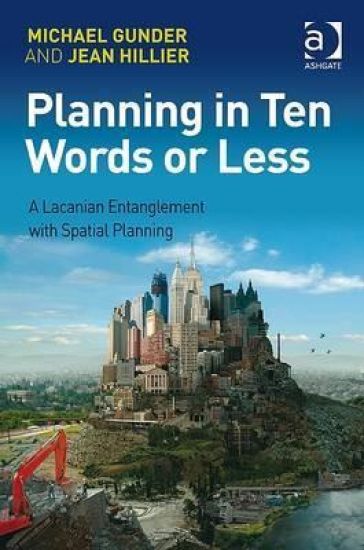
Planning in Ten Words or Less

Planning in Ten Words or Less

Michael Gunder; Jean Hillier

Ashgate Publishing Limited
2009
sidottu
This book takes a Lacanian, and related post-structuralist perspective to demythologize ten of the most heavily utilised terms in spatial planning: rationality, the good, certainty, risk, growth, globalization, multi-culturalism, sustainability, responsibility and 'planning' itself. It highlights that these terms, and others, are mere 'empty signifiers', meaning everything and nothing. Based on international examples of planning practice and process, Planning in Ten Words or Less suggests that spatial and urban planning is largely based on the construction and deployment of ideological knowledge claims.
Stretching Beyond the Horizon

Stretching Beyond the Horizon

Jean Hillier

Ashgate Publishing Limited
2007
sidottu
In this innovative work Jean Hillier develops a new theory for students and researchers of spatial planning and governance which is grounded primarily in the work of Gilles Deleuze. The theory recognizes the complex interrelation between place qualities and the multiple space-time relational dynamics of spatial governance. Using empirical examples from England and Australia, Hillier identifies the power of networks and trajectories through which various actors territorialize space and explores the social and political responsibilities of spatial managers and decision-makers. She considers what spatial planning and urban management practices could look like if they were to be developed along Deleuzean lines, and suggests alternative framings for spatial practice: broad trajectories or 'visions' of the longer-term future and shorter-term, location-specific detailed plans and projects with collaboratively determined tangible goals.
Shadows of Power

Shadows of Power

Jean Hillier

Routledge
2002
sidottu
Shadows of Power examines public policy and in particular, the communicative processes of policy and decision-making. It explore the important who, how and why issues of policy decisions. Who really takes the decisions? How are they arrived at and why were such processes used? What relations of power may be revealed between the various participants?Using stories from planning practices, this book shows that local planning decisions, particularly those which involve consideration of issues of 'public space' cannot be understood separately from the socially constructed, subjective territorial identities, meanings and values of the local people and the planners concerned. Nor can it be fully represented as a linear planning process concentrating on traditional planning policy-making and decision-making ideas of survey analysis-plan or officer recommendation-council decision-implementation. Such notions assume that policy-and decision-making proceed in a relatively technocratic and value neutral, unidirectional, step-wise process towards a finite end point. In this book Jean Hiller explores ways in which different values and mind-sets may affect planning outcomes and relate to systemic power structures. By unpacking these and bring them together as influences on participants' communication, she reveals influences at work in decision-making processes that were previously invisible.If planning theory is to be of real use to practitioners, it needs to address practice as it is actually encountered in the worlds of planning officers and elected representatives. Hillier shed light on the shadows so that practitioners may be better able to understand the circumstances in which they find themselves and act more effectively in what is in reality a messy, highly politicised decision-making process.
Shadows of Power

Shadows of Power

Jean Hillier

Routledge
2002
nidottu
Shadows of Power examines public policy and in particular, the communicative processes of policy and decision-making. It explore the important who, how and why issues of policy decisions. Who really takes the decisions? How are they arrived at and why were such processes used? What relations of power may be revealed between the various participants?Using stories from planning practices, this book shows that local planning decisions, particularly those which involve consideration of issues of 'public space' cannot be understood separately from the socially constructed, subjective territorial identities, meanings and values of the local people and the planners concerned. Nor can it be fully represented as a linear planning process concentrating on traditional planning policy-making and decision-making ideas of survey analysis-plan or officer recommendation-council decision-implementation. Such notions assume that policy-and decision-making proceed in a relatively technocratic and value neutral, unidirectional, step-wise process towards a finite end point. In this book Jean Hiller explores ways in which different values and mind-sets may affect planning outcomes and relate to systemic power structures. By unpacking these and bring them together as influences on participants' communication, she reveals influences at work in decision-making processes that were previously invisible.If planning theory is to be of real use to practitioners, it needs to address practice as it is actually encountered in the worlds of planning officers and elected representatives. Hillier shed light on the shadows so that practitioners may be better able to understand the circumstances in which they find themselves and act more effectively in what is in reality a messy, highly politicised decision-making process.