Kirjojen hintavertailu. Mukana 12 595 353 kirjaa ja 12 kauppaa.

Kirjailija

Jean-Louis Basdevant

Kirjat ja teokset yhdessä paikassa: 14 kirjaa, julkaisuja vuosilta 2005-2024, suosituimpien joukossa Particle Physics. Vertaile teosten hintoja ja tarkista saatavuus suomalaisista kirjakaupoista.

14 kirjaa

Kirjojen julkaisuhaarukka 2005-2024.

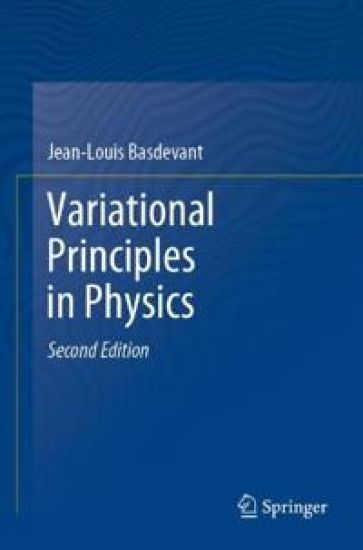
Variational Principles in Physics

Variational Principles in Physics

Jean-Louis Basdevant

Springer International Publishing AG
2024
nidottu
This revised and enhanced new edition of a well-established textbook provides a balanced overview of various areas of theoretical physics based on the use of variational principles. As well as field theory, the book deals with motion in curved spaces, the cradle of general relativity, and gravitational optics. New chapters on the relation of classical mechanics and geometrical optics as well as gravitational waves, which are considered as a true confirmation of general relativity, have been included. Each chapter has been carefully revised and enlarged. Finally, the text describes Feynman's formulation of quantum mechanics by path integrals, which gives the link between quantum and classical mechanics.The book provides a set of exercises, problems, and solutions.
Variational Principles in Physics

Variational Principles in Physics

Jean-Louis Basdevant

Springer International Publishing AG
2023
sidottu
This revised and enhanced new edition of a well-established textbook provides a balanced overview of various areas of theoretical physics based on the use of variational principles. As well as field theory, the book deals with motion in curved spaces, the cradle of general relativity, and gravitational optics. New chapters on the relation of classical mechanics and geometrical optics as well as gravitational waves, which are considered as a true confirmation of general relativity, have been included. Each chapter has been carefully revised and enlarged. Finally, the text describes Feynman's formulation of quantum mechanics by path integrals, which gives the link between quantum and classical mechanics.The book provides a set of exercises, problems, and solutions.
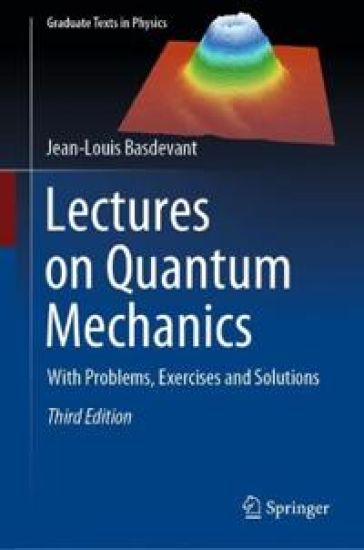
Lectures on Quantum Mechanics

Lectures on Quantum Mechanics

Jean-Louis Basdevant

Springer International Publishing AG
2023
sidottu
The new edition of this remarkable textbook offers the reader a conceptually strong introduction to quantum mechanics, but goes beyond this to present a fascinating tour of modern theoretical physics. Beautifully illustrated and engagingly written, it starts with a brief overview of diverse topics across physics including nanotechnology, materials science, and cosmology. It provides new chapters on astrophysics, quantum information and the photon. Each chapter provides a set of exercises, questions, a problem and solutions. The core of the book covers both established and emerging aspects of quantum mechanics. A concise introduction to traditional quantum mechanics covers the Schrödinger equation, Hilbert space, photon physics, the algebra of observables, hydrogen atom, spin and Pauli principle. Modern features of the field are presented with Bell's inequality by exploring systems of entangled states, that have generated the 'second quantum revolution' of systems that communicate instantly at a distance, and the birth of quantum information: cryptography, teleportation and quantum computers.
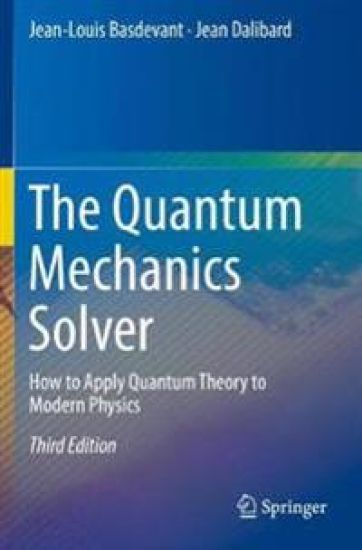
The Quantum Mechanics Solver

The Quantum Mechanics Solver

Jean-Louis Basdevant; Jean Dalibard

Springer Nature Switzerland AG
2020
nidottu
This textbook presents problems with detailed solutions showing how to apply quantum theory to modern physics. The text is divided in three parts, the first dealing with elementary particles, nuclei and atoms, the second presents quantum entanglement and measurement. Finally complex systems are examinated in depth. The aim of the text is to guide the student towards applying quantum mechanics to research problems. Advanced undergraduates and graduate students will find a rich and challenging source for improving their skills.This new edition has been extended with sections on neutrino oscillations, quantized vortices in Bose-Einstein condensates, quantum correlations in multi-particle systems, Bloch oscillations in periodic lattices and non-destructive quantum measurements.
The Quantum Mechanics Solver

The Quantum Mechanics Solver

Jean-Louis Basdevant; Jean Dalibard

Springer Nature Switzerland AG
2019
sidottu
This textbook presents problems with detailed solutions showing how to apply quantum theory to modern physics. The text is divided in three parts, the first dealing with elementary particles, nuclei and atoms, the second presents quantum entanglement and measurement. Finally complex systems are examinated in depth. The aim of the text is to guide the student towards applying quantum mechanics to research problems. Advanced undergraduates and graduate students will find a rich and challenging source for improving their skills.This new edition has been extended with sections on neutrino oscillations, quantized vortices in Bose-Einstein condensates, quantum correlations in multi-particle systems, Bloch oscillations in periodic lattices and non-destructive quantum measurements.
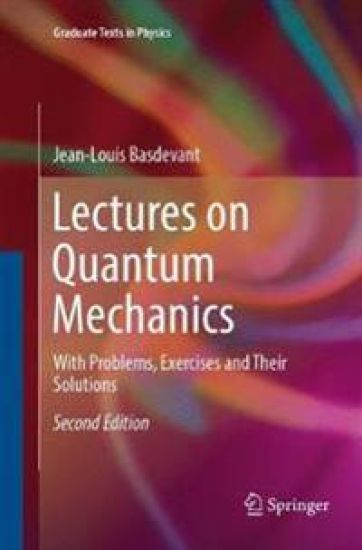
Lectures on Quantum Mechanics

Lectures on Quantum Mechanics

Jean-Louis Basdevant

Springer International Publishing AG
2018
nidottu
The new edition of this remarkable text offers the reader a conceptually strong introduction to quantum mechanics, but goes beyond this to present a fascinating tour of modern theoretical physics. Beautifully illustrated and engagingly written, it starts with a brief overview of diverse topics across physics including nanotechnology, statistical physics, materials science, astrophysics, and cosmology.The core of the book covers both established and emerging aspects of quantum mechanics. A concise introduction to traditional quantum mechanics covers the Schrödinger equation, Hilbert space, the algebra of observables, hydrogen atom, spin and Pauli principle. Modern features of the field are presented by exploring entangled states, Bell's inequality, quantum cryptography, quantum teleportation and quantum mechanics in the universe. This new edition has been enchanced through the addition of numerous problems with detailed solutions, an introduction to the mathematical tools neededand expanded discussion of the state-of-the-art in applications of quantum mechanics.Reviews of the 1st Edition:“This stimulating book on quantum mechanics documents many of the lively introduetory lectures given by Jean-Louis Basdevant during the past 25 years...written in a very engaging manner with regular mention of interesting applications and events and personages in the history of quantum mechanics…An insightful discussion is given of the methodology involved in the construction of quantum theory…” (Howard E. Brandt, Mathematical Reviews)"The strength of the book lies in Basdevant’s obvious talent as a lecturer. He is engaging and interesting and uses a wide variety of examples and sources. … These are interesting lectures and would be useful to anyone interested in an advanced introduction, or a review, of the topic." (E. Kincanon, CHOICE) "This textbook presents theoretical physics with a breathtaking arrayof examples and anecdotes. The author’s style is clear and stimulating, in the manner of a brisk classroom lecture that students can follow with ease and enjoyment. The book is written in physical language, without the excessive mathematics." (Vladimir Dzhunushaliev, Zentralblatt MATH)
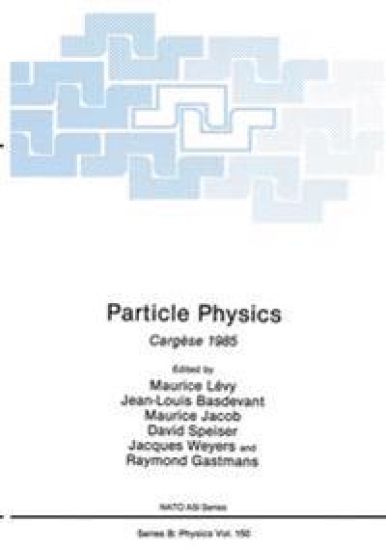
Particle Physics

Particle Physics

Maurice Lévy; Jean-Louis Basdevant; Maurice Jacob; David Speiser; Jacques Weyers; Raymond Gastmans

Springer-Verlag New York Inc.
2013
nidottu
The 1981 Cargese Summer Institute on Fundamental Interactions was organized by the Universite Pierre et Marie Curie, Paris (M. LEVY and J-L. BASDEVANT), CERN (M. JACOB), the Universite Catholique de Louvain (D. SPEISER and J. WEYERS), and the Kotholieke Universiteit te Leuven (R. GASTMANS), which, since 1975 have joined their efforts and worked in common. It was the 24th Summer Institute held at Cargese and the 8th one organized by the two institutes of theoretical physics at Leuven and Louvain-Ia-Neuve. The 1985 school was centered around two main themes : the standard model of the fundamental interactions (and beyond) and astrophysics. The remarkable advances in the theoretical understanding and experimental confirmation of the standard model were reviewed in several lectures where the reader will find a thorough analysis of recent experiments as well as a detailed comparaison of the standard model with experiment. On a more theoretical side, supersymmetry, supergravity and strings were discussed as well. The second theme concerns astrophysics where the school was quite successful in bridging the gap between this fascinating subject and more conventional particle physics. We owe many thanks to all those who have made this Summer Institute possible ! Thanks are due to the Scientific Committee of NATO and its President and to the "Region Corse" for a generous grant. .. We wish to thank Miss M-F. HANSELER, Mrs ALRIFRAI, Mr and Mrs ARIANO, and Mr BERNIA and all others from Paris, Leuven, Louvain-la-Neuve and especially Cargese for their collaboration.
Fundamentals in Nuclear Physics

Fundamentals in Nuclear Physics

Jean-Louis Basdevant; James Rich; Michael Spiro

Springer-Verlag New York Inc.
2010
nidottu
Nuclear physics began one century ago during the “miraculous decade” - tween 1895 and 1905 when the foundations of practically all modern physics were established. The period started with two unexpected spino?s of the Crooke’s vacuum tube: Roentgen’s X-rays (1895) and Thomson’s electron (1897), the ?rst elementary particle to be discovered. Lorentz and Zeemann developed the the theory of the electron and the in?uence of magnetism on radiation. Quantum phenomenology began in December, 1900 with the - pearance of Planck’s constant followed by Einstein’s 1905 proposal of what is now called the photon. In 1905, Einstein also published the theories of relativity and of Brownian motion, the ultimate triumph of Boltzman’s s- tistical theory, a year before his tragic death. For nuclear physics, the critical discovery was that of radioactivity by Becquerel in 1896. By analyzing the history of science, one can be convinced that there is some rationale in the fact that all of these discoveries came nearly sim- taneously, after the scienti?cally triumphant 19th century. The exception is radioactivity, an unexpected baby whose discovery could have happened s- eral decades earlier. Talentedscientists,theCuries,Rutherford,andmanyothers,tookthe- servationofradioactivityandconstructedtheideasthatarethesubjectofthis book. Of course, the discovery of radioactivity and nuclear physics is of much broader importance. It lead directly to quantum mechanics via Rutherford’s planetary atomic model and Bohr’s interpretation of the hydrogen spectrum. This in turn led to atomic physics, solid state physics, and material science.
Lectures on Quantum Mechanics

Lectures on Quantum Mechanics

Jean-Louis Basdevant

Springer-Verlag New York Inc.
2007
sidottu
Beautifully illustrated and engagingly written, Twelve Lectures in Quantum Mechanics presents theoretical physics with a breathtaking array of examples and anecdotes. Basdevant’s style is clear and stimulating, in the manner of a brisk classroom lecture that students can follow with ease and enjoyment. Here is a sample of the book’s style, from the opening of Chapter 1: "If one were to ask a passer-by to quote a great formula of physics, chances are that the answer would be ‘E = mc2’. In fact, of the three watershed years for physics toward the beginning of the 20th century – 1905: the Special Relativity of Einstein, Lorentz and Poincaré; 1915: the General Relativity of Einstein, with its extraordinary reflections on gravitation, space and time; and 1925: the development of Quantum Mechanics – it is surely the last which has the most profound implications for the development of science and technology. There is no way around it: all physics is quantum, from elementary particles, to stellar physics and the Big Bang, not to mention semiconductors and solar cells." A graduate of the Ecole Normale Superieure, Jean-Louis Basdevant is Professor and Chair of the Department of Physics at the Ecole Polytechnique, and Director of Research for the CNRS. Specializing in the theoretical physics of elementary particles, quantum field theory and astrophysics, Prof. Basdevant works in the Leprince-Ringuet Laboratory at the Ecole Polytechnique.
Variational Principles in Physics

Variational Principles in Physics

Jean-Louis Basdevant

Springer-Verlag New York Inc.
2006
sidottu
Optimization under constraints is an essential part of everyday life. Indeed, we routinely solve problems by striking a balance between contradictory interests, individual desires and material contingencies. This notion of equilibrium was dear to thinkers of the enlightenment, as illustrated by Montesquieu’s famous formulation: "In all magistracies, the greatness of the power must be compensated by the brevity of the duration." Astonishingly, natural laws are guided by a similar principle. Variational principles have proven to be surprisingly fertile. For example, Fermat used variational methods to demonstrate that light follows the fastest route from one point to another, an idea which came to be known as Fermat’s principle, a cornerstone of geometrical optics. Variational Principles in Physics explains variational principles and charts their use throughout modern physics. The heart of the book is devoted to the analytical mechanics of Lagrange and Hamilton, the basic tools of any physicist. Prof. Basdevant also offers simple but rich first impressions of Einstein’s General Relativity, Feynman’s Quantum Mechanics, and more revealing and amazing interconnections between various fields of physics.
The Quantum Mechanics Solver

The Quantum Mechanics Solver

Jean-Louis Basdevant; Jean Dalibard

Springer-Verlag Berlin and Heidelberg GmbH Co. K
2005
sidottu
Quantum mechanics is an endless source of new questions and fascinating observations. Examples can be found in fundamental physics and in applied physics, in mathematical questions as well as in the currently popular debates ontheinterpretationofquantummechanicsanditsphilosophicalimplications. Teaching quantum mechanics relies mostly on theoretical courses, which are illustrated by simple exercises often of a mathematical character. Red- ing quantum physics to this type of problem is somewhat frustrating since very few, if any, experimental quantities are available to compare the results with. For a long time, however, from the 1950s to the 1970s, the only alter- tive to these basic exercises seemed to be restricted to questions originating from atomic and nuclear physics, which were transformed into exactly soluble problems and related to known higher transcendental functions. In the past ten or twenty years, things have changed radically. The dev- opment of high technologies is a good example. The one-dimensional squa- well potential used to be a rather academic exercise for beginners. The em- gence of quantum dots and quantum wells in semiconductor technologies has changed things radically. Optronics and the associated developments in inf- redsemiconductorandlasertechnologieshaveconsiderablyelevatedthesocial rank of the square-well model. As a consequence, more and more emphasis is given to the physical aspects of the phenomena rather than to analytical or computational considerations.
Quantum Mechanics

Quantum Mechanics

Jean-Louis Basdevant; Jean Dalibard

Springer-Verlag Berlin and Heidelberg GmbH Co. K
2005
sidottu
This course on quantum mechanics offers a fresh and modern approach to the field. It is a textbook on the principles of the theory, its mathematical framework and its first applications. It consistently refers to modern and practical developments, such as tunneling microscopy, quantum information, Bell inequalities, quantum cryptography, Bose-Einstein condensation and quantum astrophysics. The book contains 92 exercises with their solutions.Supplementary material on extras.springer.com contains outstanding and "easy access" Java-based simulations, which illustratively help the user to better understand how the theory actually operates. It also contains a variety of links where one can discover updated applications and further readings. A complementary book The Quantum Mechanics Solver guides students to applying the theory developed here to research problems in atomic and molecular physics, condensed matter and laser physics.
Fundamentals in Nuclear Physics

Fundamentals in Nuclear Physics

Jean-Louis Basdevant; James Rich; Michael Spiro

Springer-Verlag New York Inc.
2005
sidottu
Nuclear physics began one century ago during the “miraculous decade” - tween 1895 and 1905 when the foundations of practically all modern physics were established. The period started with two unexpected spino?s of the Crooke’s vacuum tube: Roentgen’s X-rays (1895) and Thomson’s electron (1897), the ?rst elementary particle to be discovered. Lorentz and Zeemann developed the the theory of the electron and the in?uence of magnetism on radiation. Quantum phenomenology began in December, 1900 with the - pearance of Planck’s constant followed by Einstein’s 1905 proposal of what is now called the photon. In 1905, Einstein also published the theories of relativity and of Brownian motion, the ultimate triumph of Boltzman’s s- tistical theory, a year before his tragic death. For nuclear physics, the critical discovery was that of radioactivity by Becquerel in 1896. By analyzing the history of science, one can be convinced that there is some rationale in the fact that all of these discoveries came nearly sim- taneously, after the scienti?cally triumphant 19th century. The exception is radioactivity, an unexpected baby whose discovery could have happened s- eral decades earlier. Talentedscientists,theCuries,Rutherford,andmanyothers,tookthe- servationofradioactivityandconstructedtheideasthatarethesubjectofthis book. Of course, the discovery of radioactivity and nuclear physics is of much broader importance. It lead directly to quantum mechanics via Rutherford’s planetary atomic model and Bohr’s interpretation of the hydrogen spectrum. This in turn led to atomic physics, solid state physics, and material science.