Kirjailija
Jean-Luc Marion
Kirjat ja teokset yhdessä paikassa: 55 kirjaa, julkaisuja vuosilta 1993-2025, suosituimpien joukossa Das Erscheinen Des Unsichtbaren: Fragen Zur Phanomenalitat Der Offenbarung. Vertaile teosten hintoja ja tarkista saatavuus suomalaisista kirjakaupoista.
Mukana myös kirjoitusasut: Jean–luc Marion
55 kirjaa
Kirjojen julkaisuhaarukka 1993-2025.
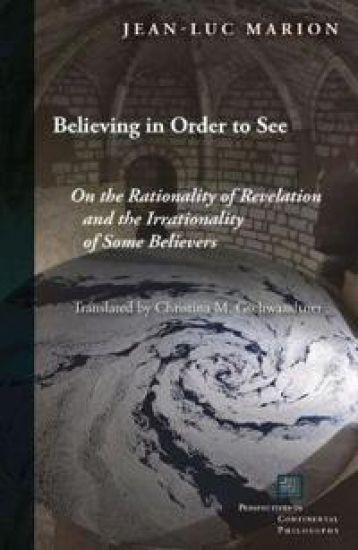
Faith and reason, especially in Roman Catholic thought, are less contradictory today than ever. But does the supposed opposition even make sense to begin with? One can lose faith, but surely not because one gains in reason. Some, in fact, lose faith when reason is not able to make sense of the experiences of our lives. We very quickly realize that reason does not understand everything. Immense areas remain incomprehensible and irrational, which we abandon to belief and opinion. Soon we definitively renounce thinking what that has been excluded from the realm of the thinkable. Ideological nightmares arise from this slumber of reason. Thus, the separation between faith and reason, too quickly taken as self-evident and even natural, is born from a lack of rationality, an easy capitulatin of reason before what is supposedly unthinkable. Rather than lose faith through excessive rationality, we often lose rationality because faith is too quickly excluded from the realm that it claims to open, that of revelation. We lose reason by losing faith. Examining such topics as the role of the intellectual in the church, the rationality of faith, the infinite worth and incomprehensibility of the human, the phenomenality of the sacraments, and the phenomenological nature of miracles and of revelation more broadly, this book spans the range of Marion's thought on Christianity. Throughout he stresses that faith has its own rationality, structured according to the logic of the gift that calls forth a response of love and devotion through kenotic abandon.
Givenness and Revelation represents both the unity and the deep continuity of Jean-Luc Marions thinking over many decades. This investigation into the origins and evolution of the concept of revelation arises from an initial reappraisal of the tension between natural theology and the revealed knowledge of God or sacra doctrina. Marion draws on the re-definition of the notions of possibility and impossibility, the critique of the reification of the subject, and the unpredictability of the event in its relationship to the gift in order to assess the respective capacities of dogmatic theology, modern metaphysics, contemporary phenomenology, and the biblical texts, especially the New Testament, to conceive the paradoxical phenomenality of a revelation. This work thus brings us to the very heart and soul of Marions theology, concluding with a phenomenological approach to the Trinity that uncovers the logic of gift performed in the scriptural manifestation of Jesus Christ as Son of the Father. Givenness and Revelation enhances not only our understanding of religious experience, but enlarges the horizon of possibility of phenomenology itself. With a Foreword by Ramona Fotiade, Senior Lecturer in French, and David Jasper, Professor of Literature and Theology, both at the University of Glasgow.
In Negative Certainties, renowned philosopher Jean-Luc Marion challenges some of the most fundamental assumptions we have developed about knowledge: that it is categorical, predicative, and positive. Following Descartes, Kant, and Heidegger, he looks toward our finitude and the limits of our reason. He asks an astonishingly simple-but profoundly provocative-question in order to open up an entirely new way of thinking about knowledge: Isn't our uncertainty, our finitude and rational limitations, one of the few things we can be certain about? Marion shows how the assumption of knowledge as positive demands a reductive epistemology that disregards immeasurable or disorderly phenomena. He shows that we have experiences every day that have no identifiable causes or predictable reasons, and that these constitute a very real knowledge-a knowledge of the limits of what can be known. Establishing this "negative certainty," Marion applies it to four aporias, or issues of certain uncertainty: the definition of man; the nature of God; the unconditionality of the gift; and the unpredictability of events. Translated for the first time into English, Negative Certainties is an invigorating work of epistemological inquiry that will take a central place in Marion's oeuvre.
Gott ohne Sein meint nicht, dass Gott nicht ist oder dass Gott nicht wirklich Gott ist, sondern weist hin auf seine absolute Freiheit hinsichtlich jeder begrifflichen Bestimmung, einschlie lich der des Seins. Welcher Name oder welcher Begriff aber bleiben dann noch brig, wenn Gott au erhalb der Frage nach dem Sein gedacht werden soll? Zweifellos nur einer, die Liebe, als die sich Gott im Neuen Testament selbst offenbart hat - Gott, ist' die Liebe (1 Joh 4,8). Warum die Liebe? Weil ber diesen Ausdruck, den die gesamte Metaphysik im Hinblick auf das Sein stets als zweitrangig betrachtete, noch nicht ausreichend nachgedacht wurde, um das Denken Gottes aus jeder Idolatrie zu befreien. Die gewaltige, weil so noch nie in Angriff genommene Aufgabe besteht also darin, sich mit der Liebe begrifflich so auseinanderzusetzen (und umgekehrt jeden Begriff selbst von der Liebe her so zu bearbeiten), dass sich deren spekulative Kraft vollst ndig entfalten kann. Dieses zentrale Werk Marions, das sich auf der Grenze von Philosophie und Theologie bewegt und so disparate Denker wie Dionysios Areopagita, Thomas von Aquin, von Balthasar, Nietzsche, Heidegger, Levinas und Derrida miteinander ins Gespr ch bringt, bereitet einen neuen Denkhorizont f r eine zeitgen ssische christliche Theologie vor, den man zugleich als pr - und postmodern bezeichnen k nnte. Pr modern deshalb, weil die Selbstoffenbarung Gottes in der Liebe die unhintergehbare Voraussetzung jeder wahren Theologie bleiben muss; postmodern insofern, als diese Selbstoffenbarung Gottes nur au erhalb des Horizontes des Seins zu denken m glich ist. Gott ohne Sein ist der faszinierende Entwurf einer offenbarungszentrierten postmetaphysischen Theologie, in der es vor allem um eines geht: das rein Gegebene zu denken geben.
The question of the given is central to philosophy; phenomenology uses the method of reduction to find the given. This lecture asks whether there is anything that resists reduction, whether there is something irreducible. The author concludes that the phenomenology of givenness addresses the gap between what gives itself and what shows itself, so that the self of the phenomenon emerges only by the exercise of a properly phenomenological hermeneutics.
Jean-Luc Marion: The Essential Writings is the first anthology of this major contemporary philosopher's writings. It spans his entire career as a historian of philosophy, as a theologian, and as a theoretician of "saturated phenomena." The editor's long general Introduction situates Marion in the history of modern philosophy, especially phenomenology, and shorter introductions preface each section of the anthology. The entire volume will enable professors to teach Marion by assigning a single book, and the editor's introductions will make it possible for students to learn enough about phenomenology to read Marion without having to take preliminary courses in Husserl and Heidegger.
In the Self's Place is an original phenomenological reading of Augustine that considers his engagement with notions of identity in Confessions. Using the Augustinian experience of confessio, Jean-Luc Marion develops a model of selfhood that examines this experience in light of the whole of the Augustinian corpus. Towards this end, Marion engages with noteworthy modern and postmodern analyses of Augustine's most "experiential" work, including the critical commentaries of Jacques Derrida, Martin Heidegger, and Ludwig Wittgenstein. Marion ultimately concludes that Augustine has preceded postmodernity in exploring an excess of the self over and beyond itself, and in using this alterity of the self to itself, as a driving force for creative relations with God, the world, and others. This reading establishes striking connections between accounts of selfhood across the fields of contemporary philosophy, literary studies, and Augustine's early Christianity.
Jean-Luc Marion is one of the world's foremost philosophers of religion as well as one of the leading Catholic thinkers of modern times. In "God Without Being", Marion challenges a fundamental premise of traditional philosophy, theology, and metaphysics: that God, before all else, must be. Taking a characteristically postmodern stance and engaging in passionate dialogue with Heidegger, he locates a "God without Being" in the realm of agape, or Christian charity and love. If God is love, Marion contends, then God loves before he actually is. First translated into English in 1991, "God Without Being" continues to be a key book for discussions of the nature of God. This second edition contains a new preface by Marion as well as his 2003 essay on Thomas Aquinas. Offering a controversial, contemporary perspective, "God Without Being" will remain essential reading for scholars and students of philosophy and religion.
Figures de Phenomenologie: Husserl, Heidegger, Levinas, Henry, Derrida
Jean-Luc Marion
Librarie Philosophique J. Vrin
2012
nidottu
English summary: This volume contains essays on some of the foremost thinkers on phenomenology, the study of structures of consciousness as experienced from the first-person point of view. French description: Dans le triptyque, ouvert par Reduction et donation. Recherches sur Husserl, Heidegger et la phenomenologie, assure dans Etant donne. Essai d'une phenomenologie de la donation et complete avec De Surcroit. Etudes sur les phenomenes satures, nous avons procede assez globalement pour qu'on nous permette ici de rassembler apres-coup certains des travaux qui l'ont prepare et qui ont pris une importance renforcee lorsqu'il se fut agi de prolonger la phenomenalite de la donation par la description du phenomene erotique (Le phenomene erotique) ou de l'appliquer hermeneutiquement a une oeuvre theologique (Au lieu de soi. L'approche de saint Augustin). Ainsi reconnaitra-t-on ici des recherches historiques sur le depassement de l'horizon de l'objectite du phenomene impose par la notion, necessaire mais d'abord incomprise, de donation, ou Husserl et Heidegger ont repris et enfin aborde de front ce qui, pour tous les neo-kantiens, restait une pierre d'achoppement. Puis on trouvera deux moments d'une discussion avec Emmanuel Levinas, commencee des L'idole et la distance et les Prolegomenes a la charite mais restee en suspens, sur la legitimite de recourir a l'amour comme a un concept. Deux autres debats furent aussi essentiels, tant Henry et Derrida ont conduit plus avant dans la comprehension des questions de l'invisibilite phenomenale et de l'impossibilite comme une ouverture. Enfin les trois dernieres etudes, en discussion serree avec tous, fixent l'acces au soi par autrui, l'emergence du tiers comme second autrui accomplissant l'evasion hors de soi, et a la fin l'irreductible par excellence, celui que toute reduction atteste negativement.
This book represents a continuation of Jean-Luc Marion’s work on givennessas a foundational concept. A former student of Jacques Derrida, Marion is known for his work in seventeenth-century French philosophy, for his theory of ""God without being,"" and for his reformulation of phenomenology. Marion’s groundbreaking work on givenness is articulated through attentive readings in a striking array of philosophical texts. The four pieces collected here, based on the fall 2008 Richard Lectures at the University of Virginia, expand upon and go beyond the lines of Marion’s previous work and exemplify the intersection of his own constructive brilliance with his talent and rigor as a historian ofphilosophy. Reengaging philosophers long central to Marion’s own work (Husserl, Heidegger, Levinas) and highlighting the significance of lesser-known but decisive influences (Natorp, Rickert, Meinong), these lectures will be valuable to readers interested in the ongoing conversation seeking to bridge the divide between Continental and analytic philosophies, particularly through the exploration of common points of origin. These pieces tackle some of themost pressing debates in contemporary European philosophy and offer students of Marion material to ponder as they seek to further understand his influences. Taken together, these essays form an important volume by a major figure in contemporary philosophy.
Comment peut-on entrer en philosophie ? Il vaut mieux poser cette question a quelqu'un qui semble bien y etre parvenu. Jean-Luc Marion nous explique son entree en philosophie, il s'en explique aussi avec lui-meme. Et ainsi nous fait reflechir sur la notre. A la parole vivante de ce livre parle, puis ecrit, nous commencons a comprendre ce qu'entrer en philosophie peut vouloir dire pour un philosophe majeur, pour tout philosophe, pour nous lecteurs. Avec ce livre de Jean-Luc Marion concu avec Francois Soulages, nous entrons dans l'histoire de la philosophie, dans la question de la metaphysique, dans la phenomenologie, pour avancer vers la theologie et vers l'art, pour voir l'apparition et la donation, l'idole et l'icone, la distance, l'ego et l'amant: c'est-a-dire notre monde, mais devenu plus intelligible, parce que nous le voyons dans son concept et dans sa forme. Nous entrons en plus que nous n'entrons dans, et cela est essentiel.
In The Visible and the Revealed, Jean-Luc Marion brings together his most significant papers dealing with the relationship between philosophy and theology. Covering the ground from some of his earliest writings on this topic to very recent reflections, they are particularly useful for understanding the progression of Marion's thought on such topics as the saturated phenomenon and the possibility of something like "Christian Philosophy." The book contains his seminal pieces on the saturated phenomenon and on the gift, although the essays also explore more recent developments of his thought on these topics. Several chapters explicitly explore the boundary line between philosophy and theology or their mutual enrichment and influence. In one of the final pieces, "The Banality of Saturation," Marion considers some of the most recent objections brought against his notion of the saturated phenomenon and responds to them in detail, suggesting that saturated phenomena are neither as rare nor as inflexible as often assumed. The work contains two chapters not previously available in English and brings together several other pieces previously translated but now difficult to find. For readers interested in the relation between the two disciplines, this is indispensable reading.
While humanists have pondered the subject of love to the point of obsessiveness, philosophers have steadfastly ignored it. The word philosophy means "love of wisdom," but the absence of love from philosophical discourse is curiously glaring. In "The Erotic Phenomenon", Jean-Luc Marion attends to this dearth with an inquiry into the concept of love itself.Marion begins with a critique of Descartes' equation of the ego's ability to doubt with the certainty that one exists. We encounter love, he says, when we first step forward as a lover: I love therefore I am, and my love is the reason I care whether I exist or not. This philosophical base allows Marion to probe several manifestations of love and its variations, including carnal excitement, self-hate, lying and perversion, fidelity, the generation of children, and the love of God. Throughout, Marion stresses that all erotic phenomena stem not from the ego as popularly understood but instead from love.
In this most recent of his seminal studies on Descartes, Jean-Luc Marion brings together essays on the topics of the ego and of God, most of them previously unavailable in English. More than any other of Marion's works, the book illustrates the profound connection between his phenomenological concerns and his writings on Descartes. Liberating God and the self from the constrictions of metaphysics are fundamental tenets of Marion's theological and phenomenological work. This book highlights the same topics in the philosophy of Descartes. In Part I (On the Ego), Marion explores the alterity of the Cartesian ego, arguing that it is not as solitary as has often been assumed, and shows how Descartes' writings themselves are framed by dialogue. He explicates the status of the "rule of truth" in the Meditations, on the one hand highlighting how Descartes' argument is not circular, on the other hand showing how Pascal responds to and alters Descartes. He also elucidates the ambivalent status of the concept of substance in Descartes by returning to its roots in the philosophy of Suarez. In Part II (On God), Marion returns to the important Cartesian thesis of the creation of the eternal truths, setting it in the context of the claims of earlier thinkers and showing its demise in philosophies following Descartes. The study closes with a careful delineation of the concept of causa sui and a detailed survey of the idea of God in seventeenth-century thought.
While humanists have pondered the subject of love to the point of obsessiveness, philosophers have steadfastly ignored it. The word philosophy means "love of wisdom," but the absence of love from philosophical discourse is curiously glaring. In "The Erotic Phenomenon", Jean-Luc Marion attends to this dearth with an inquiry into the concept of love itself.Marion begins with a critique of Descartes' equation of the ego's ability to doubt with the certainty that one exists. We encounter love, he says, when we first step forward as a lover: I love therefore I am, and my love is the reason I care whether I exist or not. This philosophical base allows Marion to probe several manifestations of love and its variations, including carnal excitement, self-hate, lying and perversion, fidelity, the generation of children, and the love of God. Throughout, Marion stresses that all erotic phenomena stem not from the ego as popularly understood but instead from love.