Kirjojen hintavertailu. Mukana 12 595 353 kirjaa ja 12 kauppaa.

Kirjailija

Jean M. Twenge

Kirjat ja teokset yhdessä paikassa: 9 kirjaa, julkaisuja vuosilta 2010-2025, suosituimpien joukossa 10 Rules for Raising Kids in a High-Tech World: How Parents Can Stop Smartphones, Social Media, and Gaming from Taking Over Their Children's Lives. Vertaile teosten hintoja ja tarkista saatavuus suomalaisista kirjakaupoista.

9 kirjaa

Kirjojen julkaisuhaarukka 2010-2025.

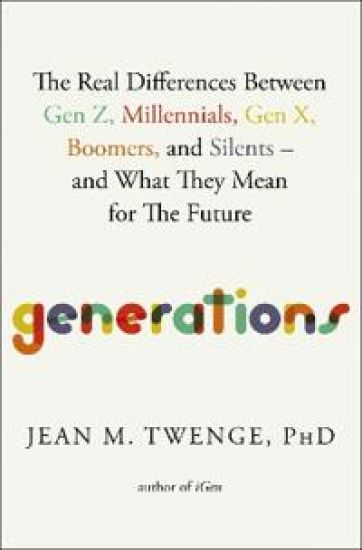
Generations

Generations

Jean M. Twenge

Atria Books
2025
pokkari
A groundbreaking, “lavishly informative” (The New York Times) portrait of the six generations that currently live in the United States and how they connect, conflict, and compete with one another—from the acclaimed author of Generation Me and iGen.Upending the conventional theory that generational differences are caused by major events, Dr. Jean Twenge analyzes data on 39 million people from robust national surveys—some going back nearly a century—to show that changes in technology are the underlying driver of each generation’s unique makeup. In this revelatory work, Twenge outlines key shifts in attitudes and lifestyle choices that define each generation regarding gender, income, politics, race, sexuality, marriage, mental health, and much more. Surprising, engaging, and informative, Generations “gets you thinking about how appreciating generational differences can, ironically, bring us together” (Angela Duckworth, New York Times bestselling author). It will forever change the way you view your parents, peers, coworkers, and children, no matter which generation you call your own.
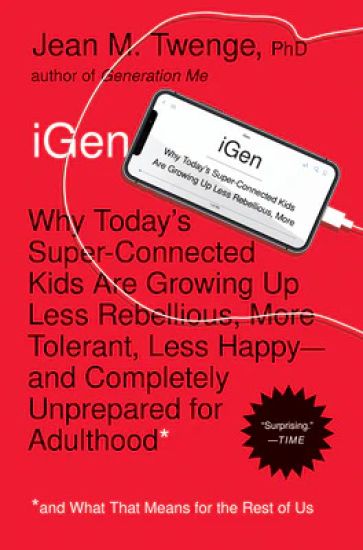
iGen

iGen

Jean M. Twenge

Atria Books
2018
pokkari
“We’ve all been desperate to learn what heavy use of social media does to adolescents. Now, thanks to Twenge’s careful analysis, we know: It is making them lonely, anxious, and fragile—especially our girls. If you are a parent, teacher, or employer, you must read this fascinating book.”—Jonathan Haidt, author of The Anxious Generation Born after 1995, they grew up with cell phones, had an Instagram page before high school, and cannot remember a time before the Internet. They are iGen. Now, here is crucial reading to understand how these children, teens, and young adults are vastly different from their millennial predecessors, and from any other generation.With generational divides wider than ever, parents, educators, and employers have an urgent need to understand today’s rising generation of teens and young adults. Born in the mid-1990s up to the mid-2000s, iGen is the first generation to spend their entire adolescence in the age of the smartphone. With social media and texting replacing other activities, iGen spends less time with their friends in person—perhaps contributing to their unprecedented levels of anxiety, depression, and loneliness. But technology is not the only thing that makes iGen distinct from every generation before them; they are also different in how they spend their time, how they behave, and in their attitudes toward religion, sexuality, and politics. They socialize in completely new ways, reject once sacred social taboos, and want different things from their lives and careers. More than previous generations, they are obsessed with safety, focused on tolerance, and have no patience for inequality. As this new group of young people grows into adulthood, we all need to understand them: friends and family need to look out for them; businesses must figure out how to recruit them and sell to them; colleges and universities must know how to educate and guide them. And members of iGen also need to understand themselves as they communicate with their elders and explain their views to their older peers. Because where iGen goes, so goes our nation—and the world. *As seen in Time, USA TODAY, The Atlantic, The Wall Street Journal, and on CBS This Morning, BBC, PBS, CNN, and NPR*
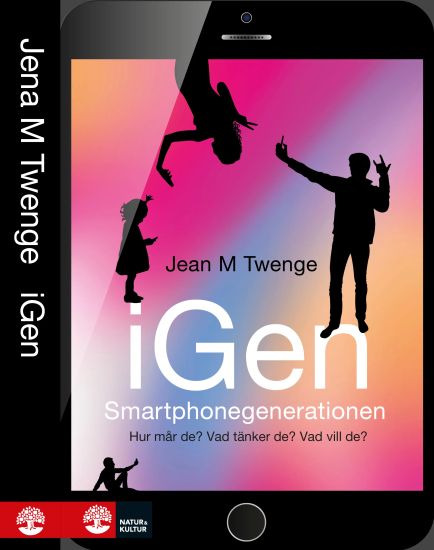
iGen - Smartphonegenerationen : Hur mår de? Vad tänker de? Vad vill de?

iGen - Smartphonegenerationen : Hur mår de? Vad tänker de? Vad vill de?

Jean M. Twenge; Sven Bremberg; Ulrik Simonsson

Natur Kultur Akademisk
2018
nidottu
Smartphone-generationen, av författaren döpt till iGen, är den grupp ungdomar och barn som är födda 1995–2012. Som generation skiljer den sig från tidigare generationer. De är mindre benägna att ha sex, dricka alkohol och ta körkort. De läser betydligt färre böcker och tidningar, jobbar mindre och lägger mindre tid på att träffa andra människor. Men det kanske viktigaste av allt – de har en väsentligt sämre psykisk hälsa än tidigare generationer.Orsaken till den omvälvande beteendeförändringen i den här generationen är det faktum att så gott som alla har växt upp med och lever med en smartphone. Författarens hypotes är att det är detta som påverkar de ungas mentala hälsa – och sociala medier pekas ut som den stora boven.
Generation Me: Why Today's Young Americans Are More Confident, Assertive, Entitled--And More Miserable Than Ever Before
In this provocative and newly revised book, headline-making psychologist Dr. Jean Twenge explores why the young people she calls "Generation Me" are tolerant, confident, open-minded, and ambitious but also disengaged, narcissistic, distrustful, and anxious.Born in the '80s, and '90s and called "The Entitlement Generation" or Millennials, they are reshaping schools, colleges, and businesses all over the country. The children of the Baby Boomers are not only feeling the effects of the recession and the changing job market--they are affecting change the world over. Now, in this new edition of Generation Me, Dr. Twenge incorporates the latest research, data, and statistics, as well as new stories and cultural references, to show how "Gen Me-ers" have shifted the American character, redefining what it means to be an individual in today's society. Dr. Twenge uses data from 11 million respondents to reveal shocking truths about this generation, including dramatic differences in sexual behavior and religious practice, and controversial predictions about what the future holds for them and society as a whole. Her often humorous, eyebrow-raising stories about real people vividly bring to life the hopes, disappointments, and challenges of Generation Me. Engaging, controversial, prescriptive, and funny, Generation Me gives Boomers and GenX'ers new and fascinating insights into their offspring, and helps those in their teens, twenties, and thirties find their road to happiness.
The Impatient Woman's Guide to Getting Pregnant
The Impatient Woman's Guide to Getting Pregnantis a complete guide to getting pregnant-the medical, psychological, social, and sexual aspects, told in a straight-forward, funny, and compassionate manner, like talking to a good friend who's been through it all. Jean Twenge covers everything you'll be wondering about and advises what you can do at home, before getting a doctor involved. Twenge explains how to prepare mentally and physically when thinking about having a child, how to talk about it with family, friends, and your partner, how to know when you're ovulating, and when best to have sex, how to tilt the odds toward having a boy or a girl, how to handle the great sadness of a miscarriage, and what to do when you do get pregnant. Trying to conceive often involves an enormous amount of emotion, from anxiety and utter disappointment to hope and joy. With comfort, humor, and straightforward advice, The Impatient Woman's Guide to Getting Pregnantis the bedside companion to help you through it.
The Narcissism Epidemic: Living in the Age of Entitlement

The Narcissism Epidemic: Living in the Age of Entitlement

Jean M. Twenge; W. Keith Campbell

Atria Books
2010
nidottu
The author of Generation Me explores the spread of narcissism in today's culture and its catastrophic effects at every level of society. Narcissism--an inflated view of the self--is everywhere. Public figures say it's what makes them stray from their wives. Teenagers and young adults hone it on social media, and celebrity newsmakers have elevated it to an art form. And it's what's making people depressed, lonely, and buried under piles of debt. Dr. Jean Twenge joins forces with W. Keith Campbell, PhD, a nationally recognized expert on narcissism, to explore this new plague in The Narcissism Epidemic. Even the world economy has been damaged by risky, unrealistic overconfidence. Drawing on their own extensive research as well as decades of other experts' studies, Twenge and Campbell show us how to identify narcissism, minimize the forces that sustain and transmit it, and treat it or manage it where we find it. Filled with arresting, alarming, and even amusing stories of vanity gone off the tracks, The Narcissism Epidemic is at once a riveting window into the consequences of narcissism, a prescription to combat the widespread problems it causes, and a probing analysis of the culture at large.