Kirjojen hintavertailu. Mukana 12 491 144 kirjaa ja 12 kauppaa.
Kirjailija
Jean-Pierre Antoine
Kirjat ja teokset yhdessä paikassa: 5 kirjaa, julkaisuja vuosilta 2008-2016, suosituimpien joukossa Fluctuations de la température et des vents au lac Tanganyika. Vertaile teosten hintoja ja tarkista saatavuus suomalaisista kirjakaupoista.
This second edition is fully updated, covering in particular new types of coherent states (the so-called Gazeau-Klauder coherent states, nonlinear coherent states, squeezed states, as used now routinely in quantum optics) and various generalizations of wavelets (wavelets on manifolds, curvelets, shearlets, etc.). In addition, it contains a new chapter on coherent state quantization and the related probabilistic aspects. As a survey of the theory of coherent states, wavelets, and some of their generalizations, it emphasizes mathematical principles, subsuming the theories of both wavelets and coherent states into a single analytic structure. The approach allows the user to take a classical-like view of quantum states in physics.Starting from the standard theory of coherent states over Lie groups, the authors generalize the formalism by associating coherent states to group representations that are square integrable over a homogeneous space; a further step allows one to dispense with the group context altogether. In this context, wavelets can be generated from coherent states of the affine group of the real line, and higher-dimensional wavelets arise from coherent states of other groups. The unified background makes transparent an entire range of properties of wavelets and coherent states. Many concrete examples, such as coherent states from semisimple Lie groups, Gazeau-Klauder coherent states, coherent states for the relativity groups, and several kinds of wavelets, are discussed in detail. The book concludes with a palette of potential applications, from the quantum physically oriented, like the quantum-classical transition or the construction of adequate states in quantum information, to the most innovative techniques to be used in data processing.Intended as an introduction to current research for graduate students and others entering the field, the mathematical discussion is self-contained. With its extensive references to the researchliterature, the first edition of the book is already a proven compendium for physicists and mathematicians active in the field, and with full coverage of the latest theory and results the revised second edition is even more valuable.
This second edition is fully updated, covering in particular new types of coherent states (the so-called Gazeau-Klauder coherent states, nonlinear coherent states, squeezed states, as used now routinely in quantum optics) and various generalizations of wavelets (wavelets on manifolds, curvelets, shearlets, etc.). In addition, it contains a new chapter on coherent state quantization and the related probabilistic aspects. As a survey of the theory of coherent states, wavelets, and some of their generalizations, it emphasizes mathematical principles, subsuming the theories of both wavelets and coherent states into a single analytic structure. The approach allows the user to take a classical-like view of quantum states in physics.Starting from the standard theory of coherent states over Lie groups, the authors generalize the formalism by associating coherent states to group representations that are square integrable over a homogeneous space; a further step allows one to dispense with the group context altogether. In this context, wavelets can be generated from coherent states of the affine group of the real line, and higher-dimensional wavelets arise from coherent states of other groups. The unified background makes transparent an entire range of properties of wavelets and coherent states. Many concrete examples, such as coherent states from semisimple Lie groups, Gazeau-Klauder coherent states, coherent states for the relativity groups, and several kinds of wavelets, are discussed in detail. The book concludes with a palette of potential applications, from the quantum physically oriented, like the quantum-classical transition or the construction of adequate states in quantum information, to the most innovative techniques to be used in data processing.Intended as an introduction to current research for graduate students and others entering the field, the mathematical discussion is self-contained. With its extensive references to the researchliterature, the first edition of the book is already a proven compendium for physicists and mathematicians active in the field, and with full coverage of the latest theory and results the revised second edition is even more valuable.
The idea of the workshop on Functional Integration, Theory and Applications, held in Louvain-Ia-Neuve from November 6 to 9 1979, was to put in close and informal contact, during a few days, active workers in the field. There is no doubt now that functional integration is a tool that is being applied in all branches of modern physics. Since the earlier works of Dirac and Feynman enormous progress has been made, but unfortunately we lack still a unifying and rigo rous mathematical framework to account for all the situations in which one is interested. We are then in presence of a rapid ly changing field in which new achievements, proposals, and points of view are the normal pattern. Considering this state of affairs we have decided to order the articles starting from the more fundamental and ambitious from the point of view of mathematical rigour, followed by ar ticles in which the main interest is the application to con crete physical situations. It is obvious that this ordering should not be taken too seriously since in many cases there will be an interplay of both objects.
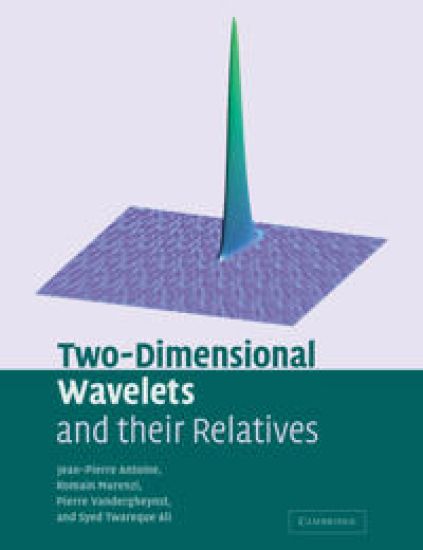
Two-dimensional wavelets offer a number of advantages over discrete wavelet transforms when processing rapidly varying functions and signals. In particular, they offer benefits for real-time applications such as medical imaging, fluid dynamics, shape recognition, image enhancement and target tracking. This book introduces the reader to 2-D wavelets via 1-D continuous wavelet transforms, and includes a long list of useful applications. The authors then describe in detail the underlying mathematics before moving on to more advanced topics such as matrix geometry of wavelet analysis, three-dimensional wavelets and wavelets on a sphere. Throughout the book, practical applications and illustrative examples are used extensively, ensuring the book's value to engineers, physicists and mathematicians alike.