Kirjojen hintavertailu. Mukana 12 595 353 kirjaa ja 12 kauppaa.

Kirjailija

Jean-Pierre Aubin

Kirjat ja teokset yhdessä paikassa: 18 kirjaa, julkaisuja vuosilta 1996-2018, suosituimpien joukossa Tychastic Measure of Viability Risk. Vertaile teosten hintoja ja tarkista saatavuus suomalaisista kirjakaupoista.

18 kirjaa

Kirjojen julkaisuhaarukka 1996-2018.

Tychastic Measure of Viability Risk

Tychastic Measure of Viability Risk

Jean-Pierre Aubin; Luxi Chen; Olivier Dordan

Springer International Publishing AG
2016
nidottu
This book presents a forecasting mechanism of the price intervals for deriving the SCR (solvency capital requirement) eradicating the risk during the exercise period on one hand and measuring the risk by computing the hedging exit time function associating with smaller investments the date until which the value of the portfolio hedges the liabilities on the other. This information, summarized under the term “tychastic viability measure of risk” is an evolutionary alternative to statistical measures, when dealing with evolutions under uncertainty. The book is written by experts in the field and the target audience primarily comprises research experts and practitioners.

Tychastic Measure of Viability Risk

Tychastic Measure of Viability Risk

Jean-Pierre Aubin; Luxi Chen; Olivier Dordan

Springer International Publishing AG
2014
sidottu
This book presents a forecasting mechanism of the price intervals for deriving the SCR (solvency capital requirement) eradicating the risk during the exercise period on one hand and measuring the risk by computing the hedging exit time function associating with smaller investments the date until which the value of the portfolio hedges the liabilities on the other. This information, summarized under the term “tychastic viability measure of risk” is an evolutionary alternative to statistical measures, when dealing with evolutions under uncertainty. The book is written by experts in the field and the target audience primarily comprises research experts and practitioners.
Traffic Networks as Information Systems

Traffic Networks as Information Systems

Jean-Pierre Aubin; Anya Désilles

Springer-Verlag Berlin and Heidelberg GmbH Co. K
2018
nidottu
This authored monograph covers a viability to approach to traffic management by advising to vehicles circulated on the network the velocity they should follow for satisfying global traffic conditions;. It presents an investigation of three structural innovations: The objective is to broadcast at each instant and at each position the advised celerity to vehicles, which could be read by auxiliary speedometers or used by cruise control devices. Namely, 1. Construct regulation feedback providing at each time and position advised velocities (celerities) for minimizing congestion or other requirements.2. Taking into account traffic constraints of different type, the first one being to remain on the roads, to stop at junctions, etc. 3. Use information provided by the probe vehicles equipped with GPS to the traffic regulator;4. Use other global traffic measures of vehicles provided by different types of sensors; These results are based on convex analysis, intertemporal optimization and viability theory as mathematical tools as well as viability algorithms on the computing side, instead of conventional techniques such as partial differential equations and their resolution by finite difference or finite elements algorithms. The target audience primarily covers researchers and mathematically oriented engineers but the book may also be beneficial for graduate students.
Traffic Networks as Information Systems

Traffic Networks as Information Systems

Jean-Pierre Aubin; Anya Désilles

Springer-Verlag Berlin and Heidelberg GmbH Co. K
2016
sidottu
This authored monograph covers a viability to approach to traffic management by advising to vehicles circulated on the network the velocity they should follow for satisfying global traffic conditions;. It presents an investigation of three structural innovations: The objective is to broadcast at each instant and at each position the advised celerity to vehicles, which could be read by auxiliary speedometers or used by cruise control devices. Namely, 1. Construct regulation feedback providing at each time and position advised velocities (celerities) for minimizing congestion or other requirements.2. Taking into account traffic constraints of different type, the first one being to remain on the roads, to stop at junctions, etc. 3. Use information provided by the probe vehicles equipped with GPS to the traffic regulator;4. Use other global traffic measures of vehicles provided by different types of sensors; These results are based on convex analysis, intertemporal optimization and viability theory as mathematical tools as well as viability algorithms on the computing side, instead of conventional techniques such as partial differential equations and their resolution by finite difference or finite elements algorithms. The target audience primarily covers researchers and mathematically oriented engineers but the book may also be beneficial for graduate students.
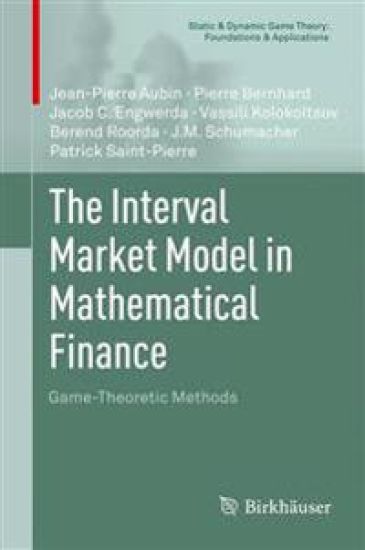
The Interval Market Model in Mathematical Finance

The Interval Market Model in Mathematical Finance

Pierre Bernhard; Jacob C. Engwerda; Berend Roorda; J.M. Schumacher; Vassili Kolokoltsov; Patrick Saint-Pierre; Jean-Pierre Aubin

Birkhauser Boston Inc
2015
nidottu
Toward the late 1990s, several research groups independently began developing new, related theories in mathematical finance. These theories did away with the standard stochastic geometric diffusion “Samuelson” market model (also known as the Black-Scholes model because it is used in that most famous theory), instead opting for models that allowed minimax approaches to complement or replace stochastic methods. Among the most fruitful models were those utilizing game-theoretic tools and the so-called interval market model. Over time, these models have slowly but steadily gained influence in the financial community, providing a useful alternative to classical methods.A self-contained monograph, The Interval Market Model in Mathematical Finance: Game-Theoretic Methods assembles some of the most important results, old and new, in this area of research. Written by seven of the most prominent pioneers of the interval market model and game-theoretic finance, the work provides a detailed account of several closely related modeling techniques for an array of problems in mathematical economics. The book is divided into five parts, which successively address topics including:· probability-free Black-Scholes theory;· fair-price interval of an option;· representation formulas and fast algorithms for option pricing;· rainbow options;· tychastic approach of mathematical finance based upon viability theory.This book provides a welcome addition to the literature, complementing myriad titles on the market that take a classical approach to mathematical finance. It is a worthwhile resource for researchers in applied mathematics and quantitative finance, and has also been written in a manner accessible to financially-inclined readers with a limited technical background.
Dynamic Economic Theory

Dynamic Economic Theory

Jean-Pierre Aubin

Springer-Verlag Berlin and Heidelberg GmbH Co. K
2013
nidottu
This book is intended to provide economists with mathematical tools necessary to handle the concepts of evolution under uncertainty and adaption arising in economics, pursuing the Arrow-Debreu-Hahn legacy. It applies the techniques of viability theory to the study of economic systems evolving under contingent uncertainty, faced with scarcity constraints, and obeying various implementation of the inertia principle. The book illustrates how new tools can be used to move from static analysis, built on concepts of optima, equilibria and attractors to a contingent dynamic framework.
Time and Money

Time and Money

Jean-Pierre Aubin

Springer International Publishing AG
2013
nidottu
This authored monograph presents an unconventional approach to an important topic in economic theory. The author is an expert in the field of viability theory and applies this theory to analyze how an economy should be dynamically endowed so that it is economically viable. Economic viability requires an assumption on the joint evolution of transactions, fluctuations of prices and units of numeraire goods: the sum of the “transactions values” and the “impact of price fluctuations” should be negative or equal to zero. The book presents a computation of the minimum endowment which restores economic viability and derives the dynamic laws that regulate both transactions and price fluctuations.The target audience primarily comprises open-minded and mathematically interested economists but the book may also be beneficial for graduate students.
The Interval Market Model in Mathematical Finance

The Interval Market Model in Mathematical Finance

Pierre Bernhard; Jacob C. Engwerda; Berend Roorda; J.M. Schumacher; Vassili Kolokoltsov; Patrick Saint-Pierre; Jean-Pierre Aubin

Birkhauser Boston Inc
2012
sidottu
Toward the late 1990s, several research groups independently began developing new, related theories in mathematical finance. These theories did away with the standard stochastic geometric diffusion “Samuelson” market model (also known as the Black-Scholes model because it is used in that most famous theory), instead opting for models that allowed minimax approaches to complement or replace stochastic methods. Among the most fruitful models were those utilizing game-theoretic tools and the so-called interval market model. Over time, these models have slowly but steadily gained influence in the financial community, providing a useful alternative to classical methods.A self-contained monograph, The Interval Market Model in Mathematical Finance: Game-Theoretic Methods assembles some of the most important results, old and new, in this area of research. Written by seven of the most prominent pioneers of the interval market model and game-theoretic finance, the work provides a detailed account of several closely related modeling techniques for an array of problems in mathematical economics. The book is divided into five parts, which successively address topics including:· probability-free Black-Scholes theory;· fair-price interval of an option;· representation formulas and fast algorithms for option pricing;· rainbow options;· tychastic approach of mathematical finance based upon viability theory.This book provides a welcome addition to the literature, complementing myriad titles on the market that take a classical approach to mathematical finance. It is a worthwhile resource for researchers in applied mathematics and quantitative finance, and has also been written in a manner accessible to financially-inclined readers with a limited technical background.
Mutational and Morphological Analysis

Mutational and Morphological Analysis

Jean-Pierre Aubin

Springer-Verlag New York Inc.
2012
nidottu
The analysis, processing, evolution, optimization and/or regulation, and control of shapes and images appear naturally in engineering (shape optimization, image processing, visual control), numerical analysis (interval analysis), physics (front propagation), biological morphogenesis, population dynamics (migrations), and dynamic economic theory. These problems are currently studied with tools forged out of differential geometry and functional analysis, thus requiring shapes and images to be smooth. However, shapes and images are basically sets, most often not smooth. J.-P. Aubin thus constructs another vision, where shapes and images are just any compact set. Hence their evolution -- which requires a kind of differential calculus -- must be studied in the metric space of compact subsets. Despite the loss of linearity, one can transfer most of the basic results of differential calculus and differential equations in vector spaces to mutational calculus and mutational equations in any mutational space, including naturally the space of nonempty compact subsets. "Mutational and Morphological Analysis" offers a structure that embraces and integrates the various approaches, including shape optimization and mathematical morphology. Scientists and graduate students will find here other powerful mathematical tools for studying problems dealing with shapes and images arising in so many fields.
Neural Networks and Qualitative Physics

Neural Networks and Qualitative Physics

Jean-Pierre Aubin

Cambridge University Press
2011
pokkari
This book is devoted to some mathematical methods that arise in two domains of artificial intelligence: neural networks and qualitative physics. Professor Aubin makes use of control and viability theory in neural networks and cognitive systems, regarded as dynamical systems controlled by synaptic matrices, and set-valued analysis that plays a natural and crucial role in qualitative analysis and simulation. This allows many examples of neural networks to be presented in a unified way. In addition, several results on the control of linear and nonlinear systems are used to obtain a 'learning algorithm' of pattern classification problems, such as the back-propagation formula, as well as learning algorithms of feedback regulation laws of solutions to control systems subject to state constraints. This book will be of value to anyone with an interest in neural networks and cognitive systems.
Viability Theory

Viability Theory

Jean-Pierre Aubin; Alexandre M. Bayen; Patrick Saint-Pierre

Springer-Verlag Berlin and Heidelberg GmbH Co. K
2011
sidottu
Viability theory designs and develops mathematical and algorithmic methods for investigating the adaptation to viability constraints of evolutions governed by complex systems under uncertainty that are found in many domains involving living beings, from biological evolution to economics, from environmental sciences to financial markets, from control theory and robotics to cognitive sciences. It involves interdisciplinary investigations spanning fields that have traditionally developed in isolation. The purpose of this book is to present an initiation to applications of viability theory, explaining and motivating the main concepts and illustrating them with numerous numerical examples taken from various fields.
Viability Theory

Viability Theory

Jean-Pierre Aubin; Alexandre M. Bayen; Patrick Saint-Pierre

Springer-Verlag Berlin and Heidelberg GmbH Co. K
2011
nidottu
Viability theory designs and develops mathematical and algorithmic methods for investigating the adaptation to viability constraints of evolutions governed by complex systems under uncertainty that are found in many domains involving living beings, from biological evolution to economics, from environmental sciences to financial markets, from control theory and robotics to cognitive sciences. It involves interdisciplinary investigations spanning fields that have traditionally developed in isolation. The purpose of this book is to present an initiation to applications of viability theory, explaining and motivating the main concepts and illustrating them with numerous numerical examples taken from various fields.
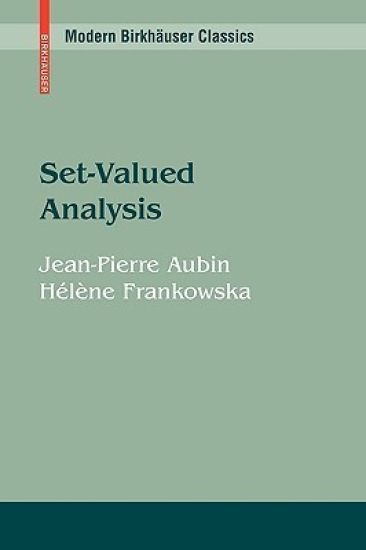
Set-Valued Analysis

Set-Valued Analysis

Jean-Pierre Aubin; Hélène Frankowska

Birkhauser Boston Inc
2008
nidottu
“An elegantly written, introductory overview of the field, with a near perfect choice of what to include and what not, enlivened in places by historical tidbits and made eminently readable throughout by crisp language. It has succeeded in doing the near-impossible—it has made a subject which is generally inhospitable to nonspecialists because of its ‘family jargon’ appear nonintimidating even to a beginning graduate student.” (The Journal of the Indian Institute of Science) “The book under review gives a comprehensive treatment of basically everything in mathematics that can be named multivalued/set-valued analysis. It includes…results with many historical comments giving the reader a sound perspective to look at the subject…The book is highly recommended for mathematicians and graduate students who will find here a very comprehensive treatment of set-valued analysis.” (Mathematical Reviews) “This book provides a thorough introduction to multivalued or set-valued analysis...Examples in many branches of mathematics, given in the introduction, prevail [upon] the reader the indispensability [of dealing] with sequences of sets and set-valued maps…The style is lively and vigorous, the relevant historical comments and suggestive overviews increase the interest for this work...Graduate students and mathematicians of every persuasion will welcome this unparalleled guide to set-valued analysis.” (Zentralblatt Math)
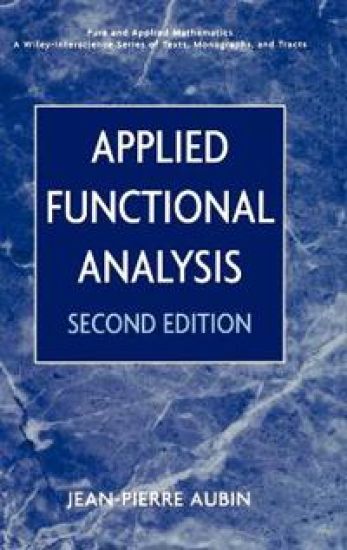
Applied Functional Analysis

Applied Functional Analysis

Jean-Pierre Aubin

John Wiley Sons Inc
2000
sidottu
A novel, practical introduction to functional analysis In the twenty years since the first edition of Applied Functional Analysis was published, there has been an explosion in the number of books on functional analysis. Yet none of these offers the unique perspective of this new edition. Jean-Pierre Aubin updates his popular reference on functional analysis with new insights and recent discoveries-adding three new chapters on set-valued analysis and convex analysis, viability kernels and capture basins, and first-order partial differential equations. He presents, for the first time at an introductory level, the extension of differential calculus in the framework of both the theory of distributions and set-valued analysis, and discusses their application for studying boundary-value problems for elliptic and parabolic partial differential equations and for systems of first-order partial differential equations. To keep the presentation concise and accessible, Jean-Pierre Aubin introduces functional analysis through the simple Hilbertian structure. He seamlessly blends pure mathematics with applied areas that illustrate the theory, incorporating a broad range of examples from numerical analysis, systems theory, calculus of variations, control and optimization theory, convex and nonsmooth analysis, and more. Finally, a summary of the essential theorems as well as exercises reinforcing key concepts are provided. Applied Functional Analysis, Second Edition is an excellent and timely resource for both pure and applied mathematicians.
Mutational and Morphological Analysis

Mutational and Morphological Analysis

Jean-Pierre Aubin

Birkhauser Boston Inc
1998
sidottu
The analysis, processing, evolution, optimization and/or regulation, and control of shapes and images appear naturally in engineering (shape optimization, image processing, visual control), numerical analysis (interval analysis), physics (front propagation), biological morphogenesis, population dynamics (migrations), and dynamic economic theory. These problems are currently studied with tools forged out of differential geometry and functional analysis, thus requiring shapes and images to be smooth. However, shapes and images are basically sets, most often not smooth. J.-P. Aubin thus constructs another vision, where shapes and images are just any compact set. Hence their evolution -- which requires a kind of differential calculus -- must be studied in the metric space of compact subsets. Despite the loss of linearity, one can transfer most of the basic results of differential calculus and differential equations in vector spaces to mutational calculus and mutational equations in any mutational space, including naturally the space of nonempty compact subsets. "Mutational and Morphological Analysis" offers a structure that embraces and integrates the various approaches, including shape optimization and mathematical morphology. Scientists and graduate students will find here other powerful mathematical tools for studying problems dealing with shapes and images arising in so many fields.
Neural Networks and Qualitative Physics

Neural Networks and Qualitative Physics

Jean-Pierre Aubin

Cambridge University Press
1996
sidottu
This book is devoted to some mathematical methods that arise in two domains of artificial intelligence: neural networks and qualitative physics. Professor Aubin makes use of control and viability theory in neural networks and cognitive systems, regarded as dynamical systems controlled by synaptic matrices, and set-valued analysis that plays a natural and crucial role in qualitative analysis and simulation. This allows many examples of neural networks to be presented in a unified way. In addition, several results on the control of linear and nonlinear systems are used to obtain a 'learning algorithm' of pattern classification problems, such as the back-propagation formula, as well as learning algorithms of feedback regulation laws of solutions to control systems subject to state constraints. This book will be of value to anyone with an interest in neural networks and cognitive systems.