Kirjojen hintavertailu. Mukana 12 595 353 kirjaa ja 12 kauppaa.

Kirjailija

Jeanne T. Heidler

Kirjat ja teokset yhdessä paikassa: 7 kirjaa, julkaisuja vuosilta 1996-2018, suosituimpien joukossa The Mexican War. Vertaile teosten hintoja ja tarkista saatavuus suomalaisista kirjakaupoista.

7 kirjaa

Kirjojen julkaisuhaarukka 1996-2018.

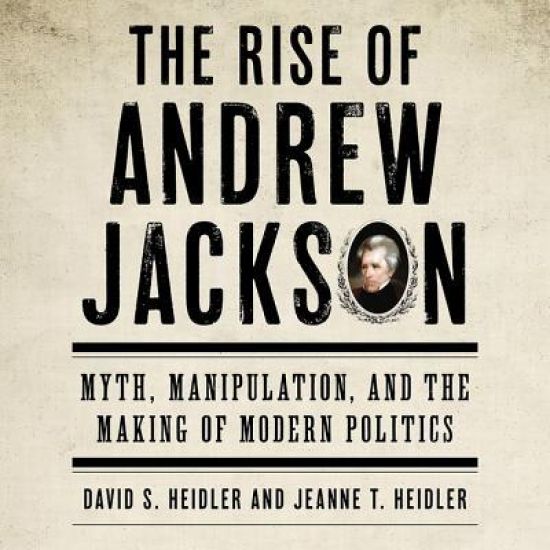
The Rise of Andrew Jackson

The Rise of Andrew Jackson

David S. Heidler; Jeanne T. Heidler

Basic Books
2018
sidottu
The Rise of Andrew Jackson recounts our seventh president's unlikely ascent to the highest office in the land. Born poor in what became the border region between North and South Carolina, Jackson's sole claim on the public's affections derived from his victory in a thirty-minute battle in early 1815 on the banks of the Mississippi River. A disputatious, often cruel man, he did not seem cut out for any public office, let alone the highest in the land. Yet he acquired acolytes-operatives, handlers, editors, politicians-who for more than a decade labored to make him the President of the United States, and who finally succeeded in 1828.The acclaimed historians David and Jeanne Heidler are the first to examine Jackson's rise by looking primarily at the men (and they were all men) who made it possible, among them future president Martin van Buren, the Karl Rove of his day; Sam Houston, later a leader of the Texas Revolution; and John Overton, Jackson's onetime roommate and romantic rival. They and other of Jackson's supporters published quaint stories of kindness, such as the rescue of the Indian baby Lyncoya. They made him the friend of debtors (he privately dismissed them as deadbeats) and the advocate for low tariffs or high tariffs (he had no opinion on the matter). They styled him the ideological heir of Thomas Jefferson, though he had openly opposed President Jefferson, and the Sage of Monticello himself had been openly dismayed by Jackson's popularity.The Heidlers have pored over the sources from the era-newspaper accounts, private correspondence, memoirs, and more-to tell a story of rude encampments on frontier campaigns and of countless torch lit gatherings where boisterous men munched barbecue, swigged whiskey, and squinted at speakers standing on tree stumps. Theirs is a tale of ink-stained editors in cluttered newspaper offices churning out partisan copy and of men pondering deals and pledges in the smoke-filled rooms of hotels and meeting halls. The Rise of Andrew Jackson is, in sum, an eye-opening account of the first instance of deliberate image-building and myth-making in American history-of nothing less than the birth of modern politics.Eventually, Jackson's supporters would be called Jacksonian Democrats and their movement would be labeled Jacksonian Democracy, giving the impression that it arose from an ethos espoused by the man himself. Yet as the Heidlers indelibly show, that was just another trick of the men trying to harness the movement, who saw in Jackson an opportunity not so much for helping the little man but for their own personal revenge against the genteel politicos of their day.
The Rise of Andrew Jackson: Myth, Manipulation, and the Making of Modern Politics
The story of Andrew Jackson's improbable ascent to the White House, centered on the handlers and propagandists who made it possible Andrew Jackson was volatile and prone to violence, and well into his forties his sole claim on the public's affections derived from his victory in a thirty-minute battle at New Orleans in early 1815. Yet those in his immediate circle believed he was a great man who should be president of the United States. Jackson's election in 1828 is usually viewed as a result of the expansion of democracy. Historians David and Jeanne Heidler argue that he actually owed his victory to his closest supporters, who wrote hagiographies of him, founded newspapers to savage his enemies, and built a political network that was always on message. In transforming a difficult man into a paragon of republican virtue, the Jacksonites exploded the old order and created a mode of electioneering that has been mimicked ever since.
Washington's Circle

Washington's Circle

David S. Heidler; Jeanne T. Heidler

Random House Inc
2016
pokkari
History enthusiasts and admirers of "Team of Rivals" will rejoice in this magisterial account of the extraordinary Americans who served the nation s first chief executive: Together, they created the presidency for a country disgusted by crowns and the people who would wear them. In 1789, as George Washington became the first president of the United States, the world was all but certain that the American experiment in liberty and representative government would founder. More than a few Americans feared that the world was right. In "Washington s Circle, " we see how Washington and his trusted advisers, close friends, and devoted family defied the doomsayers to lay the foundation for an enduring constitutional republic. This is a fresh look at an aloof man whose service in the Revolutionary War had already earned him the acclaim of fellow citizens. Washington was easy to revere, if difficult to know. David S. Heidler and Jeanne T. Heidler reveal Washington s character through his relationship with his inner circle, showing how this unlikely group created the office of the presidency. Here is a story of cooperation, confrontation, triumph, and disappointment, as the president, Congress, and the courts sorted out the limits of executive power, quarreled over funding the government, coped with domestic strife, and faced a world at war while trying to keep their country at peace. Even more, it is a story of remarkable people striving for extraordinary achievements. Many of these characters are familiar as historic icons, but in these pages they act and speak as living individuals: the often irked and frequently irksome John Adams, in the vice presidency; the mercurial Alexander Hamilton, leading the Treasury Department; the brilliant, deceptively cunning Thomas Jefferson, as secretary of state; James Madison, who was Washington s advocate and his eyes and ears in Congress; and Washington s old friend and former brother-in-arms Henry Knox, at the administration s beleaguered War Department. Their stories mingle with those of Edmund Randolph, John Jay, Gouverneur Morris, and the others who stood with a self-educated Virginia farmer to forge the presidency into an institution protective of its privileges but respectful of congressional prerogatives. Written with energy, wit, and an eye for vivid detail, "Washington s Circle" is the fascinating account of the people who met the most formidable challenges of the government s earliest hours with pluck, ability, and enviable resourcefulness. When the world said they would fail, they rolled up their sleeves. This is their story. Praise for "Washington s Circle" A fine, readable history of the first presidency . . . David and Jeanne Heidler] provide not only a lively history but a group portrait of Washington and the various figures vying to influence him. "The Wall Street Journal" "" "Washington s Circle" positively glows with narrative exuberance. This is a book that will make even the most jaded student of the American Revolution bark little laughs of pure delight while reading. "Open Letters Monthly" Traditional accounts portray Washington as a solitary actor in the drama of American nationhood, as chilly and featureless as the marble shaft that dominates his namesake capitol. In fact, he was the intensely human lead in one of history s most colorful, and contentious, ensembles. David S. Heidler and Jeanne T. Heidler bring the whole cast to unforgettable life in this character study cum group portrait cum old-fashioned page-turner. Richard Norton Smith, author of "On His Own Terms" "From the Hardcover edition.""
The Mexican War

The Mexican War

David S. Heidler; Jeanne T. Heidler

Greenwood Press
2005
sidottu
Victory over Mexico added vast western territories to America, but it also quickened the domestic slavery debate and crippled Mexico for decades, making the Mexican War one of our most ambiguous conflicts. Primary documents, biographical sketches and narrative chapters rounded out by twenty images and maps and a robust bibliography and index make this work by two of America's foremost Antebellum historians a must have to understand one of our most contentious episodes. The United States went to war with Mexico in the spring of 1846 and by the fall of 1847 American soldiers were walking in the streets of Mexico City. The following February, Mexico was forced to sign the Treaty fo Guadalupe Hidalgo that ceded what became the U.S. Southwest and Pacific Coast. Rather than an isolated episode, the war was the culmination of a series of events that began before Mexican independence and included treaty arrangements with Spain, the revolt of Mexico's northern province of Texas, and the growing discord over American reactions to Texan independence. The legacy of the war was dire for both countries. The victorious United States commenced a bitter argument over the fate of slavery in the territories acquired from Mexico that eventually culminated in southern secession and Civil War. Defeated Mexico coped for decades with a ruined economy and a broken political system while nursing a grudge against the Colossus of the North. This book examines these events from both the American and Mexican perspectives. Topics covered include succinct histories of the American and Mexican Republics from their colonial founding to their independence from European countries; The problems over Texas, including Anglo immigration, the Texas Revolution, and the controversies surrounding U.S. annexation of Texas; the crises instigated by American annexation of Texas brought on by the crossed purposes of American expansionist aims and domestic concerns over slavery; the northern campaigns of the war in California and New Mexico; Winfield Scott's amphibious landing and siege at Vera Cruz and his epic march to Mexico City and the collapse of the Mexican government; and finally the crafting of the peace treaty and the bitter legacies of the war for both the U.S. and Mexico. Biographical sketches of Valentin Gomez Farias, Jose Joaquin de Herrere, Sam Houston, Stephen Watts Kearny, President James Polk and other notable figures of the event provide firsthand glimpses into the motivations of the key players. Nine maps, eleven images, a detailed chronology, and a dozen vital annotated primary documents add considerable depth to the book. An extensive annotated biography and robust index complete this valuable new edition on one of Young America's most trying and contentious periods.
Daily Life in the Early American Republic, 1790-1820

Daily Life in the Early American Republic, 1790-1820

David S. Heidler; Jeanne T. Heidler

Greenwood Press
2004
sidottu
In the early years of the American Republic the political ideals of the Revolution took definite form, and pervaded the daily lives of Americans in multifarious ways, affirming and transforming the country and its people in the process. In this informative and eminently readable resource, award-winning authors David and Jeanne Heidler discuss the people who lived during this critical time, and uncover the essential and unexpected realities of ordinary life in the early American republic.Rapid developments in agriculture, encouraged by a strong sense of dignity in work and a bold new spirit of ingenuity sharply reduced the percentage of people who made their living in the fields; the tone of religious tolerance taken up by the founders manifested itself in a fervent yet incredibly diverse spiritual community; workingmen and educated citizens alike attended intellectual lectures together in an effort to become responsible and informed citizens; and the family dynamic underwent a profound transformation, especially as it involved children, at the hands of a new democratic idealism. In this informative and eminently readable resource, award-winning authors David and Jeanne Heidler discuss the people who lived during this critical time, and uncover the essential and unexpected realities of ordinary life in the early American republic.Included are sections on agriculture; rituals of life, love, and death; employment and the economy; leisure; religion; life beyond the mainstream; and life in the military. This volume is ideal for high school and college students, as well as anyone interested in examining the prosaic realities underpinning the lives of the people of the time. A chronology of the time period, maps, illustrations, a bibliography and an index are also included.
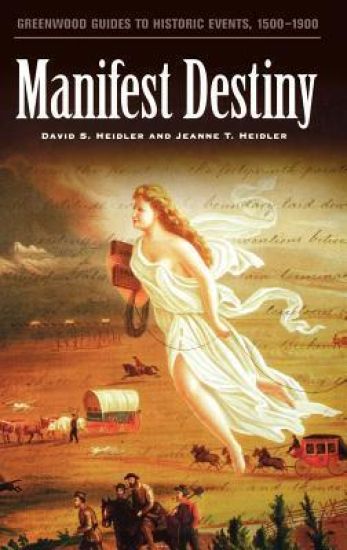
Manifest Destiny

Manifest Destiny

David S. Heidler; Jeanne T. Heidler

Greenwood Press
2003
sidottu
From Colonial times through the 19th century, European Americans advanced toward the west. This book explains the origins of territorial expansion and traces the course of Manifest Destiny to its culminating moment, the conquest of Mexico and the acquisition of the western territories. It also weighs major historical interpretations that have evolved over the years, from those praising expansionism to those condemning it as imperialistic and racist. A mixture of essays, biographical portraits, primary documents, a timeline, and an annotated bibliography gives students and researchers everything they need to begin their examination of this prominent and oft-disputed concept in American history. Manifest Destiny opens with an overview that traces the causes and consequences of American expansionism. Six subsequent chapters cover topics varying from Andrew Jackson's invasion of Spanish Florida and Indian removal to the settlement of Texas and the Oregon Question. Biographical portraits of Stephen Austin, James K. Polk, Osceola, Santa Ana, John O'Sullivan—the coiner of the phrase Manifest Destiny—and others provide personal glimpses of some of the era's major players. Primary documents such as the Oregon Treaty of 1846, the Indian Removal Act of 1830, and the Polk's declaration of war against Mexico enable students to see actual historical evidence from the time period. A chronology, a glossary, and an index make this the most well-rounded and recent reference source on the topic.