
Kirjojen hintavertailu. Mukana 12 327 922 kirjaa ja 12 kauppaa.

Kirjailija

Jeff Bridoux

Kirjat ja teokset yhdessä paikassa: 4 kirjaa, julkaisuja vuosilta 2010-2014, suosituimpien joukossa Democracy Promotion. Vertaile teosten hintoja ja tarkista saatavuus suomalaisista kirjakaupoista.

4 kirjaa

Kirjojen julkaisuhaarukka 2010-2014.

Democracy Promotion

Democracy Promotion

Jeff Bridoux; Milja Kurki

Routledge
2014
sidottu
This critical introduction to democracy promotion seeks to provide students with an understanding of some of the key dynamics and contentions revolving around this controversial policy agenda.Specifically, this textbook examines democracy promotion through seeking to answer, from the perspective of an approach informed by ‘critical theory’, a set of important questions often posed to democracy promoters, such as: Who is involved in democracy promotion today and what kinds of power relations are embedded in it? Is democracy promotion driven by the values or interests of key actors? Is democracy promotion regime-change by another name? Is democracy promotion ‘context-sensitive’ or an imposition of Western powers? Is democracy promotion about achieving liberal economic reform in target states? Is democracy promotion a tool of the powerful, a form of hegemonic control of target populations?The book suggests a set of provocative answers to these questions and also puts forward a set of challenges for democracy promoters and supporters to take on today.Democracy Promotion serves as an effective introduction to an increasingly topical policy agenda for students and general readers and, at the same time, seeks to advance an important set of new critical perspectives for practitioners and policy-makers of democracy promotion to consider.
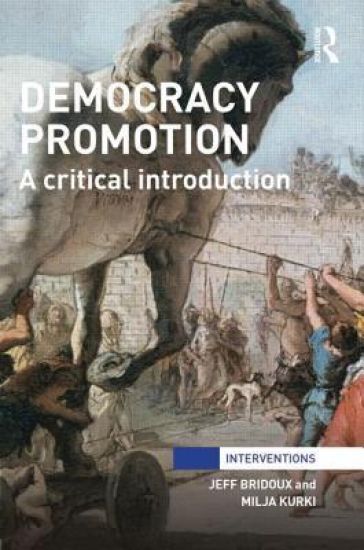
Democracy Promotion

Democracy Promotion

Jeff Bridoux; Milja Kurki

Routledge
2014
nidottu
This critical introduction to democracy promotion seeks to provide students with an understanding of some of the key dynamics and contentions revolving around this controversial policy agenda.Specifically, this textbook examines democracy promotion through seeking to answer, from the perspective of an approach informed by ‘critical theory’, a set of important questions often posed to democracy promoters, such as: Who is involved in democracy promotion today and what kinds of power relations are embedded in it? Is democracy promotion driven by the values or interests of key actors? Is democracy promotion regime-change by another name? Is democracy promotion ‘context-sensitive’ or an imposition of Western powers? Is democracy promotion about achieving liberal economic reform in target states? Is democracy promotion a tool of the powerful, a form of hegemonic control of target populations?The book suggests a set of provocative answers to these questions and also puts forward a set of challenges for democracy promoters and supporters to take on today.Democracy Promotion serves as an effective introduction to an increasingly topical policy agenda for students and general readers and, at the same time, seeks to advance an important set of new critical perspectives for practitioners and policy-makers of democracy promotion to consider.
American Foreign Policy and Postwar Reconstruction
On the eve of the invasion of Iraq, President G.W. Bush argued that if setting up democracy in Japan and Germany after WW II was successful, then it should also be successful in Iraq. This book provides a detailed comparison of the reconstruction of Japan from 1945 to 1952 with the current reconstruction of Iraq, evaluating the key factors affecting the success or failure of such projects. The book seeks to understand why American officials believed that extensive social reengineering aiming at seeding democracy and economic development is replicable, through identifying factors explaining the outcome of U.S.-led post-conflict reconstruction projects. The analysis reveals that in addition to the effective use of material resources of power, the outcome of reconstruction projects depends on a variety of other intertwined factors, and Bridoux provides a new analytical framework relying on a Gramscian concept of power to develop a greater understanding of these factors, and the ultimate success or failure of these reconstruction projects. Appraising the effectiveness of American power in the contemporary international structure, this work is a significant contribution to the field and will be of great interest to all scholars of foreign policy, international relations and conflict studies.
American Foreign Policy and Postwar Reconstruction
On the eve of the invasion of Iraq, President G.W. Bush argued that if setting up democracy in Japan and Germany after WW II was successful, then it should also be successful in Iraq. This book provides a detailed comparison of the reconstruction of Japan from 1945 to 1952 with the current reconstruction of Iraq, evaluating the key factors affecting the success or failure of such projects. The book seeks to understand why American officials believed that extensive social reengineering aiming at seeding democracy and economic development is replicable, through identifying factors explaining the outcome of U.S.-led post-conflict reconstruction projects. The analysis reveals that in addition to the effective use of material resources of power, the outcome of reconstruction projects depends on a variety of other intertwined factors, and Bridoux provides a new analytical framework relying on a Gramscian concept of power to develop a greater understanding of these factors, and the ultimate success or failure of these reconstruction projects. Appraising the effectiveness of American power in the contemporary international structure, this work is a significant contribution to the field and will be of great interest to all scholars of foreign policy, international relations and conflict studies.