Kirjojen hintavertailu. Mukana 12 083 983 kirjaa ja 12 kauppaa.

Kirjailija

Jeffrey A. Segal

Kirjat ja teokset yhdessä paikassa: 10 kirjaa, julkaisuja vuosilta 1992-2015, suosituimpien joukossa Supreme Court Compendium. Vertaile teosten hintoja ja tarkista saatavuus suomalaisista kirjakaupoista.

10 kirjaa

Kirjojen julkaisuhaarukka 1992-2015.
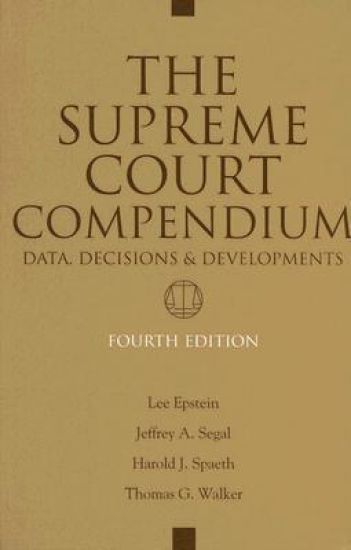
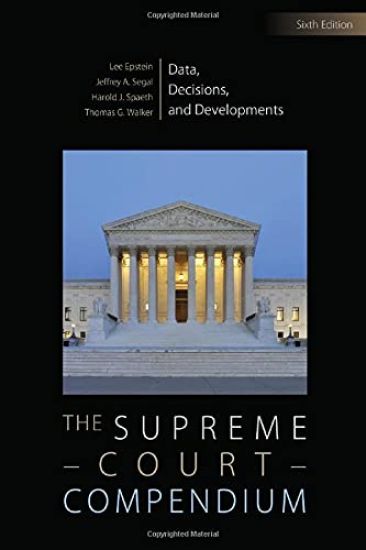
Supreme Court Compendium

Supreme Court Compendium

Thomas G. Walker; Jeffrey A. Segal; Harold J. Spaeth; Lee Epstein
CQ Press
2006
sidottu
The Supreme Court Compendium is the only reference that presents historical and statistical information on every important aspect of the U.S. Supreme Court, including its history, development as an institution, the justices backgrounds, nominations, and confirmations, and the Court's relationship with the public and other governmental and judicial bodies. The newest edition of this comprehensive reference includes important new perspective on the legacy of the Rehnquist court. Readers will also find: An institutional overview of the Court's history including a chronology of important events from 1787-2006, important Congressional legislation relating to the Supreme Court, internet sites relating to law and courts, and much more Background information on all the justices such as family backgrounds, childhood environments, marital status, educational and employment histories, political experiences and trends in voting agreement The political and legal environment of the Court is presented including the success rate of the United States as a party before the Supreme Court, the rates of success of various administrative agencies, and state participation in court litigation with success rates This new edition includes more than 180 tables and charts and is updated to cover Supreme Court events through the 2005-2006 term. This reference is an invaluable resource to judicial scholars, students, and those interested in the history of the Supreme Court.
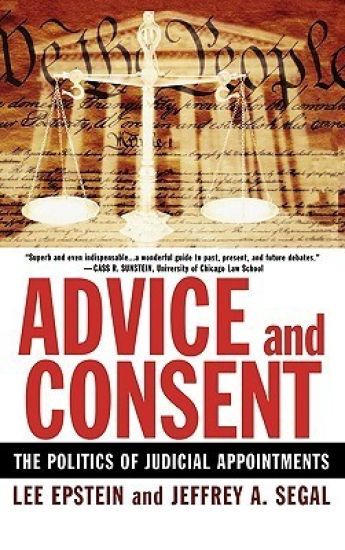
Advice and Consent

Advice and Consent

Lee Epstein; Jeffrey A. Segal

Oxford University Press
2007
nidottu
From Louis Brandeis to Robert Bork to Clarence Thomas, the nomination of federal judges has generated intense political conflict. With the coming retirement of one or more Supreme Court Justices—and threats to filibuster lower court judges—the selection process is likely to be, once again, the center of red-hot partisan debate. In Advice and Consent, two leading legal scholars, Lee Epstein and Jeffrey A. Segal, offer a brief, illuminating Baedeker to this highly important procedure, discussing everything from constitutional background, to crucial differences in the nomination of judges and justices, to the role of the Judiciary Committee in vetting nominees. Epstein and Segal shed light on the role played by the media, by the American Bar Association, and by special interest groups (whose efforts helped defeat Judge Bork). Though it is often assumed that political clashes over nominees are a new phenomenon, the authors argue that the appointment of justices and judges has always been a highly contentious process—one largely driven by ideological and partisan concerns. The reader discovers how presidents and the senate have tried to remake the bench, ranging from FDR's controversial "court packing" scheme to the Senate's creation in 1978 of 35 new appellate and 117 district court judgeships, allowing the Democrats to shape the judiciary for years. The authors conclude with possible "reforms," from the so-called nuclear option, whereby a majority of the Senate could vote to prohibit filibusters, to the even more dramatic suggestion that Congress eliminate a judge's life tenure either by term limits or compulsory retirement. With key appointments looming on the horizon, Advice and Consent provides everything concerned citizens need to know to understand the partisan rows that surround the judicial nominating process.
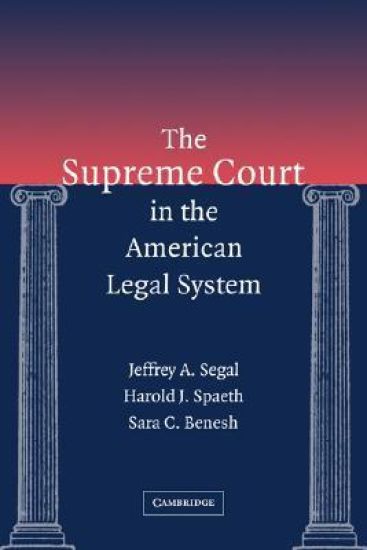
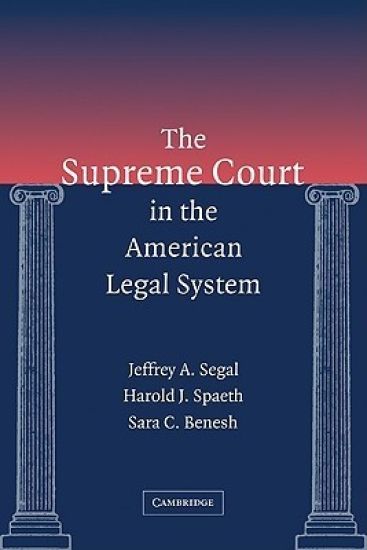
The Supreme Court in the American Legal System

The Supreme Court in the American Legal System

Jeffrey A. Segal; Harold J. Spaeth; Sara C. Benesh
Cambridge University Press
2005
sidottu
This book examines the American legal system, including a comprehensive treatment of the U.S. Supreme Court. Despite this treatment, the 'in' from the title deserves emphasis, for it extensively examines lower courts, providing separate chapters on state courts, the US District Courts, and the US Courts of Appeals. The book analyzes these courts from a legal/extralegal framework, drawing different conclusions about the relative influence of each based on institutional structures and empirical evidence. The book is also tied together through its attention to the relationship between lower courts and the Supreme Court. Additionally, Election 2000 litigation provides a common substantive topic linking many of the chapters. Finally, it provides extended coverage to the legal process, with separate chapters on civil procedure, evidence, and criminal procedure.
The Supreme Court in the American Legal System

The Supreme Court in the American Legal System

Jeffrey A. Segal; Harold J. Spaeth; Sara C. Benesh
Cambridge University Press
2005
pokkari
This book examines the American legal system, including a comprehensive treatment of the U.S. Supreme Court. Despite this treatment, the 'in' from the title deserves emphasis, for it extensively examines lower courts, providing separate chapters on state courts, the US District Courts, and the US Courts of Appeals. The book analyzes these courts from a legal/extralegal framework, drawing different conclusions about the relative influence of each based on institutional structures and empirical evidence. The book is also tied together through its attention to the relationship between lower courts and the Supreme Court. Additionally, Election 2000 litigation provides a common substantive topic linking many of the chapters. Finally, it provides extended coverage to the legal process, with separate chapters on civil procedure, evidence, and criminal procedure.
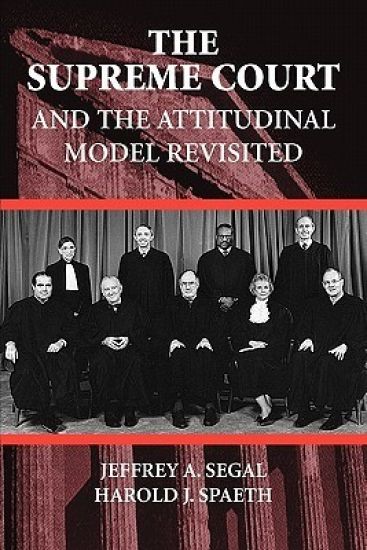
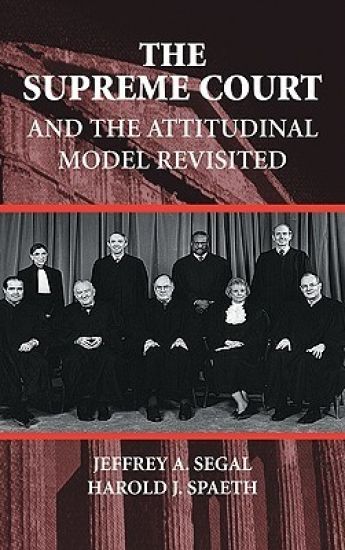
The Supreme Court and the Attitudinal Model Revisited

The Supreme Court and the Attitudinal Model Revisited

Jeffrey A. Segal; Harold J. Spaeth

Cambridge University Press
2002
sidottu
This book, authored by two leading scholars of the Supreme Court and its policy making, systematically presents and validates the use of the attitudinal model to explain and predict Supreme Court decision making. In the process, it critiques the two major alternative models of Supreme Court decision making and their major variants: the legal and rational choice. Using the US Supreme Court Data Base, the justices' private papers, and other sources of information, the book analyzes the appointment process, certiorari, the decision on the merits, opinion assignments, and the formation of opinion coalitions. The book will be the definitive presentation of the attitudinal model as well as an authoritative critique of the legal and rational choice models. The book thoroughly reflects research done since the 1993 publication of its predecessor, as well as decisions and developments in the Supreme Court, including the momentous decision of Bush v. Gore.
Majority Rule or Minority Will

Majority Rule or Minority Will

Harold J. Spaeth; Jeffrey A. Segal

Cambridge University Press
2001
pokkari
This book, first published in 1999, examines the influence of precedent on the behavior of US Supreme Court justices throughout the Court's history. Under the assumption that for precedent to be an influence on the behavior of justices it must lead to a result they would not otherwise have reached, the results show that when justices disagree with the establishment of a precedent, they rarely shift from their previously stated views in subsequent cases. In other words, they are hardly ever influenced by precedent. Nevertheless, the doctrine of stare decisis does exhibit some low level influence on the justices in the least salient of the Court's decisions. The book examines these findings in light of several leading theories of judicial decision making.
Majority Rule or Minority Will

Majority Rule or Minority Will

Harold J. Spaeth; Jeffrey A. Segal

Cambridge University Press
1999
sidottu
This book examines the influence of precedent on the behavior of US Supreme Court justices throughout the Court’s history. Under the assumption that for precedent to be an influence on the behavior of justices it must lead to a result they would not otherwise have reached, the results show that when justices disagree with the establishment of a precedent, they rarely shift from their previously stated views in subsequent cases. In other words, they are hardly ever influenced by precedent. Nevertheless, the doctrine of stare decisis does exhibit some low level influence on the justices in the least salient of the Court’s decisions. The book examines these findings in light of several leading theories of judicial decision making.