Kirjojen hintavertailu. Mukana 12 390 323 kirjaa ja 12 kauppaa.

Kirjailija

Jeffrey Bennett

Kirjat ja teokset yhdessä paikassa: 37 kirjaa, julkaisuja vuosilta 2008-2026, suosituimpien joukossa Yo soy la humanidad. Vertaile teosten hintoja ja tarkista saatavuus suomalaisista kirjakaupoista.

37 kirjaa

Kirjojen julkaisuhaarukka 2008-2026.

Activity Manual with Integrated Review Worksheets for Using & Understanding Mathematics
More than 30 activities correlated to Bennett/Briggs' Using & Understanding Mathematics: A Quantitative Approach Plus MyLab Math with Integrated Review, 7egive students hands-on experiences that reinforce the course content. Activities can be completed individually or in a group. Each activity includes an overview, estimated time of completion, objectives, guidelines for group size, and list of materials needed. Additionally, the manual provides the worksheets for the Integrated Review version of the MyLab(TM) Math course. 0135168201 / 9780135168202 Student Activity Manual with Integrated Review Worksheets for Using & Understanding Mathematics: A Quantitative Approach Plus MyLab Math with Integrated Review, 7/e
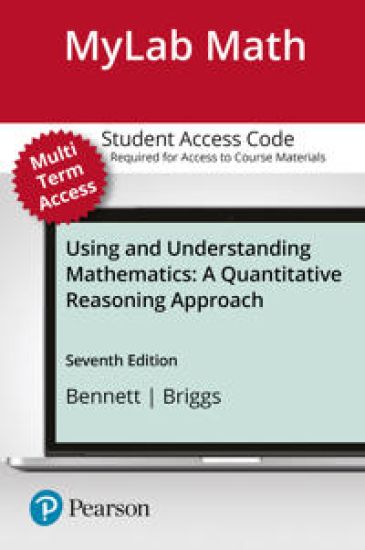
MyLab Math with Pearson eText Access Code (24 Months) for Using & Understanding Mathematics
MyLab Math Standalone Access Card to accompany Bennett/Briggs, Using & Understanding Mathematics, 7/e This item is an access card for MyLab(TM) Math. This physical access card includes an access code for your MyLab Math course. In order to access the online course you will also need a Course ID, provided by your instructor. This title-specific access card provides access to the Bennett/Briggs, Using & Understanding Mathematics, 7/e accompanying MyLab course ONLY. 0134715853 / 9780134715858 MYLAB MATH WITH PEARSON ETEXT -- ACCESS CARD -- FOR USING AND UNDERSTANDING MATHEMATICS, 7/e MyLab Math is the world's leading online tutorial, and assessment program designed to help you learn and succeed in your mathematics course. MyLab Math online courses are created to accompany one of Pearson's best-selling math textbooks. Every MyLab Math course includes a complete, interactive eText. Learn more about MyLab Math. ALERT: Before you purchase, check with your instructor or review your course syllabus to ensure that you select the correct ISBN. Used or rental books If you rent or purchase a used book with an access code, the access code may have been redeemed previously and you may have to purchase a new access code. Access codes Access codes that are purchased from sellers other than Pearson carry a higher risk of being either the wrong ISBN or a previously redeemed code. Check with the seller prior to purchase.
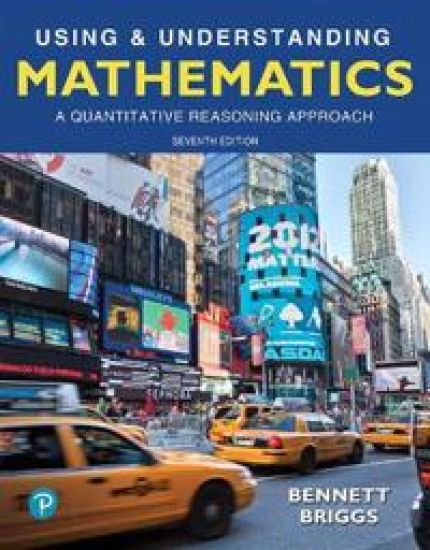
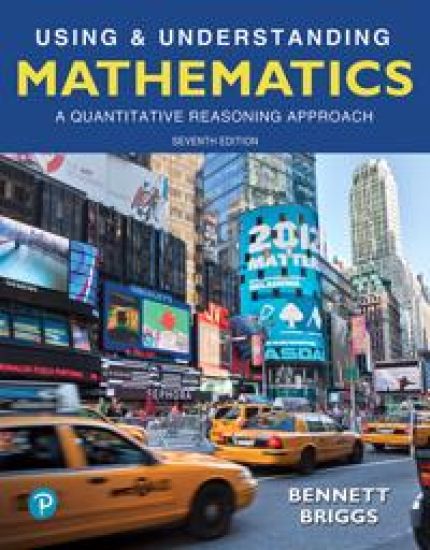
Using & Understanding Mathematics

Using & Understanding Mathematics

Jeffrey Bennett; William Briggs

Pearson
2018
muu
NOTE: Before purchasing, check with your instructor to ensure you select the correct ISBN. Several versions of the MyLab™ and Mastering™ platforms exist for each title, and registrations are not transferable. To register for and use MyLab or Mastering, you may also need a Course ID, which your instructor will provide. Used books, rentals, and purchases made outside of Pearson If purchasing or renting from companies other than Pearson, the access codes for the MyLab platform may not be included, may be incorrect, or may be previously redeemed. Check with the seller before completing your purchase. For courses in Liberal Arts Mathematics and Quantitative Literacy. This package includes MyLab Math. The standard in quantitative reasoning instruction — by authorities in the field The 7th Edition of Using & Understanding Mathematics by Jeff Bennett and Bill Briggs aims to prepare students for the mathematics they will encounter in other college courses, future careers, and life. The authors' goal is to develop students’ ability to reason with quantitative information in a way that will help achieve success in their careers, and to give students the critical-thinking and quantitative reasoning skills needed to understand major life issues. Through new resources in MyLab™ Math and updated content within the text, the Bennett/Briggs team continues to set the standard in quantitative reasoning instruction. Personalize learning with MyLab Math By combining trusted author content with digital tools and a flexible platform, MyLab Math personalizes the learning experience and often improves results for each student. 0134679091 / 9780134679099 Using & Understanding Mathematics: A Quantitative Reasoning Approach Plus MyMathLab -- Access Card Package, 7/e Package consists of: 0134705181 / 9780134705187 Using & Understanding Mathematics: A Quantitative Reasoning Approach 0134715853 / 9780134715858 MyLab Math with Pearson eText - Access Card - for Using & Understanding Mathematics: A Quantitative Reasoning Approach
MyLab Math with Pearson eText Access Code (24 Months) for Using & Understanding Mathematics
MyLab Math Standalone Access Card to accompany Bennett/Briggs, Using & Understanding Mathematics, 7/e This item is an access card for MyLab™ Math. This physical access card includes an access code for your MyLab Math course. In order to access the online course you will also need a Course ID, provided by your instructor. This title-specific access card provides access to the Bennett/Briggs, Using & Understanding Mathematics, 7/e accompanying MyLab course ONLY. 0134715853 / 9780134715858 MYLAB MATH WITH PEARSON ETEXT -- ACCESS CARD -- FOR USING AND UNDERSTANDING MATHEMATICS, 7/e MyLab Math is the world’s leading online tutorial, and assessment program designed to help you learn and succeed in your mathematics course. MyLab Math online courses are created to accompany one of Pearson’s best-selling math textbooks. Every MyLab Math course includes a complete, interactive eText. Learn more about MyLab Math. ALERT: Before you purchase, check with your instructor or review your course syllabus to ensure that you select the correct ISBN. Used or rental books If you rent or purchase a used book with an access code, the access code may have been redeemed previously and you may have to purchase a new access code. Access codes Access codes that are purchased from sellers other than Pearson carry a higher risk of being either the wrong ISBN or a previously redeemed code. Check with the seller prior to purchase.
A Global Warming Primer

A Global Warming Primer

Jeffrey Bennett

Big Kid Science
2016
pokkari
Winner:2017 NSTA, Outstanding Science Trade Books2017 Children's Book Council, Best STEM BooksNautilus Book Award, Silver, Ecology and EnvironmentIs human-induced global warming a real threat to our future? Most people will express an opinion on this question, but relatively few can back their opinions with solid evidence. Many times we’ve even heard pundits say “I am not a scientist” to avoid the issue altogether. But the truth is, the basic science is not that difficult. Using a question and answer format, this book will help readers achieve three major goals: To see that anyone can understand the basic science of global warming; To understand the arguments about this issue made by skeptics, so that readers will be able to decide for themselves what to believe; To understand why, despite the “gloom and doom” that often surrounds this topic, the solutions are ones that will not only protect the world for our children and grandchildren, but that will actually lead us to a stronger economy with energy that is cheaper, cleaner, and more abundant than the energy we use today.
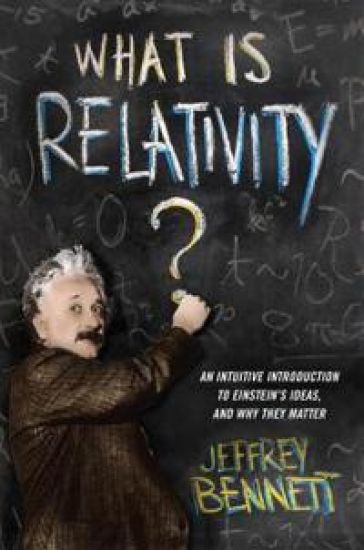
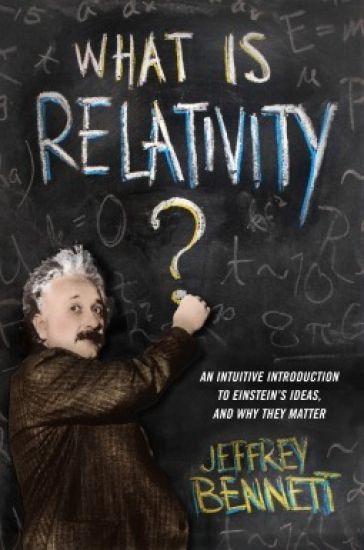
What Is Relativity?

What Is Relativity?

Jeffrey Bennett

Columbia University Press
2016
pokkari
It is commonly assumed that if the Sun suddenly turned into a black hole, it would suck Earth and the rest of the planets into oblivion. Yet, as prominent author and astrophysicist Jeffrey Bennett points out, black holes don't suck. With that simple idea in mind, Bennett begins an entertaining introduction to Einstein's theories of relativity, describing the amazing phenomena readers would actually experience if they took a trip to a black hole. The theory of relativity reveals the speed of light as the cosmic speed limit, the mind-bending ideas of time dilation and curvature of spacetime, and what may be the most famous equation in history: E = mc2. Indeed, the theory of relativity shapes much of our modern understanding of the universe. It is not "just a theory"-every major prediction of relativity has been tested to exquisite precision, and its practical applications include the Global Positioning System (GPS). Amply illustrated and written in clear, accessible prose, Bennett's book proves anyone can grasp the basics of Einstein's ideas. His intuitive, nonmathematical approach gives a wide audience its first real taste of how relativity works and why it is so important to science and the way we view ourselves as human beings.
Yo soy la humanidad

Yo soy la humanidad

Jeffrey Bennett

Big Kid Science
2016
sidottu
Written in the first person with the viewpoint of a narrator who represents the human race throughout history, Yo soy la humanidad tells the story of what we now know about the universe and how we learned it. It begins with the ancient view of a small, flat Earth, and page-by-page shows how we’ve gradually learned about our planet, its orbit, and its place in the vast universe. The book is designed to work on three different levels: education, perspective, and inspiration. The educational aspect comes in the factual content of the story, the perspective element involves enabling children learn to see themselves and our planet in a new light, and the inspirational component comes in helping children dream of how they can help make the world a better place.
I, Humanity

I, Humanity

Jeffrey Bennett

Big Kid Science
2016
sidottu
Winner:2017 NSTA, Outstanding Science Trade BooksNautilus Book Awards, Gold, Children's Illustrated NonfictionStory Time From Space Official SelectionPart of a set of books launched to the International Space Station through NASA’s Story Time from Space program, read aloud by astronauts for children around the world Written in the first person with the viewpoint of a narrator who represents the human race throughout history, I, Humanity tells the story of what we now know about the universe and how we learned it. It begins with the ancient view of a small, flat Earth, and page-by-page shows how we’ve gradually learned about our planet, its orbit, and its place in the vast universe. The book is designed to work on three different levels: education, perspective, and inspiration. The educational aspect comes in the factual content of the story, the perspective element involves enabling children learn to see themselves and our planet in a new light, and the inspirational component comes in helping children dream of how they can help make the world a better place.
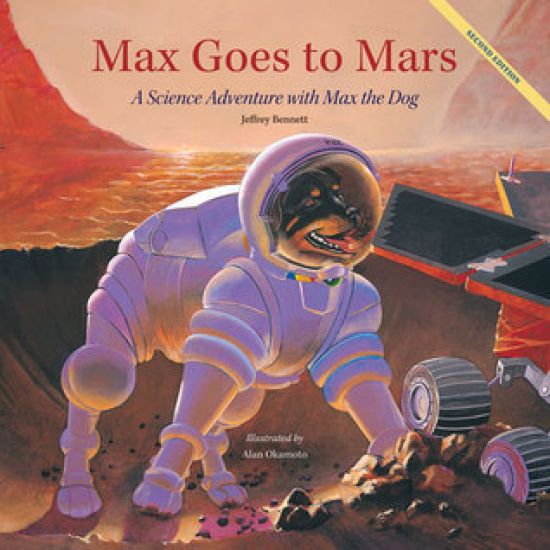
Max Goes to Mars

Max Goes to Mars

Jeffrey Bennett

Big Kid Science
2015
sidottu
Winner:2016 ILA CBC Children's Choice ListThis is the updated edition of the first children’s book ever launched into space and read aloud by astronauts from the International Space StationCome with Max as he takes off on his next exciting science adventure, this time joining astronauts on the first human mission to Mars. Equipped with a specially designed spacesuit, Max sniffs for signs of microscopic life. Will he find any? Read the exciting story to find out, and to learn how his trip to Mars helps his young friend Tori reflect on the beauty and fragility of our own planet Earth. Max Goes to Mars is more than just a fun story. Educationally designed “Big Kid Boxes” along the sides of the pages help children and parents learn about Mars as the adventure unfolds. This second edition is fully updated to incorporate the latest scientific discoveries about Mars.
What Is Relativity?

What Is Relativity?

Jeffrey Bennett

Columbia University Press
2014
sidottu
It is commonly assumed that if the Sun suddenly turned into a black hole, it would suck Earth and the rest of the planets into oblivion. Yet, as prominent author and astrophysicist Jeffrey Bennett points out, black holes don't suck. With that simple idea in mind, Bennett begins an entertaining introduction to Einstein's theories of relativity, describing the amazing phenomena readers would actually experience if they took a trip to a black hole. The theory of relativity reveals the speed of light as the cosmic speed limit, the mind-bending ideas of time dilation and curvature of spacetime, and what may be the most famous equation in history: E = mc2. Indeed, the theory of relativity shapes much of our modern understanding of the universe. It is not "just a theory"-every major prediction of relativity has been tested to exquisite precision, and its practical applications include the Global Positioning System (GPS). Amply illustrated and written in clear, accessible prose, Bennett's book proves anyone can grasp the basics of Einstein's ideas. His intuitive, nonmathematical approach gives a wide audience its first real taste of how relativity works and why it is so important to science and the way we view ourselves as human beings.
Max Goes to the Space Station

Max Goes to the Space Station

Jeffrey Bennett

Big Kid Science
2013
sidottu
Winner of: 2015 Golden Duck Picture Book Award, Children's Science Fiction The long-awaited prequel to the other books in the Science Adventures with Max the Dog series, this installment follows Max on his trip to the International Space Station where he shares in the adventures of astronaut life and helps save everyone from a potential disaster along the way. The book teaches children to see themselves and the planet in a new light and encourages readers to discover how they can help make the world a better place. Accompanying the story of how Max saves the day are numerous “Big Kid Box” sidebars that offer science facts and other pieces of fascinating information. Grown-ups and kids learn about science together with this fun and educational picture book.
Max viaja a la luna

Max viaja a la luna

Jeffrey Bennett

Big Kid Science
2012
sidottu
Max the Dog and a young girl named Tori take the first trip to the Moon since the Apollo era, and their trip proves so inspiring to people back on Earth that all the nations of the world come together to build a great Moon colony. From the colony, the views of Earth make everyone realize how small and precious planet Earth is. Along the way, the story sets the stage for more sophisticated science, featured in the 19 “Big Kid Box” sidebars which cover topics including “Phases of the Moon,” “Wings in Space?,” and “Frisbees and Curve Balls on the Moon”—all thoughtfully explained so that grownups and children can learn about science together. Behind-the-scenes science lessons with activities round out this entertaining and educational picture book, which is designed to accompany the new Max Goes to the Moon planetarium show, coming soon to planetariums around the world. El perro Max y una joven llamada Tori emprenden el primer viaje a la luna desde la Época del programa Apolo, y su viaje resulta ser tan inspirador para los habitantes de la Tierra que todas las naciones trabajan juntas para construir una colonia en la luna. Las vistas de la Tierra desde la colonia les recuerdan a todos lo pequeÑo y precioso que es el planeta. A lo largo del libro, la historia presenta conceptos cientÍficos mÁs sofisticados en 19 notas de recuadro que abarcan temas como “Las fases de la luna,” “¿Alas en el espacio?” y “Frisbees y bolas curva en la luna”—todos explicados de tal manera que los adultos y los niÑos puedan aprender juntos sobre la ciencia. Lecciones cientÍficas con actividades tambiÉn se incluyen en este divertido y didÁctico libro ilustrado, el cual estÁ diseÑado para acompaÑar la nueva exposiciÓn en planetarios Max Goes to the Moon, el cual estarÁ pasando por planetarios nacionales e internacionales.
Max Goes to the Moon

Max Goes to the Moon

Jeffrey Bennett

Big Kid Science
2012
sidottu
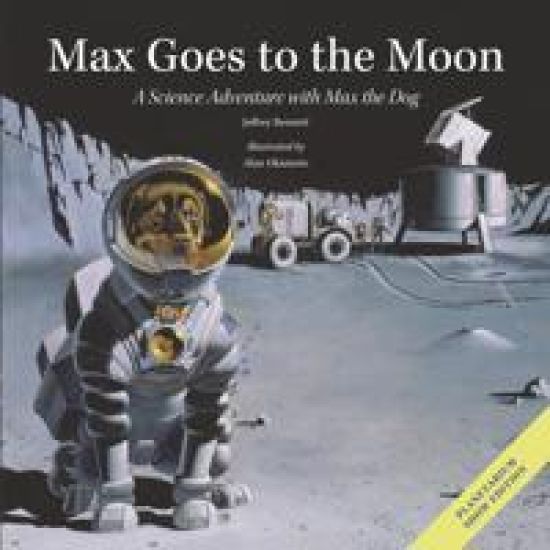
Winner of:2013 Science Communication Award, American Institute of PhysicsMax the Dog and a young girl named Tori take the first trip to the Moon since the Apollo era, and their trip proves so inspiring to people back on Earth that all the nations of the world come together to build a great Moon colony. From the colony, the views of Earth make everyone realize how small and precious planet Earth is. Along the way, the story sets the stage for more sophisticated science, featured in the 19 “Big Kid Box” sidebars that have been fully updated in this new edition, which cover topics including “Phases of the Moon,” “Wings in Space?,” and “Frisbees and Curve Balls on the Moon”—all thoughtfully explained so that grown-ups and children can learn together about science. Behind-the-scenes science lessons with activities round out this entertaining and educational picture book, the new edition of which is designed to accompany the new Max Goes to the Moon planetarium show, coming soon to planetariums around the world.
Beyond UFOs

Beyond UFOs

Jeffrey Bennett

Princeton University Press
2011
pokkari
The quest for extraterrestrial life doesn't happen only in science fiction. This book describes the startling discoveries being made in the very real science of astrobiology, an intriguing new field that blends astronomy, biology, and geology to explore the possibility of life on other planets. Jeffrey Bennett takes readers beyond UFOs to discuss some of the tantalizing questions astrobiologists grapple with every day: What is life and how does it begin? What makes a planet or moon habitable? Is there life on Mars or elsewhere in the solar system? How can life be recognized on distant worlds? Is it likely to be microbial, more biologically complex--or even intelligent? What would such a discovery mean for life here on Earth? Come along on this scientific adventure and learn the astonishing implications of discoveries made in this field for the future of the human race. Bennett, who believes that "science is a way of helping people come to agreement," explains how the search for extraterrestrial life can help bridge the divide that sometimes exists between science and religion, defuse public rancor over the teaching of evolution, and quiet the debate over global warming. He likens humanity today to a troubled adolescent teetering on the edge between self-destruction and a future of virtually limitless possibilities. Beyond UFOs shows why the very quest to find alien life can help us to grow up as a species and chart a course for the stars. In a new afterword, Bennett shares the most recent developments in extrasolar research, and discusses how they might further our quest to find alien life.
Beyond UFOs

Beyond UFOs

Jeffrey Bennett

Princeton University Press
2008
sidottu
The quest for extraterrestrial life doesn't happen only in science fiction. This book describes the startling discoveries being made in the very real science of astrobiology, an intriguing new field that blends astronomy, biology, and geology to explore the possibility of life on other planets. Jeffrey Bennett takes readers beyond UFOs to discuss some of the tantalizing questions astrobiologists grapple with every day: What is life and how does it begin? What makes a planet or moon habitable? Is there life on Mars or elsewhere in the solar system? How can life be recognized on distant worlds? Is it likely to be microbial, more biologically complex--or even intelligent? What would such a discovery mean for life here on Earth? Come along on this scientific adventure and learn the astonishing implications of discoveries made in this field for the future of the human race. Bennett, who believes that "science is a way of helping people come to agreement," explains how the search for extraterrestrial life can help bridge the divide that sometimes exists between science and religion, defuse public rancor over the teaching of evolution, and quiet the debate over global warming. He likens humanity today to a troubled adolescent teetering on the edge between self-destruction and a future of virtually limitless possibilities. Beyond UFOs shows why the very quest to find alien life can help us to grow up as a species and chart a course for the stars.