Kirjojen hintavertailu. Mukana 12 595 353 kirjaa ja 12 kauppaa.
Kirjailija
Jeffrey D. Sachs
Kirjat ja teokset yhdessä paikassa: 26 kirjaa, julkaisuja vuosilta 1985-2026, suosituimpien joukossa Economic Development and the Division of Labor. Vertaile teosten hintoja ja tarkista saatavuus suomalaisista kirjakaupoista.
A respected international economic advisor and the director of The Earth Institute shares a wide-spectrum theory about how to enable economic success throughout the world, identifying the different categories into which various nations fall in today's economy while posing solutions to top political, environmental, and social problems that contribute to poverty. Reprint.
This book describes the importance of the millennium development goals and gives an explanation of the progress toward the goals. It provides recommendations to be implemented at the country level and presents a guide for the international system's support for the country-level processes.
Die globale Ausrichtung der Makro konomik ist der besondere Vorzug dieses Lehrwerks zweier weltber hmter Volkswirte. F r Grund- und Hauptstudium gleicherma en zu empfehlen. Aus dem Inhalt: Grundlegende Konzepte der Makro konomik. Bestimmung des Outputs. Konsum und Sparen. Investition. Ersparnis. Investition und Leistungsbilanz. Der staatliche Sektor. Geldnachfrage. Der Geldangebotsproze . Geld, Wechselkurse und Preise. Inflation. Makropolitik und Outputbestimmung in einer geschlossenen Volkswirtschaft. Makropolitik in der offenen Volkswirtschaft: feste Wechselkurse. Makropolitik in der offenen Volkswirtschaft: flexibel Wechselkurse. Inflation und Arbeitslosigkeit. Institutionelle Bestimmungsgr nde von L hnen und Arbeitlsosigkeit. Zur Erkl rung von Konjunkturzyklen. Langfristiges Wachstum. Theorie und Praxis der Wirtschaftspolitik. Finanzm rkte. Handelbare und nicht-handelbare G ter. Beendigung hoher Inflationen.
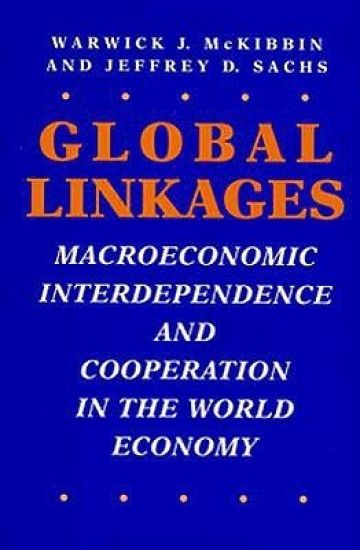
"With the rapid deterioration of the U.S. trade balance in the 1980s, the United States was forced to finance deficits by borrowing heavily from the rest of the world. In doing so, the United States went from being the world's largest creditor country to the world's largest debtor, while Japan and West Germany experienced a rise in trade surpluses. Such a shift in international trade flows has had profound effects on the world economy. McKibbin and Sachs address a range of issues involving macroeconomic imbalances in the world economy. Through the use of a new simulation model of the world economy they explore how policy actions undertaken in one country affect the trade flows and macroeconomic patterns among the other counties. The authors show that key macroeconomic features of the 1980s can be explained by shifts in monetary and fiscal policies in the major economies and by supply shocks due to changes in oil prices. In addition to showing how the global macroeconomic experience can be understood, they focus on a number of current policy issues, including the reduction of global trade imbalances, the consequences of U.S. fiscal consolidation, the effects of an oil price shock, the implications for the U.S. economy of increases in Japanese and German fiscal spending, the effects of targeting exchange rates among the major currencies, and the gains of increased coordination of macroeconomic politics among the major economies. In several cases, their conclusions are shown to be quite different from those that form the basis of many conventional views. The authors also analyze the importance of interaction between policymakers in industrial economies and conclude by reemphasizing the need for U.S. politicians and policy experts to recognize that macroeconomic results in the U.S. now depend heavily on events abroad. "
This book sets forth both a theory and a comparative empirical analysis of stagflation, that peculiar combination of high unemployment, slow growth, and spurts of high inflation bedeviling the advanced industrial nations during the past fifteen years. The authors first construct a small macroeconomic model that takes full account of aggregate demand and supply forces in the determination of output, employment, and the price level, in both a single-economy and a multi-economy setting. They then apply the model to provide an understanding of comparative performance of industrial countries in the areas of unemployment, inflation, productivity, and investment growth. They argue convincingly that the decay of the major economies during this period resulted from the supply shocks of the 1970s, such as the two major OPEC oil-price increases, and from the consequent policy-induced decrease in demand in response to inflationary pressures. Their analysis differs markedly from similar studies in that it takes specific account of institutional differences in the labor markets of the various economies. This helps to explain in particular the divergent adjustment profiles of the United States and Europe. Bruno and Sachs make several key recommendations for the mix of demand management and incomes policies necessary to combat stagflation in individual countries as well as for the coordination of macroeconomic policies among the major industrial nations.