Kirjojen hintavertailu. Mukana 12 326 229 kirjaa ja 12 kauppaa.

Kirjailija

Jeffrey G. Williamson

Kirjat ja teokset yhdessä paikassa: 13 kirjaa, julkaisuja vuosilta 1990-2017, suosituimpien joukossa The Age of Mass Migration. Vertaile teosten hintoja ja tarkista saatavuus suomalaisista kirjakaupoista.

13 kirjaa

Kirjojen julkaisuhaarukka 1990-2017.

The Age of Mass Migration

The Age of Mass Migration

Timothy J. Hatton; Jeffrey G. Williamson

Oxford University Press Inc
1998
sidottu
About 55 million Europeans migrated to the New World between 1850 and 1914, landing in North and South America and in Australia. This movement, which marked a profound and permanent shift in global population and economic activity, is described in vivid detail by Timothy J. Hatton and Jeffrey G. Williamson, and the causes and effects relative to this great relocation are soundly analysed. The Age of Mass Migration offers a thorough treatment of a period of vital development in the economic history of the modern world and, moreover, devotes much objective consideration to certain economic questions that still baffle us today: Why does a nation's emigration rate typically rise with early industrialization? How do immigrants choose their destinations? Are international labour markets segmented? Do immigrants truly "rob" jobs from locals? What impact do immigrants have on wage rates and living standards in the host country? In addressing these issues, and many of others, this book takes a new and comprehensive view of mass migration. Although somewhat controversial in terms of method--it assigns to a social phenomenon an economic explanation and interpretation-- The Age of Mass Migration will be useful to all students of migration, historical or contemporary, and to anyone interested in international economic activities.
Unequal Gains

Unequal Gains

Peter H. Lindert; Jeffrey G. Williamson

Princeton University Press
2017
pokkari
Unequal Gains offers a radically new understanding of the economic evolution of the United States, providing a complete picture of the uneven progress of America from colonial times to today. While other economic historians base their accounts on American wealth, Peter Lindert and Jeffrey Williamson focus instead on income--and the result is a bold reassessment of the American economic experience. America has been exceptional in its rising inequality after an egalitarian start, but not in its long-run growth. America had already achieved world income leadership by 1700, not just in the twentieth century as is commonly thought. Long before independence, American colonists enjoyed higher living standards than Britain--and America's income advantage today is no greater than it was three hundred years ago. But that advantage was lost during the Revolution, lost again during the Civil War, and lost a third time during the Great Depression, though it was regained after each crisis. In addition, Lindert and Williamson show how income inequality among Americans rose steeply in two great waves--from 1774 to 1860 and from the 1970s to today--rising more than in any other wealthy nation in the world. Unequal Gains also demonstrates how the widening income gaps have always touched every social group, from the richest to the poorest. The book sheds critical light on the forces that shaped American income history, and situates that history in a broad global context. Economic writing at its most stimulating, Unequal Gains provides a vitally needed perspective on who has benefited most from American growth, and why.
Unequal Gains

Unequal Gains

Peter H. Lindert; Jeffrey G. Williamson

PRINCETON UNIVERSITY PRESS
2016
sidottu
Unequal Gains offers a radically new understanding of the economic evolution of the United States, providing a complete picture of the uneven progress of America from colonial times to today. While other economic historians base their accounts on American wealth, Peter Lindert and Jeffrey Williamson focus instead on income--and the result is a bold reassessment of the American economic experience. America has been exceptional in its rising inequality after an egalitarian start, but not in its long-run growth. America had already achieved world income leadership by 1700, not just in the twentieth century as is commonly thought. Long before independence, American colonists enjoyed higher living standards than Britain--and America's income advantage today is no greater than it was three hundred years ago. But that advantage was lost during the Revolution, lost again during the Civil War, and lost a third time during the Great Depression, though it was regained after each crisis. In addition, Lindert and Williamson show how income inequality among Americans rose steeply in two great waves--from 1774 to 1860 and from the 1970s to today--rising more than in any other wealthy nation in the world. Unequal Gains also demonstrates how the widening income gaps have always touched every social group, from the richest to the poorest. The book sheds critical light on the forces that shaped American income history, and situates that history in a broad global context. Economic writing at its most stimulating, Unequal Gains provides a vitally needed perspective on who has benefited most from American growth, and why.
Did British Capitalism Breed Inequality?

Did British Capitalism Breed Inequality?

Jeffrey G. Williamson

Routledge
2015
nidottu
The economic and social problems of modern Scotland are the centre of much current debate about regional economic growth, social improvement and environmental rehabilitation. In this book, relevant as much today as when it was first published in 1975, Anthony Slaven argues that the extent and causes of these problems are frequently underestimated, thus making development policies less than fully effective.The major economic and social weaknesses of the west of Scotland are shown to be rooted in the regions former strengths. The author demonstrates how, although the region and its people have resisted change, a thriving and self reliant nineteenth-century economy , based on local resources and manpower, has given way in the present century to vanishing skills and products, unemployment and social deprivation. Since 1945 economic and social planning has helped to improve the situation, although many difficulties remain.Seen in the historical perspective provided by this revealing study, the present industrial problems of the west of Scotland, and their remedies, become clearer. Mr Slaven argues that the older industries deserve more help, for without this, he believes, the ineffectiveness of development policies is likely to be perpetuated.This book was first published in 1975.
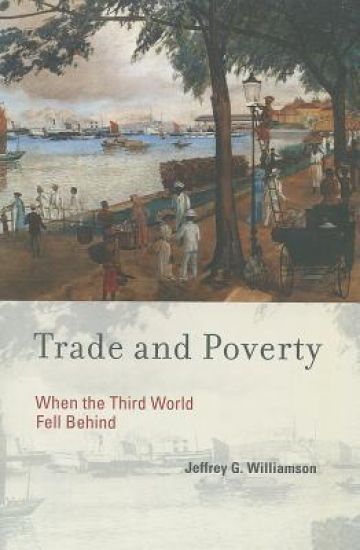
Trade and Poverty

Trade and Poverty

Jeffrey G. Williamson

MIT Press
2013
pokkari
How the rise of globalization over the past two centuries helps explain the income gap between rich and poor countries today.Today's wide economic gap between the postindustrial countries of the West and the poorer countries of the third world is not new. Fifty years ago, the world economic order-two hundred years in the making-was already characterized by a vast difference in per capita income between rich and poor countries and by the fact that poor countries exported commodities (agricultural or mineral products) while rich countries exported manufactured products. In Trade and Poverty, leading economic historian Jeffrey G. Williamson traces the great divergence between the third world and the West to this nexus of trade, commodity specialization, and poverty.Analyzing the role of specialization, de-industrialization, and commodity price volatility with econometrics and case studies of India, Ottoman Turkey, and Mexico, Williamson demonstrates why the close correlation between trade and poverty emerged. Globalization and the great divergence were causally related, and thus the rise of globalization over the past two centuries helps account for the income gap between rich and poor countries today.
Late Nineteenth-Century American Development

Late Nineteenth-Century American Development

Jeffrey G. Williamson

Cambridge University Press
2008
pokkari
Late Nineteenth-Century American Development is an economist's attempt to interpret a critical period of US history, from Civil War to World War I. The questions raised have always been at the heart of American historiography. What accounts for the retardation up to the turn of the century? How did capital markets operate and what was their influence on the pace and pattern of our growth? What determined farm performance and what impact did that performance have on the economy as a whole? Yet while the questions raised in this book are familiar, the methods are not. This book blends traditional historical analysis with general equilibrium theory, modern macroeconomics and simulation analysis. The result is a provocative book of remarkable scope which offers a fresh interpretation of late nineteenth-century American growth.
Did British Capitalism Breed Inequality?

Did British Capitalism Breed Inequality?

Jeffrey G. Williamson

Routledge
2005
sidottu
First Published in 2005. This thirteen-chapter title is divided into three parts and concludes with five appendices, references, and index. The first part focuses on income inequality and the historical state of wages. The second begins the discussion on the driving forces of economic inequality and equilibrating factors. The third provides a model for inequality in a resource-scarce open economy with data, theory, and debate. Appropriate for economic students and those interested in British economic history.
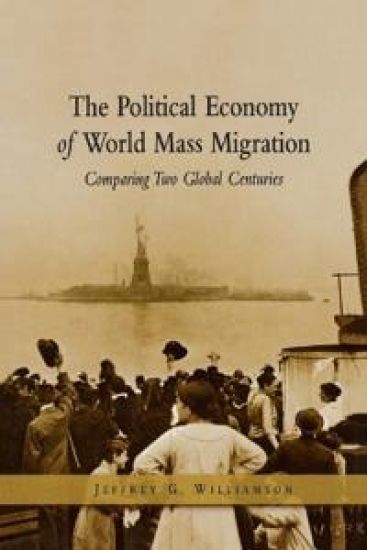
The Political Economy of World Mass Migration

The Political Economy of World Mass Migration

Jeffrey G. Williamson

AEI Press
2004
pokkari
In this study, Jeffrey G. Williamson examines the political economy of immigration backlash and immigration policy in two global centuries. The first, between 1820 and World War I, was a proglobal environment, characterized by booming trade, labor, and capital markets. It was followed by an antiglobal and autarchic retreat between 1914 and 1950. Williamson finds that the second global century has moved to reclaim world integration in trade and capital markets, but immigration policy in high-wage countries has not tried to reclaim an open stance.
Coping with City Growth during the British Industrial Revolution

Coping with City Growth during the British Industrial Revolution

Jeffrey G. Williamson

Cambridge University Press
2002
pokkari
Coping with City Growth assesses Britain’s handling of city growth during the First Industrial Revolution by combining the tools used by Third World analysts with the archival attention and eclectic style of the economic historian. What emerges is an exciting and provocative accounts that have long occupied problem development economists: urban unemployment, underemployment, and the alleged failure of city labour markets to absorb the flood of rural emigrants; the persistent influx of newcomers, which makes it difficult for municipal planners to improve the quality of social overhead; the crowding of migrants into densely packed urban slums with few, if any, social services; and rising density and city size which augment pollution while lowering the quality of the urban environment.
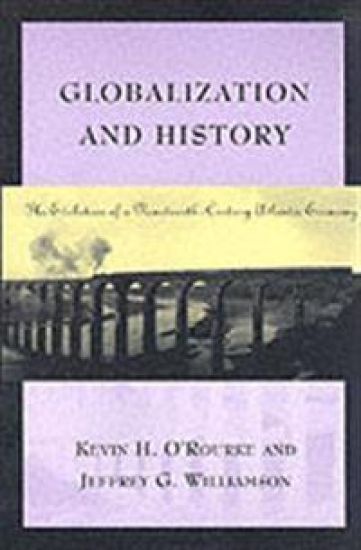
Globalization and History

Globalization and History

Kevin H. O'Rourke; Jeffrey G. Williamson

MIT Press
2001
pokkari
Kevin O'Rourke and Jeffrey Williamson present a coherent picture of trade, migration, and international capital flows in the Atlantic economy in the century prior to 1914-the first great globalization boom, which anticipated the experience of the last fifty years.Globalization is not a new phenomenon, nor is it irreversible. In Gobalization and History, Kevin O'Rourke and Jeffrey Williamson present a coherent picture of trade, migration, and international capital flows in the Atlantic economy in the century prior to 1914-the first great globalization boom, which anticipated the experience of the last fifty years. The authors estimate the extent of globalization and its impact on the participating countries, and discuss the political reactions that it provoked. The book's originality lies in its application of the tools of open-economy economics to this critical historical period-differentiating it from most previous work, which has been based on closed-economy or single-sector models. The authors also keep a close eye on globalization debates of the 1990s, using history to inform the present and vice versa. The book brings together research conducted by the authors over the past decade-work that has profoundly influenced how economic history is now written and that has found audiences in economics and history, as well as in the popular press.
Growth, Inequality, and Globalization

Growth, Inequality, and Globalization

Philippe Aghion; Jeffrey G. Williamson

Cambridge University Press
1999
pokkari
The question of how inequality is generated and how it reproduces over time has been a major concern for social scientists for more than a century. Yet the relationship between inequality and the process of economic development is far from being well understood. These Raffaele Mattioli Lectures have brought together two of the world’s leading economists, Professors Philippe Aghion (a theorist) and Jeffrey Williamson (an economic historian), to question the conventional wisdom on inequality and growth, and address its inability to explain recent economic experience. Professor Aghion assesses the affects of inequality on growth, and asks whether inequality matters: if so why is excessive inequality bad for growth, and is it possible to reconcile aggregate findings with macroeconomic theories of incentives? In the second part Jeffrey Williamson discusses the Kuznets hypothesis, and focuses on the causes of the rise of wage and income inequality in developed economies.
Growth, Inequality, and Globalization

Growth, Inequality, and Globalization

Philippe Aghion; Jeffrey G. Williamson

Cambridge University Press
1999
sidottu
The question of how inequality is generated and how it reproduces over time has been a major concern for social scientists for more than a century. Yet the relationship between inequality and the process of economic development is far from being well understood. These Raffaele Mattioli Lectures have brought together two of the world’s leading economists, Professors Philippe Aghion (a theorist) and Jeffrey Williamson (an economic historian), to question the conventional wisdom on inequality and growth, and address its inability to explain recent economic experience. Professor Aghion assesses the affects of inequality on growth, and asks whether inequality matters: if so why is excessive inequality bad for growth, and is it possible to reconcile aggregate findings with macroeconomic theories of incentives? In the second part Jeffrey Williamson discusses the Kuznets hypothesis, and focuses on the causes of the rise of wage and income inequality in developed economies.
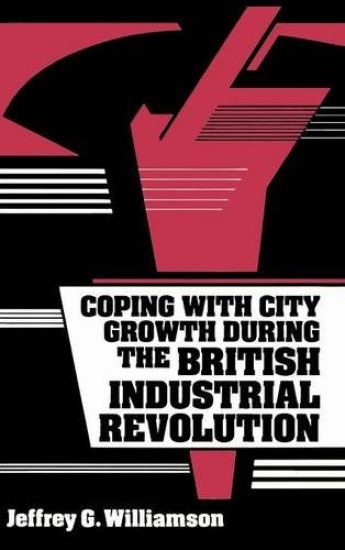
Coping with City Growth during the British Industrial Revolution

Coping with City Growth during the British Industrial Revolution

Jeffrey G. Williamson

Cambridge University Press
1990
sidottu
Coping with City Growth assesses Britain's handling of city growth during the First Industrial Revolution by combining the tools used by Third World analysts with the archival attention and eclectic style of the economic historian. What emerges is an exciting and provocative accounts that have long occupied problem development economists: urban unemployment, underemployment, and the alleged failure of city labour markets to absorb the flood of rural emigrants; the persistent influx of newcomers, which makes it difficult for municipal planners to improve the quality of social overhead; the crowding of migrants into densely packed urban slums with few, if any, social services; and rising density and city size which augment pollution while lowering the quality of the urban environment.