Kirjojen hintavertailu. Mukana 12 390 323 kirjaa ja 12 kauppaa.

Kirjailija

Jeffrey J. Kripal

Kirjat ja teokset yhdessä paikassa: 25 kirjaa, julkaisuja vuosilta 1998-2025, suosituimpien joukossa The Flip. Vertaile teosten hintoja ja tarkista saatavuus suomalaisista kirjakaupoista.

Mukana myös kirjoitusasut: Jeffrey J Kripal

25 kirjaa

Kirjojen julkaisuhaarukka 1998-2025.

Esalen

Esalen

Jeffrey J. Kripal

University of Chicago Press
2008
nidottu
Jeffrey J. Kripal here recounts the spectacular history of Esalen, the institute that has long been a world leader in alternative and experiential education and stands today at the center of the human potential movement. Forged in the literary and mythical leanings of the Beat Generation, inspired in the lecture halls of Stanford by radical scholars of comparative religion, the institute was the remarkable brainchild of Michael Murphy and Richard Price.Set against the heady backdrop of California during the revolutionary 1960s, "Esalen" recounts in fascinating detail how these two maverick thinkers sought to fuse the spiritual revelations of the East with the scientific revolutions of the West, or to combine the very best elements of Zen Buddhism, Western psychology, and Indian yoga into a decidedly utopian vision that rejected the dogmas of conventional religion. In their religion of no religion, the natural world was just as crucial as the spiritual one, science and faith not only commingled but became staunch allies, and the enlightenment of the body could lead to the full realization of our development as human beings.
The Serpent's Gift

The Serpent's Gift

Jeffrey J. Kripal

University of Chicago Press
2006
nidottu
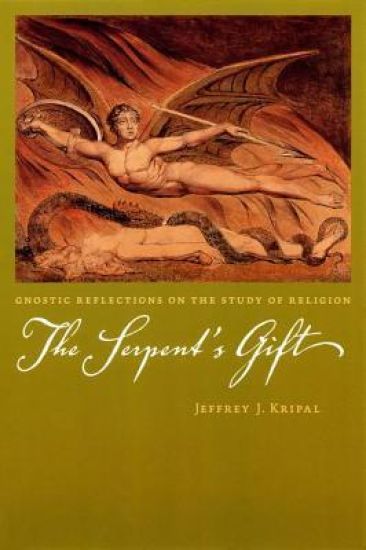
“Because thou hast done this, thou art cursed above all cattle, and above every beast of the field.” With those words in Genesis, God condemns the serpent for tempting Adam and Eve, and the serpent has shouldered the blame ever since. But how would the study of religion change if we looked at the Fall from the snake’s point of view? Would he appear as a bringer of wisdom, more generous than the God who wishes to keep his creation ignorant? Inspired by the early Gnostics who took that startling view, Jeffrey J. Kripal uses the serpent as a starting point for a groundbreaking reconsideration of religious studies and its methods. In a series of related essays, he moves beyond both rational and faith-based approaches to religion, exploring the erotics of the gospels and the sexualities of Jesus, John, and Mary Magdalene. He considers Feuerbach’s Gnosticism, the untapped mystical potential of comparative religion, and even the modern mythology of the X-Men. Ultimately, The Serpent’s Gift is a provocative call for a complete reorientation of religious studies, aimed at a larger understanding of the world, the self, and the divine.
The Serpent's Gift

The Serpent's Gift

Jeffrey J. Kripal

University of Chicago Press
2006
sidottu
“Because thou hast done this, thou art cursed above all cattle, and above every beast of the field.” With those words in Genesis, God condemns the serpent for tempting Adam and Eve, and the serpent has shouldered the blame ever since. But how would the study of religion change if we looked at the Fall from the snake’s point of view? Would he appear as a bringer of wisdom, more generous than the God who wishes to keep his creation ignorant? Inspired by the early Gnostics who took that startling view, Jeffrey J. Kripal uses the serpent as a starting point for a groundbreaking reconsideration of religious studies and its methods. In a series of related essays, he moves beyond both rational and faith-based approaches to religion, exploring the erotics of the gospels and the sexualities of Jesus, John, and Mary Magdalene. He considers Feuerbach’s Gnosticism, the untapped mystical potential of comparative religion, and even the modern mythology of the X-Men. Ultimately, The Serpent’s Gift is a provocative call for a complete reorientation of religious studies, aimed at a larger understanding of the world, the self, and the divine.
Roads of Excess, Palaces of Wisdom

Roads of Excess, Palaces of Wisdom

Jeffrey J. Kripal

University of Chicago Press
2001
nidottu
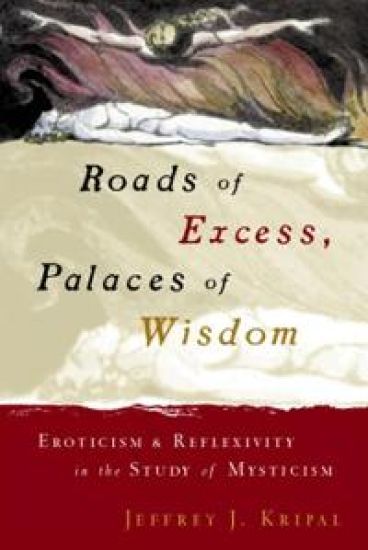
William Blake once wrote that "The road of excess leads to the palace of wisdom." Inspired by these poetic terms, Jeffrey J. Kripal reveals how the works of scholars of mysticism are often rooted in their own mystical experiences, "roads of excess," which can both lead to important insights into these scholars' works and point us to our own "palaces of wisdom."In his new book, Kripal addresses the twentieth-century study of mysticism as a kind of mystical tradition in its own right, with its own unique histories, discourses, sociological dynamics, and rhetorics of secrecy. Fluidly combining autobiography and biography with scholarly exploration, Kripal takes us on a tour of comparative mystical thought by examining the lives and works of five major historians of mysticism—Evelyn Underhill, Louis Massignon, R. C. Zaehner, Agehananda Bharati, and Elliot Wolfson—as well as relating his own mystical experiences. The result, Kripal finds, is seven "palaces of wisdom": the religious power of excess, the necessity of distance in the study of mysticism, the relationship between the mystical and art, the dilemmas of male subjectivity and modern heterosexuality, a call for ethical criticism, the paradox of the insider-outsider problem in the study of religion, and the magical power of texts and their interpretation. An original and penetrating analysis of modern scholarship and scholars of mysticism, Roads of Excess, Palaces of Wisdom is also a persuasive demonstration of the way this scholarly activity is itself a mystical phenomenon.
Roads of Excess, Palaces of Wisdom

Roads of Excess, Palaces of Wisdom

Jeffrey J. Kripal

University of Chicago Press
2001
sidottu
William Blake once wrote that "The road of excess leads to the palace of wisdom". Inspired by these poetic terms, Jeffrey J. Kripal reveals how the works of scholars of mysticism are often rooted in their own mystical experiences, "roads of excess", which can both lead to important insights into these scholars' works and point us to our own "palaces of wisdom". In his new book, Kripal addresses the 20th-century study of mysticism as a kind of mystical tradition in its own right, with its own unique histories, discourses, sociological dynamics and rhetorics of secrecy. Fluidly combining autobiography and biography with scholarly exploration, Kripal takes us on a tour of comparative mystical thought by examining the lives and works of five major historians of mysticism - Evelyn Underhill, Louis Massignon, R.C. Zaehner, Agehananda Bharati and Elliot Wolfson -as well as relating his own mystical experiences. The result, Kripal finds, is seven "palaces of wisdom": the religious power of excess, the necessity of distance in the study of mysticism, the relationship between the mystical and art, the dilemmas of male subjectivity and modern heterosexuality, a call for ethical criticism, the paradox of the insider-outsider problem in the study of religion, and the magical power of texts and their interpretation. An original and penetrating analysis of modern scholarship and scholars of mysticism, "Roads of Excess, Palaces of Wisdom" is also a persuasive demonstration of the way this scholarly activity is itself a mystical phenomenon.