Kirjojen hintavertailu. Mukana 12 459 402 kirjaa ja 12 kauppaa.

Kirjailija

Jeffrey Kenworthy

Kirjat ja teokset yhdessä paikassa: 5 kirjaa, julkaisuja vuosilta 1999-2020, suosituimpien joukossa Sustainability and Cities. Vertaile teosten hintoja ja tarkista saatavuus suomalaisista kirjakaupoista.

5 kirjaa

Kirjojen julkaisuhaarukka 1999-2020.

Big Moves

Big Moves

Anthony Perl; Matt Hern; Jeffrey Kenworthy

McGill-Queen's University Press
2020
sidottu
All countries have distinctive urban regions, but Canadian cities especially differ from one another in culture, structure, and history. Anthony Perl, Matt Hern, and Jeffrey Kenworthy reveal that despite the peculiarities and singular traits that each city embodies, a common logic has guided the development of transportation infrastructure across the country. Big Moves analyzes how Canada's three largest urban regions - Montreal, Toronto, and Vancouver - have been shaped by the interplay of globalized imperatives, aspirations, activism, investment, and local development initiatives, both historically and in a contemporary context. Canadian urban development follows a distinct pattern that involves compromise between local viewpoints and values and the pursuit of global capital at particular historical junctures. As the authors show, the success or failure of each city to construct major mobility infrastructure has always depended on the timing of investments and the specific ways that cities have gained access to necessary capital. Drawing on urban mobility history and global city theory, this book delves into the details of the big moves that have affected transport infrastructure in major Canadian cities. Knowing where urban development will head in the twenty-first century requires understanding how cities' major mobility infrastructures were built. Big Moves explains the shape of Canada's three biggest cities and how their mix of expressways and rapid transit emerged.
Big Moves

Big Moves

Anthony Perl; Matt Hern; Jeffrey Kenworthy

McGill-Queen's University Press
2020
nidottu
All countries have distinctive urban regions, but Canadian cities especially differ from one another in culture, structure, and history. Anthony Perl, Matt Hern, and Jeffrey Kenworthy reveal that despite the peculiarities and singular traits that each city embodies, a common logic has guided the development of transportation infrastructure across the country. Big Moves analyzes how Canada's three largest urban regions - Montreal, Toronto, and Vancouver - have been shaped by the interplay of globalized imperatives, aspirations, activism, investment, and local development initiatives, both historically and in a contemporary context. Canadian urban development follows a distinct pattern that involves compromise between local viewpoints and values and the pursuit of global capital at particular historical junctures. As the authors show, the success or failure of each city to construct major mobility infrastructure has always depended on the timing of investments and the specific ways that cities have gained access to necessary capital. Drawing on urban mobility history and global city theory, this book delves into the details of the big moves that have affected transport infrastructure in major Canadian cities. Knowing where urban development will head in the twenty-first century requires understanding how cities' major mobility infrastructures were built. Big Moves explains the shape of Canada's three biggest cities and how their mix of expressways and rapid transit emerged.
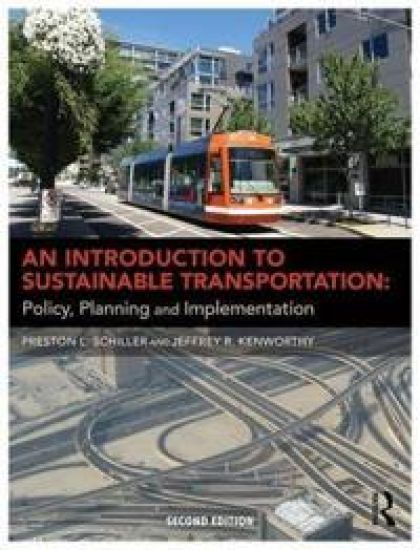
An Introduction to Sustainable Transportation

An Introduction to Sustainable Transportation

Preston L Schiller; Jeffrey Kenworthy

Routledge
2017
nidottu
Cities around the globe struggle to create better and more equitable access to important destinations and services, all the while reducing the energy consumption and environmental impacts of mobility. An Introduction to Sustainable Transportation illustrates a new planning paradigm for sustainable transportation through case studies from around the world with hundreds of valuable resources and references, color photos, graphics and tables.The second edition builds and expands upon the highly acclaimed first edition, with new chapters on urban design and urban, regional and intercity public transportation, as well as expanded chapters on automobile dependence and equity issues; automobile cities and the car culture; the history of sustainable and unsustainable transportation; the interrelatedness of technologies, infrastructure energy and functionalities; and public policy and public participation and exemplary places, people and programs around the globe. Among the many valuable additions are discussions of autonomous vehicles (AVs), electric vehicles (EVs), airport cities, urban fabrics, urban heat island effects and mobility as a service (MaaS). New case studies show global exemplars of sustainable transportation, including several from Asia, a case study of participative and deliberative public involvement, as well as one describing life in the Vauban ecologically planned community of Freiburg, Germany. Students in affiliated sustainability disciplines, planners, policymakers and concerned citizens will find many provides practical techniques to innovate and transform transportation.
The End of Automobile Dependence

The End of Automobile Dependence

Peter Newman; Jeffrey Kenworthy

Island Press
2015
nidottu
This book offers new guidance for urban and transportation planners and urban policy makers on how to accelerate development of cities away from automobile dependence. In The End of Automobile Dependence, Newman and Kenworthy look at how we can accelerate a planning approach to designing urban environments that can function reliably and conveniently on alternative modes, with a refined and more civilized automobile playing a very much reduced and manageable role in urban transportation. The authors examine the rise and fall of automobile dependence using updated data on 44 global cities to better understand how to facilitate and guide cities to the most productive and sustainable outcomes. This is the final volume in a trilogy by Newman and Kenworthy on automobile dependence (Cities and Automobile Dependence in 1989 and Sustainability and Cities: Overcoming Automobile Dependence in 1999). Like all good trilogies, this one shows the rise of an empire, in this case that of the automobile, the peak of its power, and the decline of that empire.
Sustainability and Cities

Sustainability and Cities

Peter Newman; Jeffrey Kenworthy; Peter Newman

Island Press
1999
pokkari
Our dependence on cars is a huge problem - one of the most difficult facing planners and city authorities as well as residents and commuters - but the authors of this work argue that it can be overcome and a new form of urban organization developed. The text examines the trends which shape global cities and establishes transport, economic and cultural priorities within this framework. With profiles of successful working examples from across the globe, it shows how we can overcome automobile dependence and successfully tackle issues on the sustainability agenda. It provides a resource for urban and transport planners as well as students and researchers.