Kirjojen hintavertailu. Mukana 12 595 353 kirjaa ja 12 kauppaa.

Kirjailija

Jeffrey M. Berry

Kirjat ja teokset yhdessä paikassa: 11 kirjaa, julkaisuja vuosilta 1993-2025, suosituimpien joukossa The Interest Group Society. Vertaile teosten hintoja ja tarkista saatavuus suomalaisista kirjakaupoista.

11 kirjaa

Kirjojen julkaisuhaarukka 1993-2025.

Everyday Democracy

Everyday Democracy

Jeffrey M. Berry; James M. Glaser; Deborah J. Schildkraut

THE UNIVERSITY OF CHICAGO PRESS
2025
nidottu
How the everyday habits and attitudes of ordinary liberals and conservatives shape the health of American democracy. In Everyday Democracy, Jeffrey M. Berry, James M. Glaser, and Deborah J. Schildkraut study Americans’ views of several manifestations of “everyday democracy,” which they define as the attitudes, behaviors, and processes that people experience in daily life and their routine considerations of politics and community. Examples include engaging in dialogue with political opponents and giving politicians license to compromise. Ordinary political moments like these constitute much of politics, and they can lay the foundation that shapes if, when, and how crisis moments unfold. Paying particular attention to the role of ideology in shaping how Americans emulate daily democratic ideals, this book considers such questions as: How do liberals and conservatives support different aspects of democratic practice, and are there ideological asymmetries between the two groups? If and when asymmetries emerge, what factors might explain them? The authors consider what their findings mean for the health of American democracy broadly.

Everyday Democracy

Everyday Democracy

Jeffrey M. Berry; James M. Glaser; Deborah J. Schildkraut

THE UNIVERSITY OF CHICAGO PRESS
2025
sidottu
How the everyday habits and attitudes of ordinary liberals and conservatives shape the health of American democracy. In Everyday Democracy, Jeffrey M. Berry, James M. Glaser, and Deborah J. Schildkraut study Americans’ views of several manifestations of “everyday democracy,” which they define as the attitudes, behaviors, and processes that people experience in daily life and their routine considerations of politics and community. Examples include engaging in dialogue with political opponents and giving politicians license to compromise. Ordinary political moments like these constitute much of politics, and they can lay the foundation that shapes if, when, and how crisis moments unfold. Paying particular attention to the role of ideology in shaping how Americans emulate daily democratic ideals, this book considers such questions as: How do liberals and conservatives support different aspects of democratic practice, and are there ideological asymmetries between the two groups? If and when asymmetries emerge, what factors might explain them? The authors consider what their findings mean for the health of American democracy broadly.
The Interest Group Society

The Interest Group Society

Jeffrey M. Berry; Clyde Wilcox

Routledge
2018
nidottu
Considered the gold standard on interest group politics, this widely-used text analyzes interest groups within the intuitive framework of democratic theory, enabling readers to understand the workings of interest groups within the larger context of our political system. Comprehensive coverage includes not only the traditional farm, labor, and trade associations, but also citizen groups, public interest organizations, corporations, and public interest firmsBrief in page count yet comprehensive in coverage, the book is flexible for different class settings. The book's rich content and lean size allows it to stand alone as the centerpiece of a course, or be assigned as one of several texts.New to the Sixth Edition Updates the role of money in interest group activity following the Citizens United Supreme Court decision. Covers new interest group actors including the Tea Party, Occupy, and others. Examines new developments in key interest group arenas including health care and the environment. Looks at the role of social media in interest groups.Adds a comparative look at interest group action, organization, and scholarship abroad.
The Interest Group Society

The Interest Group Society

Jeffrey M. Berry; Clyde Wilcox

Routledge
2018
sidottu
Considered the gold standard on interest group politics, this widely-used text analyzes interest groups within the intuitive framework of democratic theory, enabling readers to understand the workings of interest groups within the larger context of our political system. Comprehensive coverage includes not only the traditional farm, labor, and trade associations, but also citizen groups, public interest organizations, corporations, and public interest firmsBrief in page count yet comprehensive in coverage, the book is flexible for different class settings. The book's rich content and lean size allows it to stand alone as the centerpiece of a course, or be assigned as one of several texts.New to the Sixth Edition Updates the role of money in interest group activity following the Citizens United Supreme Court decision. Covers new interest group actors including the Tea Party, Occupy, and others. Examines new developments in key interest group arenas including health care and the environment. Looks at the role of social media in interest groups.Adds a comparative look at interest group action, organization, and scholarship abroad.
The Outrage Industry

The Outrage Industry

Jeffrey M. Berry; Sarah Sobieraj

Oxford University Press Inc
2016
nidottu
In early 2012, conservative radio host Rush Limbaugh claimed that Sandra Fluke, a Georgetown University law student who advocated for insurance coverage of contraceptives, "wants to be paid to have sex." Over the next few days, Limbaugh attacked Fluke personally, often in crude terms, while a powerful backlash grew, led by organizations such as the National Organization for Women. But perhaps what was most notable about the incident was that it wasn't unusual. From Limbaugh's venomous attacks on Fluke to liberal radio host Mike Malloy's suggestion that Bill O'Reilly "drink a vat of poison... and choke to death," over-the-top discourse in today's political opinion media is pervasive. Anyone who observes the skyrocketing number of incendiary political opinion shows on television and radio might conclude that political vitriol on the airwaves is fueled by the increasingly partisan American political system. But in The Outrage Industry Jeffrey M. Berry and Sarah Sobieraj show how the proliferation of outrage-the provocative, hyperbolic style of commentary delivered by hosts like Ed Schultz, Bill O'Reilly, and Sean Hannity- says more about regulatory, technological, and cultural changes, than it does about our political inclinations. Berry and Sobieraj tackle the mechanics of outrage rhetoric, exploring its various forms such as mockery, emotional display, fear mongering, audience flattery, and conspiracy theories. They then investigate the impact of outrage rhetoric-which stigmatizes cooperation and brands collaboration and compromise as weak-on a contemporary political landscape that features frequent straight-party voting in Congress. Outrage tactics have also facilitated the growth of the Tea Party, a movement which appeals to older, white conservatives and has dragged the GOP farther away from the demographically significant moderates whose favor it should be courting. Finally, The Outrage Industry examines how these shows sour our own political lives, exacerbating anxieties about political talk and collaboration in our own communities. Drawing from a rich base of evidence, this book forces all of us to consider the negative consequences that flow from our increasingly hyper-partisan political media.
Lobbying for the People

Lobbying for the People

Jeffrey M. Berry

Princeton University Press
2016
sidottu
In recent years there has been growing recognition of the role played in American politics by groups such as Common Cause, the Sierra Club, and Zero Population Growth. This book considers their work in terms of their origins and development, resources, patterns of recruitment, decision-making processes, and lobbying tactics. How do public interest groups select the issues on which they work? How do they allocate their resources? How do they choose strategies for influencing the federal government? Professor Berry examines these questions, focusing in particular on the process by which organizations make critical decisions. His findings are based on a survey of eighty-three national organizations with offices in Washington, D.C. He analyzes in detail the operation of two groups in which he worked as a participant. Originally published in 1977. The Princeton Legacy Library uses the latest print-on-demand technology to again make available previously out-of-print books from the distinguished backlist of Princeton University Press. These editions preserve the original texts of these important books while presenting them in durable paperback and hardcover editions. The goal of the Princeton Legacy Library is to vastly increase access to the rich scholarly heritage found in the thousands of books published by Princeton University Press since its founding in 1905.
Lobbying for the People

Lobbying for the People

Jeffrey M. Berry

Princeton University Press
2015
pokkari
In recent years there has been growing recognition of the role played in American politics by groups such as Common Cause, the Sierra Club, and Zero Population Growth. This book considers their work in terms of their origins and development, resources, patterns of recruitment, decision-making processes, and lobbying tactics. How do public interest groups select the issues on which they work? How do they allocate their resources? How do they choose strategies for influencing the federal government? Professor Berry examines these questions, focusing in particular on the process by which organizations make critical decisions. His findings are based on a survey of eighty-three national organizations with offices in Washington, D.C. He analyzes in detail the operation of two groups in which he worked as a participant. Originally published in 1977. The Princeton Legacy Library uses the latest print-on-demand technology to again make available previously out-of-print books from the distinguished backlist of Princeton University Press. These editions preserve the original texts of these important books while presenting them in durable paperback and hardcover editions. The goal of the Princeton Legacy Library is to vastly increase access to the rich scholarly heritage found in the thousands of books published by Princeton University Press since its founding in 1905.
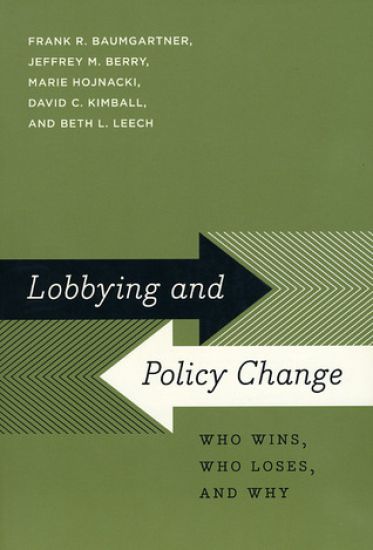
Lobbying and Policy Change

Lobbying and Policy Change

Frank R. Baumgartner; Jeffrey M. Berry; Marie Hojnacki; David C. Kimball; Beth L. Leech

University of Chicago Press
2009
nidottu
During the 2008 election season, politicians from both sides of the aisle promised to rid government of lobbyists' undue influence. For the authors of Lobbying and Policy Change, the most extensive study ever done on the topic, these promises ring hollow - not because politicians fail to keep them but because lobbies are far less influential than political rhetoric suggests. Based on a comprehensive examination of ninety-eight issues, this volume demonstrates that sixty percent of recent lobbying campaigns failed to change policy despite millions of dollars spent trying. Why? The authors find that resources explain less than five percent of the difference between successful and unsuccessful efforts. Moreover, they show, these attempts must overcome an entrenched Washington system with a tremendous bias in favor of the status quo. Though elected officials and existing policies carry more weight, lobbies have an impact too, and when advocates for a given issue finally succeed, policy tends to change significantly. The authors argue, however, that the lobbying community so strongly reflects elite interests that it will not fundamentally alter the balance of power unless its makeup shifts dramatically in favor of average Americans' concerns.
A Voice for Nonprofits

A Voice for Nonprofits

Jeffrey M. Berry

Brookings Institution
2005
nidottu
"Nonprofit organizations are playing an increasingly important role in delivering basic government services. Yet they are discouraged by federal law from participating in legislative lobbying efforts—even on issues that affect their clients directly. Without the involvement of nonprofits in the governmental process, the vulnerable populations they serve are left without effective representation in the political system. A Voice for Nonprofits analyzes the effect of government restrictions on the participation of nonprofits in the policymaking process and suggests ways to address the problems. The relationship between nonprofits and the government is ideal in many respects, according to Jeffrey M. Berry and David F. Arons. By underwriting operating budgets and subcontracting the administration of programs to nonprofits, governments at all levels are able to take advantage of nonprofits' dedication, imagination, and private fund-raising skills. However, as nonprofits assume greater responsibility for delivering services traditionally provided by government, that responsibility is not matched by a congruous increase in policy influence. Berry and Arons believe the lobbying restrictions should be eased so that nonprofits may become more involved in public policymaking. Their recommendations are designed to ensure that nonprofit organizations—and the constituencies they serve—are effectively represented in the American political system. "
The New Liberalism

The New Liberalism

Jeffrey M. Berry

Brookings Institution
2000
nidottu
"If you think liberalism is dead, think again. In this sure-to-be-controversial book, Jeffrey M. Berry argues that modern liberalism is not only still alive, it's actually thriving. Today's new liberalism has evolved from a traditional emphasis on bread-and-butter economic issues to a form he calls ""postmaterialism""--quality-of-life concerns such as enhancing the environment, protecting consumers, or promoting civil rights. Berry credits the new liberalism's success to the rise of liberal citizen lobbying groups. By analyzing the activities of Congress during three sessions (1963, 1979, and 1991), he demonstrates the correlation between the increasing lobbying activities of citizen groups and a dramatic shift in the American political agenda from an early 1960s emphasis on economic equality to today's postmaterialist issues. Although conservative groups also began to emphasize postmaterial concerns--such as abortion and other family value issues--Berry finds that liberal citizen groups have been considerably more effective than conservative ones at getting their goals onto the congressional agenda and enacted into legislation. The book provides many examples of citizen group issues that Congress enacted into law, successes when citizen groups were in direct conflict with business interests and when demands were made on behalf of traditionally marginalized constituencies, such as the women's and civil rights movements. Berry concludes that although liberal citizen groups make up only a small portion of the thousands of lobbying organizations in Washington, they have been, and will continue to be, a major force in shaping the political landscape."
The Rebirth of Urban Democracy

The Rebirth of Urban Democracy

Jeffrey M. Berry; Kent E. Portney; Ken Thomson

Brookings Institution
1993
nidottu
"In an era when government seems remote and difficult to approach, participatory democracy may seem a hopelessly romantic notion. Yet nothing is more crucial to the future of American democracy than to develop some way of spurring greater citizen participation. In this important book, Jeffrey Berry, Ken Portney, and Ken Thompson examine cities that have created systems of neighborhood government and incorporated citizens in public policymaking. Through careful research and analysis, the authors find that neighborhood based participation is the key to revitalizing American democracy. The Rebirth of Urban Democracy provides a thorough examination of five cities with strong citizen participation programs--Birmingham, Dayton, Portland, St. Paul, and San Antonio. In each city, the authors explore whether neighborhood associations encourage more people to participate; whether these associations are able to promote policy responsiveness on the art of local governments; and whether participation in these associations increases the capacity of people to take part in government. Finally, the authors outline the steps that can be taken to increase political participation in urban America. Berry, Portney, and Thomson show that citizens in participatory programs are able to get their issues on the public agenda and develop a stronger sense of community, greater trust in government officials, and more confidence in the political system. From a rigorous evaluation of surveys and interviews with thousands of citizens and policymakers, the authors also find that central governments in these cities are highly responsive to their neighborhoods and that less conflict exists among citizens and policymakers. The authors assert that these programs can provide a blueprint for major reform in cities across the country. They outline the components for successful participation programs and offer recommendations for those who want to get involved. They demonstrate that participation systems can influence citizens to become more knowledgeable, more productive, and more confident in government; and can provide more governments with a mechanism for being more responsive in setting priorities and formulating polices that closely approximate the true preferences of the people."