Kirjojen hintavertailu. Mukana 12 390 323 kirjaa ja 12 kauppaa.

Kirjailija

Jeffrey Pfeffer

Kirjat ja teokset yhdessä paikassa: 17 kirjaa, julkaisuja vuosilta 1993-2024, suosituimpien joukossa What Were They Thinking?. Vertaile teosten hintoja ja tarkista saatavuus suomalaisista kirjakaupoista.

17 kirjaa

Kirjojen julkaisuhaarukka 1993-2024.

7 Rules of Power: Surprising--But True--Advice on How to Get Things Done and Advance Your Career
If you want to "change lives, change organizations, change the world," the Stanford business school's motto, you need power. Is power the last dirty secret or the secret to success? Both. While power carries some negative connotations, power is a tool that can be used for good or evil. Don't blame the tool for how some people used it. If fully understood and harnessed effectively, power skills and understanding become the keys to increasing salaries, job satisfaction, career advancement, organizational change, and, happiness. In 7 Rules of Power, Jeffrey Pfeffer, professor of organizational behavior at the Stanford University Graduate School of Business, provides the insights that have made both his online and on-campus classes incredibly popular--with life-changing results often achieved in 8 or 10 weeks. Rooted firmly in social science research, Pfeffer's 7 rules provide a manual for increasing your ability to get things done, including increasing the positive effects of your job performance. The 7 rules are: 1) Get out of your own way. 2) Break the rules. 3) Show up in powerful fashion. 4) Create a powerful brand. 5) Network relentlessly. 6) Use your power. 7) Understand that once you have acquired power, what you did to get it will be forgiven, forgotten, or both. With 7 Rules of Power, you'll learn, through both numerous examples as well as research evidence, how to accomplish change in your organization, your life, the lives of others, and the world.

7 Rules of Power

7 Rules of Power

Jeffrey Pfeffer

Swift Press
2023
pokkari
If you want to 'change lives, change organizations, change the world,' the Stanford business school’s motto, you need power. Is power the last dirty secret or the secret to success? Both. While power carries some negative connotations, power is a tool that can be used for good or evil. Don’t blame the tool for how some people used it. Rooted firmly in social science research, Pfeffer’s 7 rules provide a manual for increasing your ability to get things done, including increasing the positive effects of your job performance. With 7 Rules of Power, you’ll learn, through both numerous examples as well as research evidence, how to accomplish change in your organization, your life, the lives of others, and the world.

Power: Why Some People Have It--And Others Don't

Power: Why Some People Have It--And Others Don't

Jeffrey Pfeffer

Harpercollins
2020
mp3 cd-levyllä
"Pfeffer blends] academic rigor and practical genius into wonderfully readable text. The leading thinker on the topic of power, Pfeffer here distills his wisdom into an indispensable guide." --Jim Collins, author of New York Times bestselling author Good to Great and How the Mighty FallSome people have it, and others don't. Jeffrey Pfeffer explores why, in Power.One of the greatest minds in management theory and author or co-author of thirteen books, including the seminal business-school text Managing With Power, Jeffrey Pfeffer shows readers how to succeed and wield power in the real world.
Power Lib/E: Why Some People Have It--And Others Don't
"Pfeffer blends] academic rigor and practical genius into wonderfully readable text. The leading thinker on the topic of power, Pfeffer here distills his wisdom into an indispensable guide." --Jim Collins, author of New York Times bestselling author Good to Great and How the Mighty FallSome people have it, and others don't. Jeffrey Pfeffer explores why, in Power.One of the greatest minds in management theory and author or co-author of thirteen books, including the seminal business-school text Managing With Power, Jeffrey Pfeffer shows readers how to succeed and wield power in the real world.
Power: Why Some People Have It--And Others Don't
"Pfeffer blends] academic rigor and practical genius into wonderfully readable text. The leading thinker on the topic of power, Pfeffer here distills his wisdom into an indispensable guide." --Jim Collins, author of New York Times bestselling author Good to Great and How the Mighty FallSome people have it, and others don't. Jeffrey Pfeffer explores why, in Power.One of the greatest minds in management theory and author or co-author of thirteen books, including the seminal business-school text Managing With Power, Jeffrey Pfeffer shows readers how to succeed and wield power in the real world.
Dying for a Paycheck

Dying for a Paycheck

Jeffrey Pfeffer

HarperBusiness
2018
sidottu
In one survey, 61 percent of employees said that workplace stress had made them sick and 7 percent said they had actually been hospitalized. Job stress costs US employers more than $300 billion annually and may cause 120,000 excess deaths each year. In China, 1 million people a year may be dying from overwork. People are literally dying for a paycheck. And it needs to stop.In this timely, provocative book, Jeffrey Pfeffer contends that many modern management commonalities such as long work hours, work-family conflict, and economic insecurity are toxic to employees--hurting engagement, increasing turnover, and destroying people's physical and emotional health--and also inimical to company performance. He argues that human sustainability should be as important as environmental stewardship.You don't have to do a physically dangerous job to confront a health-destroying, possibly life-threatening, workplace. Just ask the manager in a senior finance role whose immense workload, once handled by several employees, required frequent all-nighters--leading to alcohol and drug addiction. Or the dedicated news media producer whose commitment to getting the story resulted in a sixty-pound weight gain thanks to having no down time to eat properly or exercise. Or the marketing professional prescribed antidepressants a week after joining her employer.In Dying for a Paycheck, Jeffrey Pfeffer marshals a vast trove of evidence and numerous examples from all over the world to expose the infuriating truth about modern work life: even as organizations allow management practices that literally sicken and kill their employees, those policies do not enhance productivity or the bottom line, thereby creating a lose-lose situation.Exploring a range of important topics including layoffs, health insurance, work-family conflict, work hours, job autonomy, and why people remain in toxic environments, Pfeffer offers guidance and practical solutions all of us--employees, employers, and the government--can use to enhance workplace wellbeing. We must wake up to the dangers and enormous costs of today's workplace, Pfeffer argues. Dying for a Paycheck is a clarion call for a social movement focused on human sustainability. Pfeffer makes clear that the environment we work in is just as important as the one we live in, and with this urgent book, he opens our eyes and shows how we can make our workplaces healthier and better.
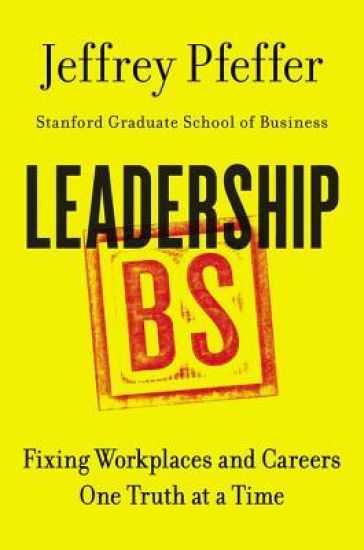
Leadership BS

Leadership BS

Jeffrey Pfeffer

HarperBusiness
2015
sidottu
Finalist for the 2015 Financial Times and McKinsey Business Book of the Year Best business book of the week from Inc.com The author of Power, Stanford business school professor, and a leading management thinker offers a hard-hitting dissection of the leadership industry and ways to make workplaces and careers work better. The leadership enterprise is enormous, with billions of dollars, thousands of books, and hundreds of thousands of blogs and talks focused on improving leaders. But what we see worldwide is employee disengagement, high levels of leader turnover and career derailment, and failed leadership development efforts. In Leadership BS, Jeffrey Pfeffer shines a bright light on the leadership industry, showing why it's failing and how it might be remade. He sets the record straight on the oft-made prescriptions for leaders to be honest, authentic, and modest, tell the truth, build trust, and take care of others. By calling BS on so many of the stories and myths of leadership, he gives people a more scientific look at the evidence and better information to guide their careers. Rooted in social science, and will practical examples and advice for improving management, Leadership BS encourages readers to accept the truth and then use facts to change themselves and the world for the better.
Power

Power

Jeffrey Pfeffer

HarperBusiness
2010
sidottu
Over decades of consulting with corporations and the people who run them and 30 years teaching MBA students the nuances of organisational power, Jeffrey Pfeffer has watched numerous people suffer career reversals even as others prevail despite the odds. The most common mistake: most of us don't have a realistic understanding of what makes some people more successful than others. We tend to subscribe to the just world phenomenon, believing that life is fair, rendering us unprepared for the challenges and competition of the real world. Now, Pfeffer brings decades of research and incredible insights to a wide audience. Brimming with counterintuitive advice, numerous examples from a variety of countries, and surprising but research-based findings, his groundbreaking guide reveals the strategies and tactics that separate the winners from the losers. Power, he argues, is a force that can be used and harnessed for individual gain, but also for the benefit of organisations and society. Power, however, cannot be learned from those in charge - their advice often puts a rosy spin on their ascent and focuses on what should have worked, rather than what did. Instead, he reveals the actual paths to power and career success. Iconoclastic and grounded in the realpolitik of human interaction, "Power" is an essential organisational survival manual and a new standard in the field of leadership and management.
What Were They Thinking?

What Were They Thinking?

Jeffrey Pfeffer

Harvard Business Review Press
2007
sidottu
Every day companies and their leaders fail to capitalize on opportunities because they misunderstand the real sources of business success. Based on his popular column in Business 2.0, Jeffrey Pfeffer delivers wise and timely business commentary that challenges conventional wisdom while providing data and insights to help companies make smarter decisions. The book contains a series of short chapters filled with examples, data, and insights that challenge questionable assumptions and much conventional management wisdom. Each chapter also provides guidelines about how to think more deeply and intelligently about critical management issues. Covering topics ranging from managing people to leadership to measurement and strategy, it's good organizational advice, delivered by Dr. Pfeffer himself.
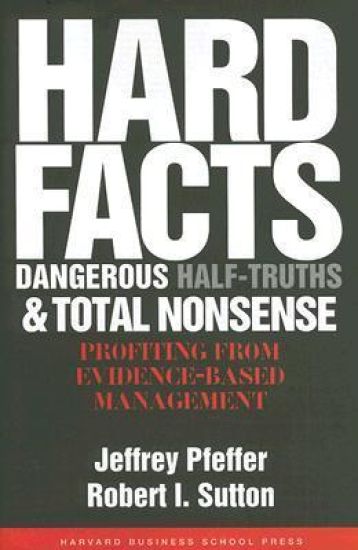
Hard Facts, Dangerous Half-Truths, and Total Nonsense

Hard Facts, Dangerous Half-Truths, and Total Nonsense

Jeffrey Pfeffer; Robert I. Sutton

Harvard Business Review Press
2006
sidottu
The best organizations have the best talent...Financial incentives drive company performance...Firms must change or die. Popular axioms like these drive business decisions every day. Yet too much common management "wisdom" isn't wise at all--but, instead, flawed knowledge based on "best practices" that are actually poor, incomplete, or outright obsolete. Worse, legions of managers use this dubious knowledge to make decisions that are hazardous to organizational health. Jeffrey Pfeffer and Robert I. Sutton show how companies can bolster performance and trump the competition through evidence-based management, an approach to decision-making and action that is driven by hard facts rather than half-truths or hype. This book guides managers in using this approach to dismantle six widely held--but ultimately flawed--management beliefs in core areas including leadership, strategy, change, talent, financial incentives, and work-life balance. The authors show managers how to find and apply the best practices for their companies, rather than blindly copy what seems to have worked elsewhere. This practical and candid book challenges leaders to commit to evidence-based management as a way of organizational life--and shows how to finally turn this common sense into common practice.
The External Control of Organizations

The External Control of Organizations

Jeffrey Pfeffer; Gerald R. Salancik

Stanford University Press
2003
pokkari
Among the most widely cited books in the social sciences, The External Control of Organizations has long been required reading for any student of organization studies. The book, reissued on its 25th anniversary as part of the Stanford Business Classics series, includes a new preface written by Jeffrey Pfeffer, which examines the legacy of this influential work in current research and its relationship to other theories. The External Control of Organizations explores how external constraints affect organizations and provides insights for designing and managing organizations to mitigate these constraints. All organizations are dependent on the environment for their survival. As the authors contend, "it is the fact of the organization's dependence on the environment that makes the external constraint and control of organizational behavior both possible and almost inevitable." Organizations can either try to change their environments through political means or form interorganizational relationships to control or absorb uncertainty. This seminal book established the resource dependence approach that has informed so many other important organization theories.
Hidden Value

Hidden Value

Charles A. O'Reilly; Jeffrey Pfeffer

Harvard Business Review Press
2000
sidottu
Discover how the best companies win not by acquiring the right people - but by building the right organization. The 'war for talent' is one battle every company believes it should be waging. But while competitors are busy chasing after the same 'hot' individuals, smart companies are doing something infinitely more useful and far more difficult to copy - they're building organizations that make it possible for ordinary people at every desk and cubicle in their companies to perform as if they were stars. Blowing up the prevailing wisdom that companies must chase and acquire top talent in order to remain successful, "Hidden Value" argues instead that the source of sustained competitive advantage already exists within every organization. O'Reilly and Pfeffer, leading experts on organizational behavior and human resources, argue that how a firm creates and uses talent is far more important than how the firm attracts talent. The authors provide vivid, detailed case studies of several organizations in widely disparate industries - including Southwest Airlines, Cisco Systems, The Men's Wearhouse, and NUMMI - to illustrate how long-term success comes from value-driven, interrelated systems that align good people management with corporate strategy. In a refreshing break from management tomes that force-feed superficial frameworks and trite 'rules', the authors instead allow the company stories to take center stage. They guide readers in discovering for themselves how seven different firms maximize talent, why one firm hasn't fully released the hidden value in its work force, and, most importantly, how the winning companies have made it tough for competitors to imitate them. Collectively, the stories reveal a common path to success that places values before strategy, emphasizes implementation over planning, and focuses on getting the best out of all employees, not just individual stars. The authors also explore concerns or questions managers might have about how each company's experience parallels or conflicts with their own. Providing a rare opportunity for managers to actively participate in an invaluable learning process, "Hidden Value" offers a customizable template for building high-performance, people-centered organizations.
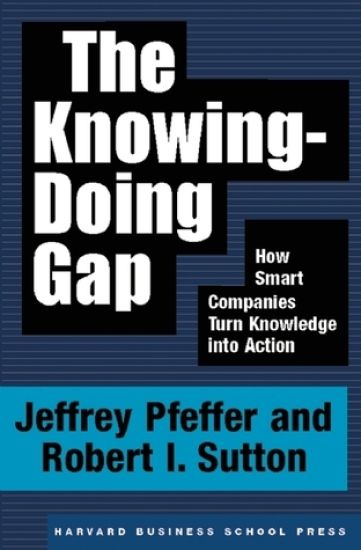
The Knowing-Doing Gap

The Knowing-Doing Gap

Jeffrey Pfeffer; Robert I. Sutton

Harvard Business Review Press
1999
sidottu
Why are there so many gaps between what firms know they should do and what they actually do? Why do so many companies fail to implement the experience and insight they've worked so hard to acquire? The Knowing-Doing Gap is the first book to confront the challenge of turning knowledge about how to improve performance into actions that produce measurable results. Jeffrey Pfeffer and Robert Sutton, well-known authors and teachers, identify the causes of the knowing-doing gap and explain how to close it. The message is clear--firms that turn knowledge into action avoid the "smart talk trap." Executives must use plans, analysis, meetings, and presentations to inspire deeds, not as substitutes for action. Companies that act on their knowledge also eliminate fear, abolish destructive internal competition, measure what matters, and promote leaders who understand the work people do in their firms. The authors use examples from dozens of firms that show how some overcome the knowing-doing gap, why others try but fail, and how still others avoid the gap in the first place. The Knowing-Doing Gap is sure to resonate with executives everywhere who struggle daily to make their firms both know and do what they know. It is a refreshingly candid, useful, and realistic guide for improving performance in today's business.
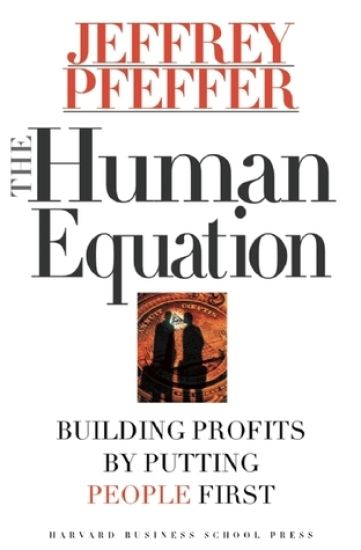
The Human Equation

The Human Equation

Jeffrey Pfeffer

Harvard Business Review Press
1998
sidottu
Why is common sense so uncommon when it comes to managing people? How is it that so many seemingly intelligent organizations implement harmful management practices and ideas? In his provocative new book, The Human Equation, bestselling author Jeffrey Pfeffer examines why much of the current conventional wisdom is wrong and asks us to re-think the way managers link people with organizational performance. Pfeffer masterfully builds a powerful business case for managing people effectively--not just because it makes for good corporate policy, but because it results in outstanding performance and profits. Challenging current thinking and practice, Pfeffer: reveals the costs of downsizing and provides alternatives; identifies troubling trends in compensation, and suggests better practices; explains why even the smartest managers sometimes manage people unwisely; demonstrates how market-based forces can fail to create good people management practices, creating a need for positive public policy; and provides practical guidelines for implementing high-performance management practices. Filled with information and ideas, The Human Equation provides much-needed guidance for managing people more wisely and more profitably.
New Directions for Organization Theory

New Directions for Organization Theory

Jeffrey Pfeffer

Oxford University Press Inc
1997
sidottu
This is a comprehensive analysis of the present state of organization theory. The author traces the evolution and particularly the more recent history of the field, and its scope and content. He then considers the relevant literature organized by major issues and concepts. Jeffrey Pfeffer makes the point that the world of organizations the book surveys has changed in four important ways: the increasing externalization of the employment relation and the development of the "new employment contract;" the change in the size distribution of organizations, with a comparative growth in the proportion of smaller organizations; the increasing influence of external capital markets on organizational governance and decision making; and the increasing salary inequality within organizations in the U.S. compared both to the past and to other industrialized nations. These changes make it especially important to understand the organizations themselves. The author is a major scholar in the field of organizations and his perspective should be of considerable interest to scholars and students in the field.
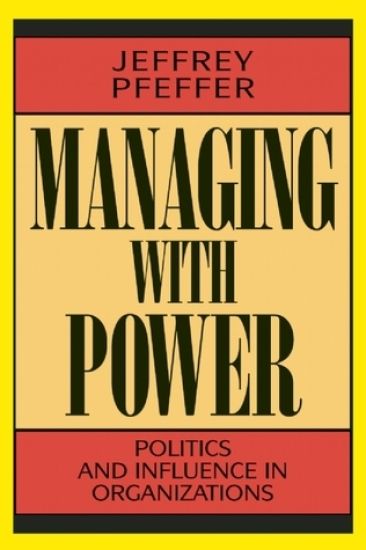
Managing With Power

Managing With Power

Jeffrey Pfeffer

Harvard Business Review Press
1993
pokkari
Although much as been written about how to make better decisions, a decision by itself changes nothing. The big problem facing managers and their organizations today is one of implementation--how to get things done in a timely and effective way. Problems of implementation are really issues of how to influence behavior, change the course of events, overcome resistance, and get people to do things they would not otherwise do. In a word, power. Managing With Power provides an in-depth look at the role of power and influence in organizations. Pfeffer shows convincingly that its effective use is an essential component of strong leadership. With vivid examples, he makes a compelling case for the necessity of power in mobilizing the political support and resources to get things done in any organization. He provides an intriguing look at the personal attributes--such as flexibility, stamina, and a high tolerance for conflict--and the structural factors--such as control of resources, access to information, and formal authority--that can help managers advance organizational goals and achieve individual success.