Kirjojen hintavertailu. Mukana 12 595 353 kirjaa ja 12 kauppaa.

Kirjailija

Jeffrey Robbins

Kirjat ja teokset yhdessä paikassa: 5 kirjaa, julkaisuja vuosilta 2010-2016, suosituimpien joukossa An Insurrectionist Manifesto. Vertaile teosten hintoja ja tarkista saatavuus suomalaisista kirjakaupoista.

5 kirjaa

Kirjojen julkaisuhaarukka 2010-2016.

An Insurrectionist Manifesto

An Insurrectionist Manifesto

Ward Blanton; Clayton Crockett; Jeffrey Robbins; Noëlle Vahanian; Peter Rollins; Catherine Keller

Columbia University Press
2016
pokkari
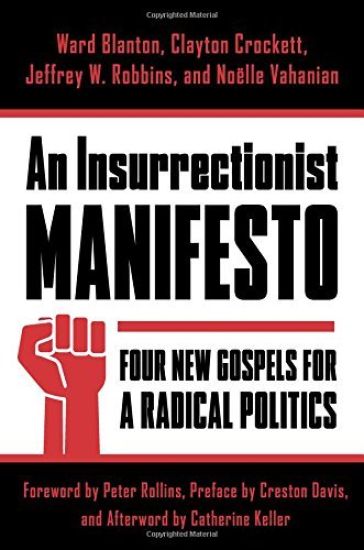
An Insurrectionist Manifesto contains four insurrectionary gospels based on Martin Heidegger's philosophical model of the fourfold: earth and sky, gods and mortals. Challenging religious dogma and dominant philosophical theories, they offer a cooperative, world-affirming political theology that promotes new life through not resurrection but insurrection. The insurrection in these gospels unfolds as a series of miraculous yet worldly practices of vital affirmation. Since these routines do not rely on fantasies of escape, they engender intimate transformations of the self along the very coordinates from which they emerge. Enacting a comparative and contagious postsecular sensibility, these gospels draw on the work of Slavoj Zizek, Giorgio Agamben, Catherine Malabou, Francois Laruelle, Peter Sloterdijk, and Gilles Deleuze yet rejuvenate scholarship in continental philosophy, critical race theory, the new materialisms, speculative realism, and nonphilosophy. They think beyond the sovereign force of the one to initiate a radical politics "after" God.
An Insurrectionist Manifesto

An Insurrectionist Manifesto

Ward Blanton; Clayton Crockett; Jeffrey Robbins; Noëlle Vahanian; Peter Rollins; Catherine Keller

Columbia University Press
2016
sidottu
An Insurrectionist Manifesto contains four insurrectionary gospels based on Martin Heidegger's philosophical model of the fourfold: earth and sky, gods and mortals. Challenging religious dogma and dominant philosophical theories, they offer a cooperative, world-affirming political theology that promotes new life through not resurrection but insurrection. The insurrection in these gospels unfolds as a series of miraculous yet worldly practices of vital affirmation. Since these routines do not rely on fantasies of escape, they engender intimate transformations of the self along the very coordinates from which they emerge. Enacting a comparative and contagious postsecular sensibility, these gospels draw on the work of Slavoj Zizek, Giorgio Agamben, Catherine Malabou, Francois Laruelle, Peter Sloterdijk, and Gilles Deleuze yet rejuvenate scholarship in continental philosophy, critical race theory, the new materialisms, speculative realism, and nonphilosophy. They think beyond the sovereign force of the one to initiate a radical politics "after" God.
Radical Democracy and Political Theology

Radical Democracy and Political Theology

Jeffrey Robbins

Columbia University Press
2013
pokkari
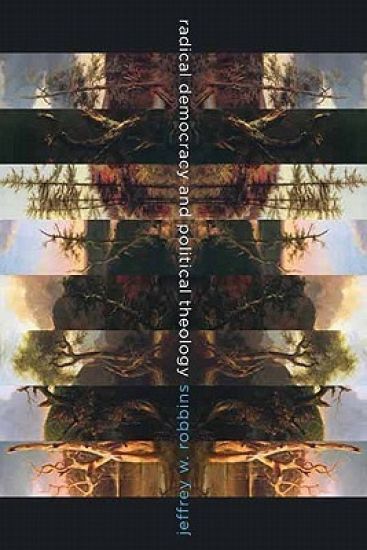
Alexis de Tocqueville once wrote that "the people reign over the American political world like God over the universe," unwittingly casting democracy as the political instantiation of the death of God. According to Jeffrey W. Robbins, Tocqueville's assessment remains an apt observation of modern democratic power, which does not rest with a sovereign authority but operates as a diffuse social force. By linking radical democratic theory to a contemporary fascination with political theology, Robbins envisions the modern experience of democracy as a social, cultural, and political force transforming the nature of sovereign power and political authority. Robbins joins his work with Michael Hardt and Antonio Negri's radical conception of "network power," as well as Sheldon Wolin's notion of "fugitive democracy," to fashion a political theology that captures modern democracy's social and cultural torment. This approach has profound implications not only for the nature of contemporary religious belief and practice but also for the reconceptualization of the proper relationship between religion and politics. Challenging the modern, liberal, and secular assumption of a neutral public space, Robbins conceives of a postsecular politics for contemporary society that inextricably links religion to the political. While effectively recasting the tradition of radical theology as a political theology, this book also develops a comprehensive critique of the political theology bequeathed by Carl Schmitt. It marks an original and visionary achievement by the scholar the Journal of the American Academy of Religion hailed "one of the best commentators on religion and postmodernism."
Radical Democracy and Political Theology

Radical Democracy and Political Theology

Jeffrey Robbins

Columbia University Press
2011
sidottu
Alexis de Tocqueville once wrote that "the people reign over the American political world like God over the universe," unwittingly casting democracy as the political instantiation of the death of God. According to Jeffrey W. Robbins, Tocqueville's assessment remains an apt observation of modern democratic power, which does not rest with a sovereign authority but operates as a diffuse social force. By linking radical democratic theory to a contemporary fascination with political theology, Robbins envisions the modern experience of democracy as a social, cultural, and political force transforming the nature of sovereign power and political authority. Robbins joins his work with Michael Hardt and Antonio Negri's radical conception of "network power," as well as Sheldon Wolin's notion of "fugitive democracy," to fashion a political theology that captures modern democracy's social and cultural torment. This approach has profound implications not only for the nature of contemporary religious belief and practice but also for the reconceptualization of the proper relationship between religion and politics. Challenging the modern, liberal, and secular assumption of a neutral public space, Robbins conceives of a postsecular politics for contemporary society that inextricably links religion to the political. While effectively recasting the tradition of radical theology as a political theology, this book also develops a comprehensive critique of the political theology bequeathed by Carl Schmitt. It marks an original and visionary achievement by the scholar the Journal of the American Academy of Religion hailed "one of the best commentators on religion and postmodernism."
An Ethics for Today

An Ethics for Today

Richard Rorty; Jeffrey Robbins; G. Dann

Columbia University Press
2010
sidottu
Richard Rorty is famous, maybe even infamous, for his philosophical nonchalance. His groundbreaking work not only rejects all theories of truth but also dismisses modern epistemology and its preoccupation with knowledge and representation. At the same time, the celebrated pragmatist believed there could be no universally valid answers to moral questions, which led him to a complex view of religion rarely expressed in his writings. In this posthumous publication, Rorty, a strict secularist, finds in the pragmatic thought of John Dewey, John Stuart Mill, William James, and George Santayana, among others, a political imagination shared by religious traditions. His intent is not to promote belief over nonbelief or to blur the distinction between religious and public domains. Rorty seeks only to locate patterns of similarity and difference so an ethics of decency and a politics of solidarity can rise. He particularly responds to Pope Benedict XVI and his campaign against the relativist vision. Whether holding theologians, metaphysicians, or political ideologues to account, Rorty remains steadfast in his opposition to absolute uniformity and its exploitation of political strength.