Kirjojen hintavertailu. Mukana 12 478 655 kirjaa ja 12 kauppaa.

Kirjailija

Jeffrey Shallit

Kirjat ja teokset yhdessä paikassa: 4 kirjaa, julkaisuja vuosilta 2003-2022, suosituimpien joukossa A Second Course in Formal Languages and Automata Theory. Vertaile teosten hintoja ja tarkista saatavuus suomalaisista kirjakaupoista.

4 kirjaa

Kirjojen julkaisuhaarukka 2003-2022.

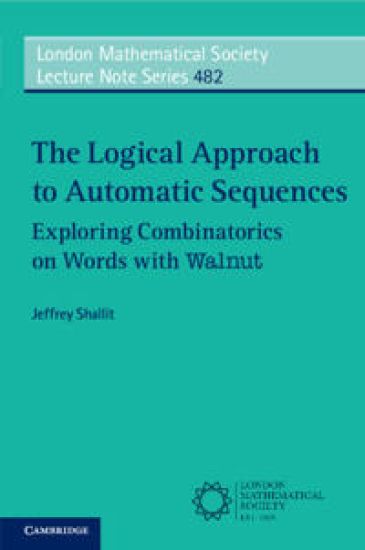
The Logical Approach to Automatic Sequences

The Logical Approach to Automatic Sequences

Jeffrey Shallit

Cambridge University Press
2022
pokkari
Automatic sequences are sequences over a finite alphabet generated by a finite-state machine. This book presents a novel viewpoint on automatic sequences, and more generally on combinatorics on words, by introducing a decision method through which many new results in combinatorics and number theory can be automatically proved or disproved with little or no human intervention. This approach to proving theorems is extremely powerful, allowing long and error-prone case-based arguments to be replaced by simple computations. Readers will learn how to phrase their desired results in first-order logic, using free software to automate the computation process. Results that normally require multipage proofs can emerge in milliseconds, allowing users to engage with mathematical questions that would otherwise be difficult to solve. With more than 150 exercises included, this text is an ideal resource for researchers, graduate students, and advanced undergraduates studying combinatorics, sequences, and number theory.
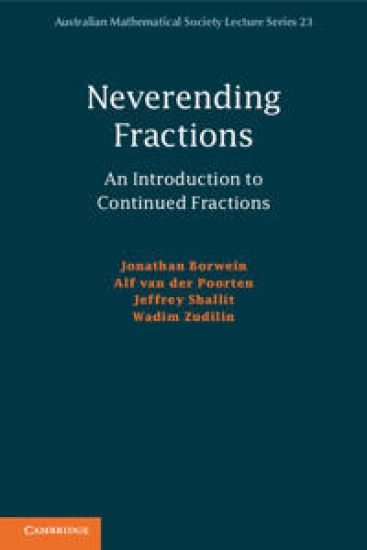
Neverending Fractions

Neverending Fractions

Jonathan Borwein; Alf van der Poorten; Jeffrey Shallit; Wadim Zudilin

Cambridge University Press
2014
pokkari
Despite their classical nature, continued fractions are a neverending research area, with a body of results accessible enough to suit a wide audience, from researchers to students and even amateur enthusiasts. Neverending Fractions brings these results together, offering fresh perspectives on a mature subject. Beginning with a standard introduction to continued fractions, the book covers a diverse range of topics, from elementary and metric properties, to quadratic irrationals, to more exotic topics such as folded continued fractions and Somos sequences. Along the way, the authors reveal some amazing applications of the theory to seemingly unrelated problems in number theory. Previously scattered throughout the literature, these applications are brought together in this volume for the first time. A wide variety of exercises guide readers through the material, which will be especially helpful to readers using the book for self-study, and the authors also provide many pointers to the literature.
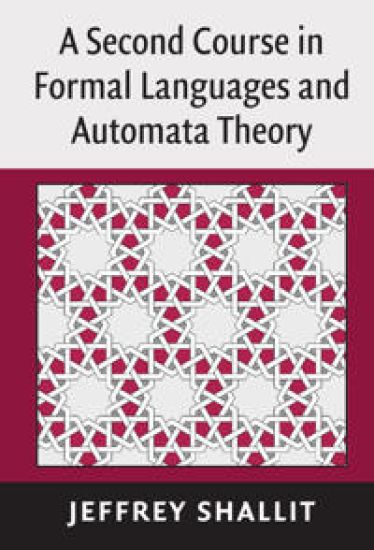
A Second Course in Formal Languages and Automata Theory

A Second Course in Formal Languages and Automata Theory

Jeffrey Shallit

Cambridge University Press
2008
sidottu
Written for graduate students and advanced undergraduates in computer science, A Second Course in Formal Languages and Automata Theory treats topics in the theory of computation not usually covered in a first course. After a review of basic concepts, the book covers combinatorics on words, regular languages, context-free languages, parsing and recognition, Turing machines, and other language classes. Many topics often absent from other textbooks, such as repetitions in words, state complexity, the interchange lemma, 2DPDAs, and the incompressibility method, are covered here. The author places particular emphasis on the resources needed to represent certain languages. The book also includes a diverse collection of more than 200 exercises, suggestions for term projects, and research problems that remain open.
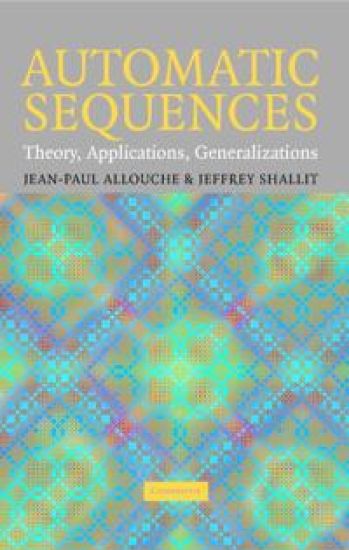
Automatic Sequences

Automatic Sequences

Jean-Paul Allouche; Jeffrey Shallit

Cambridge University Press
2003
sidottu
Uniting dozens of seemingly disparate results from different fields, this book combines concepts from mathematics and computer science to present the first integrated treatment of sequences generated by ‘finite automata’. The authors apply the theory to the study of automatic sequences and their generalizations, such as Sturmian words and k-regular sequences. And further, they provide applications to number theory (particularly to formal power series and transcendence in finite characteristic), physics, computer graphics, and music. Starting from first principles wherever feasible, basic results from combinatorics on words, numeration systems, and models of computation are discussed. Thus this book is suitable for graduate students or advanced undergraduates, as well as for mature researchers wishing to know more about this fascinating subject. Results are presented from first principles wherever feasible, and the book is supplemented by a collection of 460 exercises, 85 open problems, and over 1600 citations to the literature.