
Kirjojen hintavertailu. Mukana 12 595 353 kirjaa ja 12 kauppaa.

Kirjailija

Jeffrey Wasserman

Kirjat ja teokset yhdessä paikassa: 5 kirjaa, julkaisuja vuosilta 1991-2005, suosituimpien joukossa Combating Teen Smoking. Vertaile teosten hintoja ja tarkista saatavuus suomalaisista kirjakaupoista.

5 kirjaa

Kirjojen julkaisuhaarukka 1991-2005.

Combating Teen Smoking

Combating Teen Smoking

Peter D. Jacobson; Kenneth Edgar Warner; Paula M. Lantz; Jeffrey Wasserman; Harold Alexander Pollack; Alexis Kristiana Ahlstrom

The University of Michigan Press
2001
nidottu
Every year, more than 400,000 Americans die prematurely because of tobacco use. Most began smoking during their teen years. Adolescent tobacco use remains our nation's most preventable threat to life and health. This public health crisis has generated widespread debate over how best to prevent young people from initiating smoking or using other tobacco products. Combating Teen Smoking is an invaluable guide for policymakers and communities on the front lines of this prevention effort.Synthesizing recent research regarding the prevention and control of adolescent smoking, this book offers the reader a convenient compendium of what is known about adolescents and tobacco use; it also highlights areas where additional research is needed. Based on their assessment of the considerable amount of information presented, the authors recommend various ways to help slow--or even reverse--the recent rise in teenage smoking. A comprehensive antitobacco program might include, for example, antismoking media campaigns based on social marketing strategies, clean indoor air laws, and the increase of cigarette prices.Combating Teen Smoking will appeal to a broad spectrum of readers concerned about the problem of adolescent tobacco use, including policymakers who are actively seeking ways to help reduce teen smoking.Peter D. Jacobson is Associate Professor, University of Michigan School of Public Health. Paula Lantz is Assistant Professor, University of Michigan School of Public Health. Kenneth Warner is Richard D. Remington Collegiate Professor of Public Health and Director, University of Michigan Tobacco Research Network. Jeffrey Wasserman is Consultant, the RAND Corporation and Senior Project Director, The MEDSTAT Group. Harold Pollack is Assistant Professor, University of Michigan School of Public Health. Alexis Ahlstrom is Research Associate, University of Michigan School of Public Health.
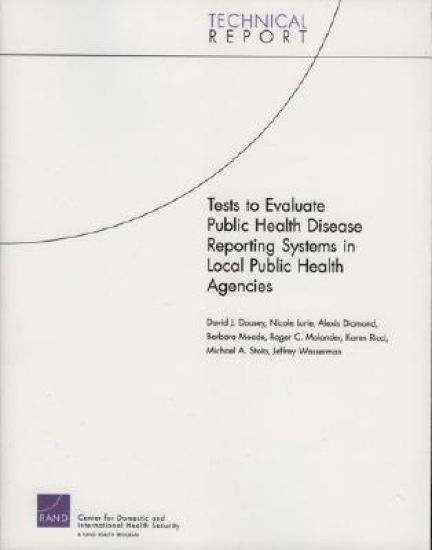
Tests to Evaluate Public Health Disease Reporting Systems in Local Public Health Agencies

Tests to Evaluate Public Health Disease Reporting Systems in Local Public Health Agencies

David J. Dausey; Nicole Lurie; Alexis Diamond; Barbara Meade; Roger C. Molander; Karen Ricci; Michael A. Stoto; Jeffrey Wasserman

RAND
2005
pokkari
A manual of standardized proficiency tests to help public health agencies develop strategies for testing their disease reporting systems. This operations manual provides public health agencies with a set of standardized proficiency tests to aid in the development of regular and consistent strategies for testing the ability of public health disease reporting systems to receive and respond to case reports 24 hours a day, seven days a week.
Understanding Potential Changes to the Veterans Equitable

Understanding Potential Changes to the Veterans Equitable

Jeffrey Wasserman; Jeanne S. Ringel; Karen Ricci; Jesse Malkin; Barbara Wynn; Jack Zwanziger; Sydne Newberry; Marika Suttorp; Afshin Rastegar

RAND
2004
pokkari
This analysis determines how particular patient and facility characteristics influence Veterans Equitable Resource Allocation (VERA) system allocations to the Department of Veterans Affairs regional service networks and simplifies and refines the models created in earlier RAND research to reflect policy changes and more recent data. The Veterans Health Administration asked RAND to conduct a quantitative analysis of the Veterans Equitable Resource Allocation (VERA) system, which allocates the congressionally appropriated medical care budget to the Veterans Integrated Service Networks. The study determines how particular patient and facility characteristics influence allocations to the service networks and simplifies and refines the models created in earlier RAND research to reflect policy changes and more recent data.
An Analysis of Potential Adjustments to the Veterans Equitable Resource Allocation (VERA) System
The Veterans Health Administration asked RAND to undertake a quantitative analysis of the Veterans Equitable Resource Allocation System (VERA), which allocates the congressionally appropriated medical care budget to the Veterans Integrated Service Networks (VISNs). The modelling approach used in this analysis provides a tool that VA policymakers can use for making resource allocation decisions.
The Costs of Poor Health Habits

The Costs of Poor Health Habits

Willard G Manning; Emmett B Keeler; Joseph P Newhouse; Elizabeth M Sloss; Jeffrey Wasserman

Harvard University Press
1991
sidottu
Poor health habits (drinking, smoking, lack of exercise) obviously take their toll on individuals and their families. The costs to society are less obvious but certainly more far-reaching. This investigation is the first to quantify the financial burden these detrimental habits place on American taxpayers. Willard Manning and his colleagues measure the direct costs of poor health habits (fire damage, motor vehicle accidents, legal fees), as well as collectively financed costs (medical care, employee sick leave, group health and life insurance, nursing home care, retirement pensions, liability insurance). Consider two co-workers covered by their employer's health plan: both pay the same premium, yet if one drinks heavily, the other--through their mutual insurance program--involuntarily funds the resulting health problems. After laying out their conceptual framework, methods, and analytical approach, the authors describe precisely how and to what extent drinking, smoking, and lack of exercise are currently subsidized, and make recommendations for reducing or reallocating the expense. They present, for example, a persuasive case for raising excise taxes on alcohol. The authors correlate their data to make costs comparable, to avoid double counting, and to determine the exact costs of each of these poor health habits and some of their findings are quite surprising. This unique study will be indispensable to public health policy specialists and researchers, as well as to health economists.