Kirjojen hintavertailu. Mukana 12 282 216 kirjaa ja 12 kauppaa.

Kirjailija

Jennifer D. P. Moroney

Kirjat ja teokset yhdessä paikassa: 38 kirjaa, julkaisuja vuosilta 2006-2025, suosituimpien joukossa Security Cooperation in a Strategic Competition. Vertaile teosten hintoja ja tarkista saatavuus suomalaisista kirjakaupoista.

Mukana myös kirjoitusasut: Jennifer D P Moroney

38 kirjaa

Kirjojen julkaisuhaarukka 2006-2025.

Overcoming Barriers to Working with Highly Capable Allies and Partners in the Air, Space, and Cyber Domains

Overcoming Barriers to Working with Highly Capable Allies and Partners in the Air, Space, and Cyber Domains

Jennifer D P Moroney; Stephanie Pezard; David E Thaler; Gene Germanovich; Beth Grill; Bruce McClintock; Karen Schwindt; Mary Kate Adgie; Anika Binnendijk; Kevin J Connolly; Katie Feistel; Jeffrey W Hornung; Alison K Hottes; Moon Kim; Isabelle Nazha; Gabrielle Tarini; Mark Toukan; Jalen Zeman

RAND Corporation
2023
pokkari
In this report, the authors use 11 case studies to create a typology of the barriers that impede U.S. security cooperation with highly capable allies and partners; identify some of the more specific barriers in the air, space, and cyber domains; suggest mitigation strategies for each of these barriers; and propose a preliminary approach for implementing some of these mitigation strategies.
Funding Global Health Engagement to Support the Geographic Combatant Commands

Funding Global Health Engagement to Support the Geographic Combatant Commands

Beth Grill; Trupti Brahmbhatt; Pauline Moore; Jennifer D P Moroney; Chandler Sachs

RAND Corporation
2023
pokkari
Global health engagement (GHE) provides an important mechanism to work with allies and partners to develop their medical capacity and medical support capabilities and improve U.S. interoperability with allies and partners. In this report, the authors identify the evolving GHE priorities of five of the six geographic commands and the challenges they face supporting combatant command objectives with current sources of funding for GHE activities.
Security Cooperation in a Strategic Competition

Security Cooperation in a Strategic Competition

Michael J Mazarr; Nathan Beauchamp-Mustafaga; Jonah Blank; Samuel Charap; Michael S Chase; Beth Grill; Derek Grossman; Dara Massicot; Jennifer D P Moroney; Lyle J Morris; Alexander Noyes; Stephanie Pezard; Ashley L Rhoades; Alice Shih; Mark Stalczynski; Melissa Shostak; David E Thaler; Dori Walker

RAND Corporation
2022
pokkari
In this study, RAND researchers examined the current role of security cooperation efforts as a tool in the emerging strategic competition among the United States, Russia, and China. In particular, they sought to identify how, where, and to what degree the three major competitors?plus Australia, Japan, India, and several countries in Europe?are using security cooperation.
Prioritizing Security Cooperation with Highly Capable U.S. Allies

Prioritizing Security Cooperation with Highly Capable U.S. Allies

Angela O'Mahony; David E Thaler; Beth Grill; Jennifer D P Moroney; Jason H Campbell; Rachel Tecott; Mary Kate Adgie

RAND
2022
nidottu
In this report, researchers present recommendations for enabling the U.S. Army to better prioritize and coordinate its security cooperation activities with its allies for coalition operations and engagements in third countries, allowing it to meet its assigned objectives and strengthen combined capabilities to compete strategically and counter common threats around the world.
Countering Violent Extremism in Australia and Abroad

Countering Violent Extremism in Australia and Abroad

Andrew Lauland; Jennifer D P Moroney; John G Rivers

RAND
2019
nidottu
As countries around the world develop countering violent extremism (CVE) programs to prevent homegrown terrorism, there is a dearth of understanding about what types of CVE programs exist and which CVE approaches are most effective. This report documents an effort to help CVE program directors and policymakers place their efforts in context and identify promising approaches internationally.
Factoring Security Cooperation Into Core U.S. Air Force Decisionmaking Processes

Factoring Security Cooperation Into Core U.S. Air Force Decisionmaking Processes

David E Thaler; Beth Grill; Jefferson P Marquis; Jennifer D P Moroney; Stephanie Pezard

RAND
2018
nidottu
Security cooperation is an important mission of the U.S. Air Force. This report reviews two core Air Force decisionmaking processes--the strategy, planning, and programming process and the concept development and acquisition process--to determine the extent to which decisionmakers consider security cooperation impact and to recommend ways to make such considerations systematic and explicit.
Assessment of the Consolidation of the Australian Customs and Border Protection Service (Acbps) with the Department of Immigration and Border Protection (Dibp)
RAND conducted an analysis of the effectiveness and efficiency of Australia's newly integrated Department of Immigration and Border Protection. The integration reflects an important inflection point in the history of customs, immigration, and border-management activities within the government of Australia.
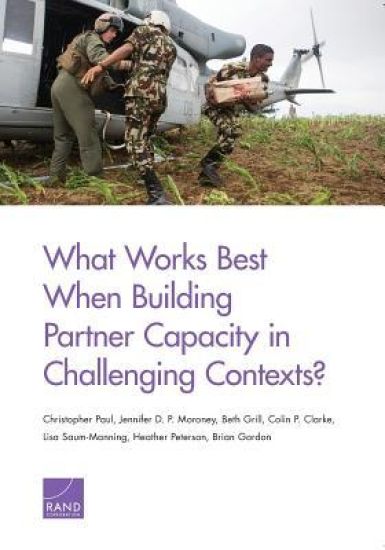
What Works Best When Building Partner Capacity in Challenging Contexts?

What Works Best When Building Partner Capacity in Challenging Contexts?

Christopher Paul; Jennifer D. P. Moroney; Beth Grill; Colin P. Clarke; Lisa Saum-Manning; Heather Peterson; Brian Gordon

RAND
2015
pokkari
Strategic imperatives sometimes compel the United States to work with partner nations that lack the characteristics that favor success in building partner capacity. This report explores what the United States can do in such contexts to maximize prospects for success by specifically looking at potential challenges and workarounds and deriving recommendations for future engagements.
Review of Security Cooperation Mechanisms Combatant Commands Utilize to Build Partner Capacity
Security cooperation is an important instrument of the U.S. government for advancing national security objectives vis-a-vis allies and partner countries. This report characterizes security cooperation mechanisms for capacity-building, produces a detailed database of the mechanism elements, develops and applies a preliminary means of evaluating select mechanisms, and recommends ways to improve mechanism effectiveness and efficiency.
Lessons from U.S. Allies in Security Cooperation with Third Countries

Lessons from U.S. Allies in Security Cooperation with Third Countries

Jennifer D. P. Moroney; Celeste Ward Gventer; Stephanie Pezard; Laurence Smallman

RAND
2011
pokkari
Several key U.S. allies engage in security cooperation, albeit on a smaller scale than the United States. To see what the U.S. Air Force can learn from these efforts, the authors examined how and why three allies--Australia, France, and the United Kingdom--provide security cooperation and highlight three key areas that could benefit from further collaboration: staff talks, exercises, and training followed by exercises.
Adding Value to Air Force Management Through Building Partnerships Assessment

Adding Value to Air Force Management Through Building Partnerships Assessment

Jefferson P. Marquis; Joe Hogler; Jennifer D. P. Moroney; Michael J. Neumann; Christopher Paul

RAND
2011
pokkari
The U.S. Air Force works to build strong and enduring partnerships with allies and friendly nations, to reinforce their capacity to defend themselves and to work in coalitions, and to ensure U.S. access to foreign territories. This volume evaluates existing Air Force capacity to conduct assessments of its security cooperation programs and describes a framework for improving assessment efforts.
Security Cooperation Organizations in the Country Team: Options for Success

Security Cooperation Organizations in the Country Team: Options for Success

Terrence M. Kelly; Jefferson P. Marquis; Cathryn Quantic Thurston; Jennifer D. P. Moroney; Charlotte Lynch

RAND
2010
pokkari
Security assistance and security cooperation are interrelated missions that rely on military staffs in U.S. embassies in partner countries. In countries threatened by insecurity or instability, actions may be required that are not easily accomplished under current systems. This report examines three options for improving current approaches to security assistance and cooperation. They range from changes in current practices to options requiring new policies, procedures, organizations, or authorities.
Preparing and Training for the Full Spectrum of Military Challenges

Preparing and Training for the Full Spectrum of Military Challenges

David E. Johnson; Jennifer D. P. Moroney; Roger Cliff; M. Wade Markel; Laurence Smallman; Michael Spirtas

RAND
2010
pokkari
What can the United States learn from other militaries about how better to prepare for full-spectrum operations - simultaneous offensive, defensive, and stability or civil support operations - and deployments? The authors examine the militaries of China, France, the UK, India, and Israel to identify different approaches to readiness, adaptability, and operational issues, including using subject-matter experts to improve training for specific deployments * using staff training to prepare forces for multiple contingencies; allowing combat training centers to focus on foundational skills; and, preparing units for a specific operational environment prior to deployment. The authors also examine how the United States, France, and the UK prepare for and conduct train, advise, and assist (TAA) missions, finding that the three countries employ significantly different approaches to staff selection, TAA deployments, staff training, and career progression.
International Cooperation with Partner Air Forces

International Cooperation with Partner Air Forces

Jennifer D P Moroney; Kim Cragin; Eric Gons; Beth Grill; John E Peters

RAND
2009
pokkari
The Air Force faces a challenging environment as it devises an approach to managing security cooperation with partner countries. The important mission of countering terrorist and insurgent groups abroad requires working closely with allies and partner countries to strengthen security. Accordingly, current U.S. defense strategy emphasizes that the U.S. armed forces should do more to work "by, with, and through partners" to accomplish missions.
Future U.S. Security Relationship with Iraq and Afghanistan

Future U.S. Security Relationship with Iraq and Afghanistan

David E. Thaler; Theodore W. Karasik; Dalia Dassa Kaye; Jennifer D. P. Moroney; Frederic M. Wehrey; Obaid Younossi; Farhana Ali; Robert A. Guffey

RAND
2008
pokkari
The authors describe possible regional security structures and bilateral U.S. relationships with Iraq and Afghanistan. They recommend that the United States offer a wide range of security cooperation activities to compatible future governments in Kabul and Baghdad and should also plan to hedge against less-favorable contingencies. They emphasize that the U.S. Air Force should expect to remain heavily tasked for the foreseeable future.This book frames potential long-term U.S. security relationships with Iraq and Afghanistan in a regional context and posits roles of U.S. forces, especially the Air Force, in supporting these relationships under a variety of contingencies.