Kirjojen hintavertailu. Mukana 12 390 323 kirjaa ja 12 kauppaa.

Kirjailija

Jennifer Rowsell

Kirjat ja teokset yhdessä paikassa: 18 kirjaa, julkaisuja vuosilta 2010-2025, suosituimpien joukossa Language, Ethnography, and Education. Vertaile teosten hintoja ja tarkista saatavuus suomalaisista kirjakaupoista.

18 kirjaa

Kirjojen julkaisuhaarukka 2010-2025.

Language, Ethnography, and Education

Language, Ethnography, and Education

Michael Grenfell; David Bloome; Cheryl Hardy; Kate Pahl; Jennifer Rowsell; Brian V Street

Routledge
2011
sidottu
This frontline volume contributes to the social study of education in general and literacy in particular by bringing together in a new way the traditions of language, ethnography, and education. Integrating New Literacy Studies and Bourdieusian sociology with ethnographic approaches to the study of classroom practice, it offers an original and useful reference point for scholars and students of education, language, and literacy wishing to incorporate Bourdieu’s ideas into their work.More than just a set of stand-alone chapters around social perspectives on language interactions in classrooms, this book develops and unfolds dialogically across three sections: Bridging New Literacy Studies and Bourdieu – Principles; Language, Ethnography and Education - Practical Studies; Working at the Intersections – In Theory and Practice.The authors posit ‘Classroom Language Ethnography’ as a genuinely new perspective with rich and developed traditions behind it, but distinct from conventional approaches to literacy and education — an approach that bridges those traditions to yield fresh insights on literacy in all its manifestations, thereby providing a pathway to more robust research on language in education.
Language, Ethnography, and Education

Language, Ethnography, and Education

Michael Grenfell; David Bloome; Cheryl Hardy; Kate Pahl; Jennifer Rowsell; Brian V Street

Routledge
2011
nidottu
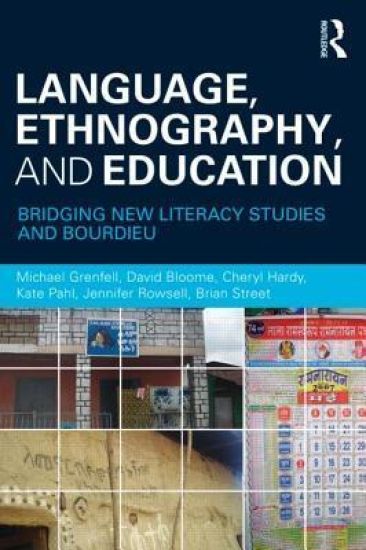
This frontline volume contributes to the social study of education in general and literacy in particular by bringing together in a new way the traditions of language, ethnography, and education. Integrating New Literacy Studies and Bourdieusian sociology with ethnographic approaches to the study of classroom practice, it offers an original and useful reference point for scholars and students of education, language, and literacy wishing to incorporate Bourdieu’s ideas into their work.More than just a set of stand-alone chapters around social perspectives on language interactions in classrooms, this book develops and unfolds dialogically across three sections: Bridging New Literacy Studies and Bourdieu – Principles; Language, Ethnography and Education - Practical Studies; Working at the Intersections – In Theory and Practice.The authors posit ‘Classroom Language Ethnography’ as a genuinely new perspective with rich and developed traditions behind it, but distinct from conventional approaches to literacy and education — an approach that bridges those traditions to yield fresh insights on literacy in all its manifestations, thereby providing a pathway to more robust research on language in education.
The Comfort of Screens

The Comfort of Screens

Jennifer Rowsell

Cambridge University Press
2025
pokkari
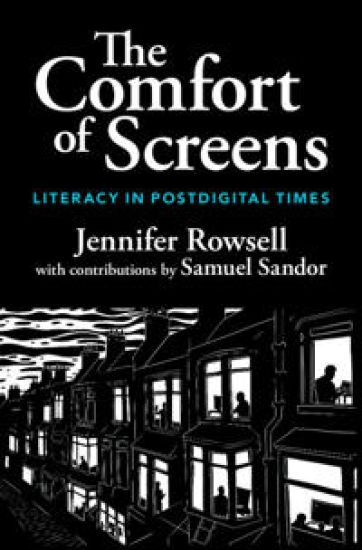
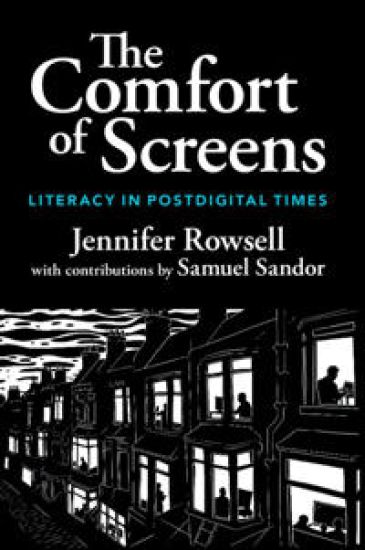
Are screens the modern mirrors of the soul? The postdigital condition blurs the line between screens, humans, physical contexts, virtual worlds, analogue texts, and time as linear and lockstep. This book presents a unique study into people and their screen lives, giving readers an original perspective on digital literacies and communication in an ever-changing and capaciously connected world. Seventeen individuals who all live on the same crescent, aged from 23 to 84, share their thoughts, habits, and ruminations on screen lives, illuminating eclectic, complex, and dynamic insights about life in a postdigital age. Their stories are brought to life through theory, interview excerpts, song lyrics, and woodcut illustrations. Breaking free from digital literacy as a separate, discrete skill to one that should be taught as it is lived – especially as automation, AI, and algorithms encroach into our everyday lives – this fascinating book pulls readers into the future of digital education.
The Comfort of Screens

The Comfort of Screens

Jennifer Rowsell

Cambridge University Press
2025
sidottu
Are screens the modern mirrors of the soul? The postdigital condition blurs the line between screens, humans, physical contexts, virtual worlds, analogue texts, and time as linear and lockstep. This book presents a unique study into people and their screen lives, giving readers an original perspective on digital literacies and communication in an ever-changing and capaciously connected world. Seventeen individuals who all live on the same crescent, aged from 23 to 84, share their thoughts, habits, and ruminations on screen lives, illuminating eclectic, complex, and dynamic insights about life in a postdigital age. Their stories are brought to life through theory, interview excerpts, song lyrics, and woodcut illustrations. Breaking free from digital literacy as a separate, discrete skill to one that should be taught as it is lived – especially as automation, AI, and algorithms encroach into our everyday lives – this fascinating book pulls readers into the future of digital education.
Teacher Professionalism in the Global South

Teacher Professionalism in the Global South

Leon Tikly; Rafael Mitchell; Angeline Barrett; Poonam Batra; Alexandra Bernal; Leanne Cameron; Alf Coles; Zawadi Juma; Nidia Aviles Nunez; Julia Paulson; Nigusse Weldemariam Reda; Jennifer Rowsell; Michael Tusiime; Beatriz Vejarano

Bristol University Press
2024
sidottu
This book provides a decolonial critique of dominant global agendas concerning teacher professionalism and proposes a new understanding based on UNESCO-funded research with teachers based in Colombia, Ethiopia (Tigray), India, Rwanda and Tanzania. Outlining from a teacher’s perspective how teacher professionalism may be conceptualized, this book critiques dominant global narratives and conceptions based on deficit discourses. The authors argue that a decolonial lens can help to contextualize the perspectives, experiences and material conditions of teachers in the global South, and the value of such a framework for informing global debates and decision-making in education.
Family Literacy Experiences

Family Literacy Experiences

Jennifer Rowsell

PEMBROKE PUBLISHING LTD
2023
pokkari
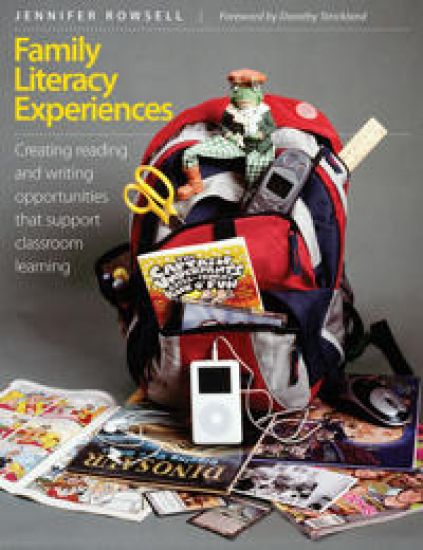
Based on the belief that literacy takes place everywhere, the book promotes learning strategies that incorporate what we see, read, hear, and do every day. The stories of students, teachers, education leaders, and parents bring immediacy to this powerful book.
Living Literacies

Living Literacies

Kate Pahl; Jennifer Rowsell

MIT Press
2020
nidottu
This book approaches literacy as lived and experienced in the everyday. A living literacies approach draws not only on such official, schooled activities as reading, writing, speaking, and listening but also on such routine, tacit activities as scrolling through Instagram, watching news footage, and listening to music. It goes beyond well-worn framings of literacy as an object of study to reimagine literacy as constantly in motion, vital, and dynamic, filled with affective intensities.A lived literacies approach implies a turn to activism, to hopeful practice, and to creativity. The authors examine literacies through a series of active verbs- seeing, disrupting, hoping, knowing, creating, and making. Case studies-ranging from an exploration of photography as a way to shift perspectives to a project in which adults teach young people how to fish-show lived literacies in both theory and practice. With these chapters, the authors position literacy differently. They make it possible to see literacy in everyday activities, woven into the modes of seeing and knowing. By disruption and activism, literacy can encompass a wide array of practices-exchanging information at a school gate or making a collage. Grounding theory in the sites and spaces of their research, working with artists, photographers, poets, and makers, the authors issue a call to action for literacy education.
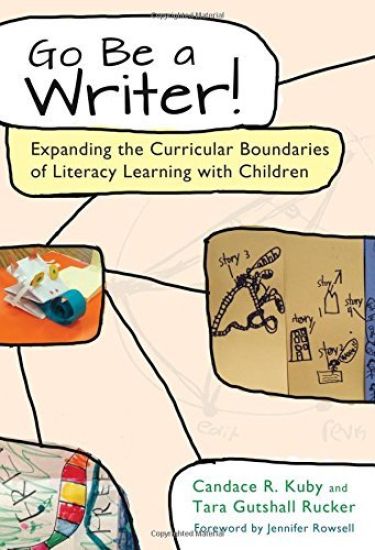
Go Be a Writer!

Go Be a Writer!

Candace R. Kuby; Tara Gutshall Rucker; Jennifer Rowsell

Teachers' College Press
2016
sidottu
This book provides an introduction to poststructural and posthumanist theories in order to imagine new possibilities for expanding literacy education. The authors put to work these theories in the context of an elementary school classroom, examining literacy-based activities that occur as students participate with materials in a multimedia writers’ studio. Focusing on literacy processes, the book emphasizes the fluid and sometimes unintentional ways multimodal artifacts come into being through intra-actions with human and nonhuman materials. Because these theories emphasize the unplanned, nonlinear aspects of literacy, the authors demonstrate an approach to literacy that works against the grain of standardization and rigid curricular models. Go Be a Writer! reveals that when educators appreciate the value of unscripted intra-actions they allow for more authentic learning.
Go Be a Writer!

Go Be a Writer!

Candace R. Kuby; Tara Gutshall Rucker; Jennifer Rowsell

Teachers' College Press
2016
nidottu
This book provides an introduction to poststructural and posthumanist theories in order to imagine new possibilities for expanding literacy education. The authors put to work these theories in the context of an elementary school classroom, examining literacy-based activities that occur as students participate with materials in a multimedia writers’ studio. Focusing on literacy processes, the book emphasizes the fluid and sometimes unintentional ways multimodal artifacts come into being through intra-actions with human and nonhuman materials. Because these theories emphasize the unplanned, nonlinear aspects of literacy, the authors demonstrate an approach to literacy that works against the grain of standardization and rigid curricular models. Go Be a Writer! reveals that when educators appreciate the value of unscripted intra-actions they allow for more authentic learning.
Resourcing Early Learners

Resourcing Early Learners

Sue Nichols; Jennifer Rowsell; Helen Nixon; Sophia Rainbird

Routledge
2014
nidottu
The landscape of early childhood education and care is changing. Governments world-wide are assuming increasing authority in relation to child-rearing in the years before school entry, beyond the traditional role in assisting parents to do the best they can by their children. As part of a social agenda aimed at forming citizens well prepared to play an active part in a globalised knowledge economy, the idea of ‘early learning’ expresses the necessity of engaging caregivers right from the start of children’s lives. Nichols, Rowsell, Rainbird, and Nixon investigate this trend over three years, in two countries, and three contrasting regions, by setting themselves the task of tracing every service and agent offering resources under the banner of early learning. Far from a dry catalogue, the study involves in-depth ethnographic research in fascinating spaces such as a church-run centre for African refugee women and children, a state-of-the-art community library and an Australian country town. Included is an unprecedented inventory of an entire suburban mall. Richly visually documented, the study employs emerging methods such as Google-mapping to trace the travels of actual parents as they search for particular resources. Each chapter features a context investigated in this large, international study: the library, the mall, the clinic, and the church. The author team unravels new spaces and new networks at work in early childhood literacy and development.
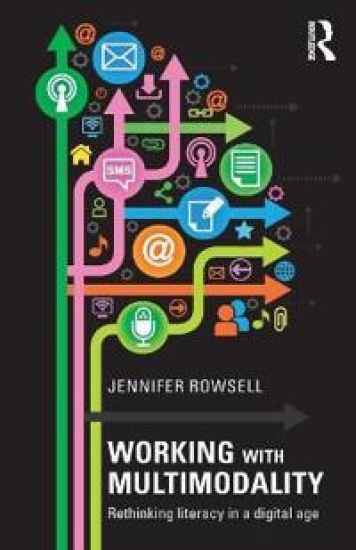
Working with Multimodality

Working with Multimodality

Jennifer Rowsell

Routledge
2012
sidottu
In today’s digital world, we have multiple modes of meaning-making: sounds, images, hypertexts. Yet, within literacy education, even ‘new’ literacies, we know relatively little about how to work with and produce modally complex texts. In Working with Multimodality, Jennifer Rowsell focuses on eight modes: words, images, sounds, movement, animation, hypertext, design and modal learning. Throughout the book each mode is illustrated by cases studies based on the author’s interviews with thirty people, who have extensive experience working with a mode in their field. From a song writer to a well known ballet dancer, these people all discuss what it means to do multimodality well. This accessible textbook brings the multiple modes together into an integrated theory of multimodality. Step-by-step, beginning with theory then exploring modes and how to work with them, before concluding with how to apply this in an investigation, each stage of working with multimodality is covered.Working with Multimodality will help students and scholars to: • Think about specific modes and how they function • Consider the implications for multimodal meaning-making • Become familiar with conventions and folk knowledge about given modes • Apply this same knowledge to their own production of media texts in classrooms Assuming no prior knowledge about multimodality and its properties, Working with Multimodality is designed to appeal to advanced undergraduate and postgraduate students interested in how learning and innovation is different in a digital and media age and is an essential textbook for courses in literacy, new media and multimodality within applied linguistics , education and communication studies.
Working with Multimodality

Working with Multimodality

Jennifer Rowsell

Routledge
2012
nidottu
In today’s digital world, we have multiple modes of meaning-making: sounds, images, hypertexts. Yet, within literacy education, even ‘new’ literacies, we know relatively little about how to work with and produce modally complex texts. In Working with Multimodality, Jennifer Rowsell focuses on eight modes: words, images, sounds, movement, animation, hypertext, design and modal learning. Throughout the book each mode is illustrated by cases studies based on the author’s interviews with thirty people, who have extensive experience working with a mode in their field. From a song writer to a well known ballet dancer, these people all discuss what it means to do multimodality well. This accessible textbook brings the multiple modes together into an integrated theory of multimodality. Step-by-step, beginning with theory then exploring modes and how to work with them, before concluding with how to apply this in an investigation, each stage of working with multimodality is covered.Working with Multimodality will help students and scholars to: • Think about specific modes and how they function • Consider the implications for multimodal meaning-making • Become familiar with conventions and folk knowledge about given modes • Apply this same knowledge to their own production of media texts in classrooms Assuming no prior knowledge about multimodality and its properties, Working with Multimodality is designed to appeal to advanced undergraduate and postgraduate students interested in how learning and innovation is different in a digital and media age and is an essential textbook for courses in literacy, new media and multimodality within applied linguistics , education and communication studies.
Resourcing Early Learners

Resourcing Early Learners

Sue Nichols; Jennifer Rowsell; Helen Nixon; Sophia Rainbird

Routledge
2012
sidottu
The landscape of early childhood education and care is changing. Governments world-wide are assuming increasing authority in relation to child-rearing in the years before school entry, beyond the traditional role in assisting parents to do the best they can by their children. As part of a social agenda aimed at forming citizens well prepared to play an active part in a globalised knowledge economy, the idea of ‘early learning’ expresses the necessity of engaging caregivers right from the start of children’s lives. Nichols, Rowsell, Rainbird, and Nixon investigate this trend over three years, in two countries, and three contrasting regions, by setting themselves the task of tracing every service and agent offering resources under the banner of early learning. Far from a dry catalogue, the study involves in-depth ethnographic research in fascinating spaces such as a church-run centre for African refugee women and children, a state-of-the-art community library and an Australian country town. Included is an unprecedented inventory of an entire suburban mall. Richly visually documented, the study employs emerging methods such as Google-mapping to trace the travels of actual parents as they search for particular resources. Each chapter features a context investigated in this large, international study: the library, the mall, the clinic, and the church. The author team unravels new spaces and new networks at work in early childhood literacy and development.
Literacy and Education

Literacy and Education

Kate Pahl; Jennifer Rowsell

SAGE Publications Ltd
2012
nidottu
Literacy and Education continues to be an accessible guide to current theory on literacy with practical applications in the classroom. This new edition has a new focus on the ecologies of literacy and on participatory and visual ways of researching literacy. The new edition examines - new literacy studies - material culture and literacy - digital literacies - the ecological, place-based approaches to literacy education - timescales and identities, and - ways in which research has moved on to inform literacy education. Classroom teachers, teacher trainers and students of literacy will find this a user-friendly guide to new theory in literacy education, clearly demonstrating how to implement this theory in the classroom in a way that is inclusive and listens to the students of today.
Literacy and Education

Literacy and Education

Kate Pahl; Jennifer Rowsell

SAGE Publications Ltd
2012
sidottu
Literacy and Education continues to be an accessible guide to current theory on literacy with practical applications in the classroom. This new edition has a new focus on the ecologies of literacy and on participatory and visual ways of researching literacy. The new edition examines - new literacy studies - material culture and literacy - digital literacies - the ecological, place-based approaches to literacy education - timescales and identities, and - ways in which research has moved on to inform literacy education. Classroom teachers, teacher trainers and students of literacy will find this a user-friendly guide to new theory in literacy education, clearly demonstrating how to implement this theory in the classroom in a way that is inclusive and listens to the students of today.
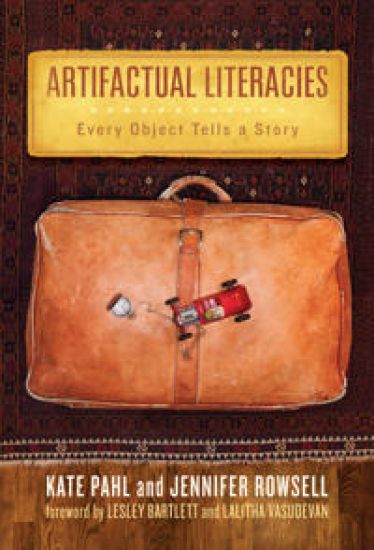
Artifactual Literacies

Artifactual Literacies

Kate Pahl; Jennifer Rowsell

Teachers' College Press
2010
nidottu
To re-engage students with literacy, teachers need an entry point that recognizes and honors students' out-of-school identities. This book looks at how artifacts (everyday objects) access the daily, sensory world in which students live. Exploring how artifacts can generate literacy learning, the book shows teachers how to use a family photo, heirloom, or recipe to tell intergenerational tales; how to collaborate with local museums and cultural centers; how to create new material artifacts; and much more. Featuring vignettes, lesson examples, and photographs, the text includes chapters on community connections, critical literacy, adolescent writing, and digital storytelling. This book features a theoretical framework for teaching literacy that unites the domains of home and school and brings students' passions to the forefront; a fresh, integrated synthesis of the fields of New Literacy Studies, multimodality, material cultural studies, and literacy education; new field-tested ideas for creating lessons that improve literacy standards.
Design Literacies

Design Literacies

Mary P. Sheridan; Jennifer Rowsell

Routledge
2010
sidottu
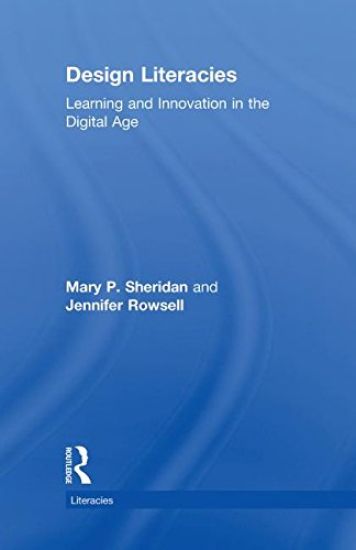
Design Literacies: Learning and Innovation in the Digital Age explores new ways of meaning making by examining the practices, stories, and products of new and digital media producers with the goal of understanding the logic of marketplace production. Based on interviews with thirty new media and digital technology producers, including designers of video games, community activists and marketers of digital technologies, Design Literacies looks at the shared patterns and common themes and offers a window into contemporary out-of-school practices, a language to describe these practices and a pedagogy that better meets students’ needs in this new media and digital age.With a foreword by Gunther Kress and an afterword by James Gee, Design Literacies: Learning and Innovation in the Digital Age will be of interest to postgraduate and graduate students of applied linguistics and education.APPLIED LINGUISTICS/ EDUCATION
Design Literacies

Design Literacies

Mary P. Sheridan; Jennifer Rowsell

Routledge
2010
nidottu
Design Literacies: Learning and Innovation in the Digital Age explores new ways of meaning making by examining the practices, stories, and products of new and digital media producers with the goal of understanding the logic of marketplace production. Based on interviews with thirty new media and digital technology producers, including designers of video games, community activists and marketers of digital technologies, Design Literacies looks at the shared patterns and common themes and offers a window into contemporary out-of-school practices, a language to describe these practices and a pedagogy that better meets students’ needs in this new media and digital age.With a foreword by Gunther Kress and an afterword by James Gee, Design Literacies: Learning and Innovation in the Digital Age will be of interest to postgraduate and graduate students of applied linguistics and education.APPLIED LINGUISTICS/ EDUCATION