Kirjojen hintavertailu. Mukana 12 320 866 kirjaa ja 12 kauppaa.

Kirjailija

Jennifer Summit

Kirjat ja teokset yhdessä paikassa: 6 kirjaa, julkaisuja vuosilta 2000-2020, suosituimpien joukossa Lost Property. Vertaile teosten hintoja ja tarkista saatavuus suomalaisista kirjakaupoista.

6 kirjaa

Kirjojen julkaisuhaarukka 2000-2020.

Action versus Contemplation

Action versus Contemplation

Jennifer Summit; Blakey Vermeule

University of Chicago Press
2020
nidottu
“All of humanity’s problems stem from man’s inability to sit quietly in a room alone,” Blaise Pascal wrote in 1654. But then there’s Walt Whitman, in 1856: “Whoever you are, come forth! Or man or woman come forth! / You must not stay sleeping and dallying there in the house.” It is truly an ancient debate: Is it better to be active or contemplative? To do or to think? To make an impact, or to understand the world more deeply? Aristotle argued for contemplation as the highest state of human flourishing. But it was through action that his student Alexander the Great conquered the known world. Which should we aim at? Centuries later, this argument underlies a surprising number of the questions we face in contemporary life. Should students study the humanities, or train for a job? Should adults work for money or for meaning? And in tumultuous times, should any of us sit on the sidelines, pondering great books, or throw ourselves into protests and petition drives? With Action versus Contemplation, Jennifer Summit and Blakey Vermeule address the question in a refreshingly unexpected way: by refusing to take sides. Rather, they argue for a rethinking of the very opposition. The active and the contemplative can—and should—be vibrantly alive in each of us, fused rather than sundered. Writing in a personable, accessible style, Summit and Vermeule guide readers through the long history of this debate from Plato to Pixar, drawing compelling connections to the questions and problems of today. Rather than playing one against the other, they argue, we can discover how the two can nourish, invigorate, and give meaning to each other, as they have for the many writers, artists, and thinkers, past and present, whose examples give the book its rich, lively texture of interplay and reference. This is not a self-help book. It won’t give you instructions on how to live your life. Instead, it will do something better: it will remind you of the richness of a life that embraces action and contemplation, company and solitude, living in the moment and planning for the future. Which is better? Readers of this book will discover the answer: both.
Action Versus Contemplation

Action Versus Contemplation

Jennifer Summit; Blakey Vermeule

University of Chicago Press
2018
sidottu
"All of humanity's problems stem from man's inability to sit quietly in a room alone," Blaise Pascal wrote in 1654. But then there's Walt Whitman, in 1856: "Whoever you are, come forth! Or man or woman come forth! / You must not stay sleeping and dallying there in the house." It is truly an ancient debate: Is it better to be active or contemplative? To do or to think? To make an impact, or to understand the world more deeply? Aristotle argued for contemplation as the highest state of human flourishing. But it was through action that his student Alexander the Great conquered the known world. Which should we aim at? Centuries later, this argument underlies a surprising number of the questions we face in contemporary life. Should students study the humanities, or train for a job? Should adults work for money or for meaning? And in tumultuous times, should any of us sit on the sidelines, pondering great books, or throw ourselves into protests and petition drives? With Action vs. Contemplation, Jennifer Summit and Blakey Vermeule address the question in a refreshingly unexpected way: by refusing to take sides. Rather, they argue for a rethinking of the very opposition. The active and the contemplative can--and should--be vibrantly alive in each of us, fused rather than sundered. Writing in a personable, accessible style, Summit and Vermeule guide readers through the long history of this debate from Plato to Pixar, drawing compelling connections to the questions and problems of today. Rather than playing one against the other, they argue, we can discover how the two can nourish, invigorate, and give meaning to each other, as they have for the many writers, artists, and thinkers, past and present, whose examples give the book its rich, lively texture of interplay and reference. Â This is not a self-help book. It won't give you instructions on how to live your life. Instead, it will do something better: it will remind you of the richness of a life that embraces action and contemplation, company and solitude, living in the moment and planning for the future. Which is better? Readers of this book will discover the answer: both.
Memory's Library

Memory's Library

Jennifer Summit

University of Chicago Press
2011
nidottu
In Jennifer Summit's account, libraries are more than inert storehouses of written tradition; they are volatile spaces that actively shape the meanings and uses of books, reading, and the past. Considering the two-hundred-year period between 1431, which saw the foundation of Duke Humfrey's famous library, and 1631, when the great antiquarian Sir Robert Cotton died, "Memory's Library" revises the history of the modern library by focusing on its origins in medieval and early modern England. Summit argues that the medieval sources that survive in English collections are the product of a Reformation and post-Reformation struggle to redefine the past by redefining the cultural place, function, and identity of libraries. By establishing the intellectual dynamism of English libraries during this crucial period of their development, "Memory's Library" demonstrates how much current discussions about the future of libraries can gain by reexamining their past.
Memory's Library

Memory's Library

Jennifer Summit

University of Chicago Press
2008
sidottu
In Jennifer Summit's account, libraries are more than inert storehouses of written tradition; they are volatile spaces that actively shape the meanings and uses of books, reading, and the past. Considering the two-hundred-year period between 1431, which saw the foundation of Duke Humfrey's famous library, and 1631, when the great antiquarian Sir Robert Cotton died, "Memory's Library" revises the history of the modern library by focusing on its origins in medieval and early modern England. Summit argues that the medieval sources that survive in English collections are the product of a Reformation and post-Reformation struggle to redefine the past by redefining the cultural place, function, and identity of libraries. By establishing the intellectual dynamism of English libraries during this crucial period of their development, "Memory's Library" demonstrates how much current discussions about the future of libraries can gain by reexamining their past.
Lost Property

Lost Property

Jennifer Summit

University of Chicago Press
2000
sidottu
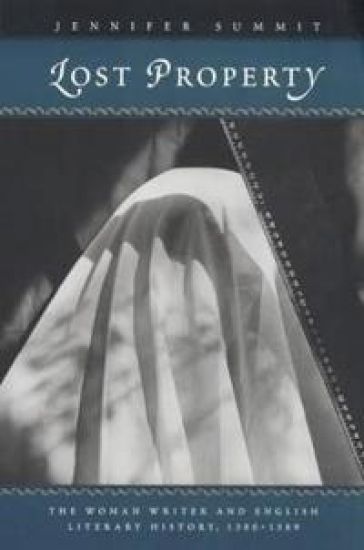
The English literary canon is haunted by the figure of the lost woman writer. She has, of course, been a powerful stimulus for the 20th-century rediscovery of works written by women. But as Jennifer Summit argues, "the lost woman writer" also served as an evocative symbol during the very formation of an English literary tradition from the 14th through the 16th centuries. Examining the history of the representations of women writers from Margery Kempe and Christine de Pizan to Elizabeth I and Mary Stuart, Queen of Scots, Summit shows how the woman writer came to embody alienation from tradition. Chaucer, for instance, used the figure of the woman writer to dramatize the problems of writing outside the dominant literary culture, while the reformation writer John Bale cast women writers as proto-Protestant icons of opposition to the Catholic church. Bringing together original archival research with new readings of key literary texts, Summit provides a revisionary account of the woman writers' role in English literary history.
Lost Property

Lost Property

Jennifer Summit

University of Chicago Press
2000
nidottu
The English literary canon is haunted by the figure of the lost woman writer. She has, of course, been a powerful stimulus for the 20th-century rediscovery of works written by women. But as Jennifer Summit argues, "the lost woman writer" also served as an evocative symbol during the very formation of an English literary tradition from the 14th through the 16th centuries. Examining the history of the representations of women writers from Margery Kempe and Christine de Pizan to Elizabeth I and Mary Stuart, Queen of Scots, Summit shows how the woman writer came to embody alienation from tradition. Chaucer, for instance, used the figure of the woman writer to dramatize the problems of writing outside the dominant literary culture, while the reformation writer John Bale cast women writers as proto-Protestant icons of opposition to the Catholic church. Bringing together original archival research with new readings of key literary texts, Summit provides a revisionary account of the woman writers' role in English literary history.