Kirjailija
Jenny Xie
Kirjat ja teokset yhdessä paikassa: 5 kirjaa, julkaisuja vuosilta 2016-2024, suosituimpien joukossa Eye Level: Poems. Vertaile teosten hintoja ja tarkista saatavuus suomalaisista kirjakaupoista.
5 kirjaa
Kirjojen julkaisuhaarukka 2016-2024.
* FINALIST FOR THE 2022 NATIONAL BOOK AWARD FOR POETRY * The astounding second collection by Jenny Xie, "a magician of perspective and scale" (The New Yorker) Shaped around moments of puncture and release, The Rupture Tense registers what leaks across the breached borders between past and future, background and foreground, silence and utterance. In polyphonic and formally restless sequences, Jenny Xie cracks open reverberant, vexed experiences of diasporic homecoming, intergenerational memory transfer, state-enforced amnesia, public secrecies, and the psychic fallout of the Chinese Cultural Revolution. Across these poems, memory--historical, collective, personal--stains and erodes. Xie voices what remains irreducible in our complex entanglements with familial ties, language, capitalism, and the histories in which we find ourselves lodged. The Rupture Tense begins with poems provoked by the photography of Li Zhensheng, whose negatives, hidden under his floorboards to avoid government seizure, provide one of the few surviving visual archives of the Chinese Cultural Revolution, and concludes with an aching elegy for the poet's grandmother, who took her own life shortly after the end of the Revolution. This extraordinary collection records the aftershocks and long distances between those years and the present, echoing out toward the ongoing past and a trembling future.
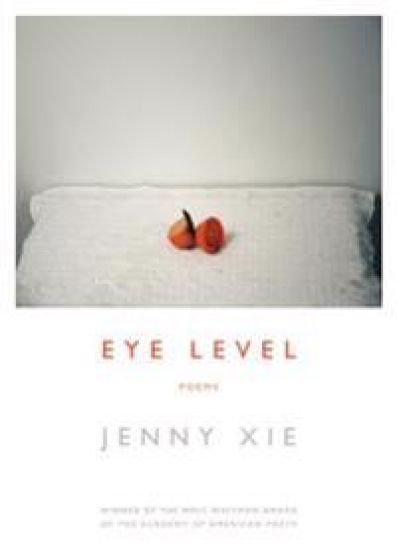
FINALIST FOR THE NATIONAL BOOK AWARD FOR POETRY Winner of the Walt Whitman Award of the Academy of American Poets, selected by Juan Felipe HerreraFor years now, I've been using the wrong palette.Each year with its itchy blue, as the bruise of solitude reaches its expiration date. Planes and buses, guesthouse to guesthouse. I've gotten to where I am by dint of my poor eyesight, my overreactive motion sickness. 9 p.m., Hanoi's Old Quarter: duck porridge and plum wine. Voices outside the door come to a soft boil. --from "Phnom Penh Diptych: Dry Season" Jenny Xie's award-winning debut, Eye Level, takes us far and near, to Phnom Penh, Corfu, Hanoi, New York, and elsewhere, as we travel closer and closer to the acutely felt solitude that centers this searching, moving collection. Animated by a restless inner questioning, these poems meditate on the forces that moor the self and set it in motion, from immigration to travel to estranging losses and departures. The sensual worlds here--colors, smells, tastes, and changing landscapes--bring to life questions about the self as seer and the self as seen. As Xie writes, "Me? I'm just here in my traveler's clothes, trying on each passing town for size." Her taut, elusive poems exult in a life simultaneously crowded and quiet, caught in between things and places, and never quite entirely at home. Xie is a poet of extraordinary perception--both to the tangible world and to "all that is untouchable as far as the eye can reach."

Nowhere to Arrive takes as its subjects the whiplash of travel, the shuttling between disparate places and climes, and an unremitting sense of dislocation. These poems court the tension between the familiar and the foreign, between the self as distinct and the self as illusory. They look plainly at the startling strangeness of varied landscapes and mindscapes, and interrogate a state of unrootedness - one thrown into relief by the speaker's years abroad in Southeast Asia.At the chapbook's center are two long poems, titled "Phnom Penh Diptych: Wet Season" and "Phnom Penh Diptych: Dry Season," that examine the escapist narratives that draw tourists and expatriates to Cambodia, and the speaker's own privileged positioning.On a formal level, the poems in Nowhere to Arrive make room for the unsaid and that which cannot be articulated. Here, we have a vocabulary of silence alongside stark imagistic juxtapositions, poems that celebrate compression and the force of paratactic constructions. Attentiveness and concentration emerge as virtues, as the speaker surveys the vast territory of the present with a wakeful gaze.