

Kirjailija
Jens Wirth
Kirjat ja teokset yhdessä paikassa: 3 kirjaa, julkaisuja vuosilta 2012-2026, suosituimpien joukossa Asymptotische Analysis. Vertaile teosten hintoja ja tarkista saatavuus suomalaisista kirjakaupoista.
3 kirjaa
Kirjojen julkaisuhaarukka 2012-2026.
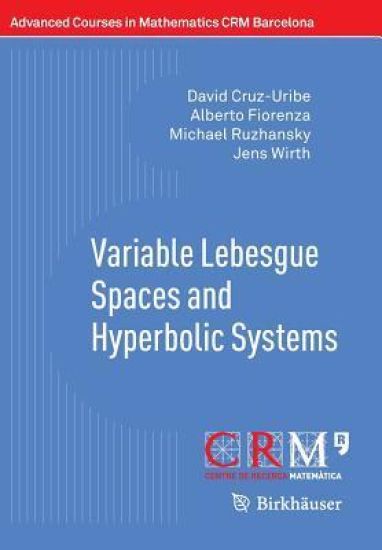
Variable Lebesgue Spaces and Hyperbolic Systems
David Cruz-Uribe; Alberto Fiorenza; Michael Ruzhansky; Jens Wirth
Springer Basel
2014
nidottu
This book targets graduate students and researchers who want to learn about Lebesgue spaces and solutions to hyperbolic equations. It is divided into two parts.Part 1 provides an introduction to the theory of variable Lebesgue spaces: Banach function spaces like the classical Lebesgue spaces but with the constant exponent replaced by an exponent function. These spaces arise naturally from the study of partial differential equations and variational integrals with non-standard growth conditions. They have applications to electrorheological fluids in physics and to image reconstruction. After an introduction that sketches history and motivation, the authors develop the function space properties of variable Lebesgue spaces; proofs are modeled on the classical theory. Subsequently, the Hardy-Littlewood maximal operator is discussed. In the last chapter, other operators from harmonic analysis are considered, such as convolution operators and singular integrals. The text is mostly self-contained, with only some more technical proofs and background material omitted. Part 2 gives an overview of the asymptotic properties of solutions to hyperbolic equations and systems with time-dependent coefficients. First, an overview of known results is given for general scalar hyperbolic equations of higher order with constant coefficients. Then strongly hyperbolic systems with time-dependent coefficients are considered. A feature of the described approach is that oscillations in coefficients are allowed. Propagators for the Cauchy problems are constructed as oscillatory integrals by working in appropriate time-frequency symbol classes. A number of examples is considered and the sharpness of results is discussed. An exemplary treatment of dissipative terms shows how effective lower order terms can change asymptotic properties and thus complements the exposition.
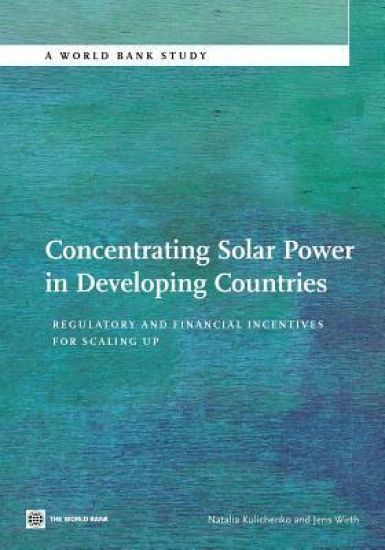
Concentrating Solar Power in Developing Countries
Natalia Kulichenko; Jens Wirth
World Bank Publications
2012
nidottu
At present, different concentrating solar thermal technologies (CST) have reached varying degrees of commercial availability. This emerging nature of CST means that there are market and technical impediments to accelerating its acceptance, including cost competitiveness, an understanding of technology capability and limitations, intermittency, and benefits of electricity storage. Many developed and some developing countries are currently working to address these barriers in order to scale up CST-based power generation. Given the considerable growth of CST development in several World Bank Group partner countries, there is a need to assess the recent experience of developed countries in designing and implementing regulatory frameworks and draw lesson that could facilitate the deployment of CST technologies in developing countries. Merely replicating developed countries’ schemes in the context of a developing country may not generate the desired outcomes. Against this background, this report (a) analyzes and draws lessons from the efforts of some developed countries and adapts them to the characteristics of developing economies; (b) assesses the cost reduction potential and economic and financial affordability of various CST technologies in emerging markets; (c) evaluates the potential for cost reduction and associated economic benefits derived from local manufacturing; and (d) suggests ways to tailor bidding models and practices, bid selection criteria, and structures for power purchase agreements (PPAs) for CST projects in developing market conditions.|Security sector reform (SSR) is widely recognized as key to conflict prevention, peace-building, sustainable development, and democratization. SSR has gained most practical relevance in the context of post-conflict reconstruction of so-called ""failed states'"" and states emerging from violent internal or inter-state conflict. As this volume shows, almost all states need to reform their security sectors to a greater or lesser extent, according to the specific security, political and socio-economic contexts, as well as in response to the new security challenges resulting from globalization and post-9/11 developments. Alan Bryden is a researcher at the Geneva Centre for the Democratic Control of Armed Forces. Heiner Hnggi is assistant director of the Geneva Centre for the Democratic Control of Armed Forces.