Kirjojen hintavertailu. Mukana 12 390 323 kirjaa ja 12 kauppaa.

Kirjailija

Jerald Hage

Kirjat ja teokset yhdessä paikassa: 8 kirjaa, julkaisuja vuosilta 1992-2025, suosituimpien joukossa Solving Crises in Capitalism and Democracy. Vertaile teosten hintoja ja tarkista saatavuus suomalaisista kirjakaupoista.

8 kirjaa

Kirjojen julkaisuhaarukka 1992-2025.

Solving Crises in Capitalism and Democracy

Solving Crises in Capitalism and Democracy

Jerald Hage; Wilbur C. Hadden

TAYLOR FRANCIS LTD
2025
nidottu
Democratic capitalism is beset with many problems producing rising inequality and growing authoritarianism. Examples include homelessness, food insecurity, child poverty, mass killings, and rising antisemitism. These problems encourage the election of authoritarian leaders. This book describes new strategies to promote inclusion and reduce inequality that do not require D.E.I. policies or affirmative action, reduce government spending without wholesale firings and in the process make government more effective, and reduce individual distrust while increasing people’s willingness to donate time and money to important causes that help others and the world.The new strategies create systematic coordinated inter-organizational networks or SCIONs to achieve the following four objectives:Increase the amount and radicalness of product or service innovationCreate a more diverse labor force with more and more varied skillsMake health and welfare programs more efficient and effectiveRestore the balance between law and freedom in community safetyAs a new mode of coordination, SCIONs provide to platforms for continued dialogue among diverse viewpoints, decentralize problem solving, and stimulate considerable organizational adaptiveness. They overcome the limitations of market and state coordination.This macro sociological theory offers policy guidelines that might lead to future jobs for sociologists, provide tools to overcome managerial satisficing, and speed responses to change. A detailed case study is provided with a discussion of the feasibility of creating SCIONs and whether or not elites will resist this new coordination mode. Given the broad range of topics, this book is relevant for many courses in the social sciences, for those interested in policy and social change, as well as the general public.
Saving Societies From Within

Saving Societies From Within

Jerald Hage; Joseph J. Valadez; Wilbur C. Hadden

TAYLOR FRANCIS LTD
2024
nidottu
Moving beyond existing models from economics and political science, this book shows how crises in capitalism and democracy can be solved with Systemic coordinated inter-organizational networks.It offers a new model of societal coordination that builds cooperation and trust while solving today’s modern and complex practical problems: Systemic coordinated inter-organizational networks (SCIONs). It details how SCIONs can quickly catalyze organizational change among interorganizational network members while providing a general framework for characterizing individual and organizational change. The chapters apply these theoretical ideas in an epic case study of the rebuilding of the health care system in rural Nicaragua after a major natural disaster (Hurricane Mitch). They provide lessons for public health program managers while contributing to the literatures on modes of coordination and on social capital.The book is a vital text for upper-division courses on management, inter-organizational collaboration, crisis management and public health.
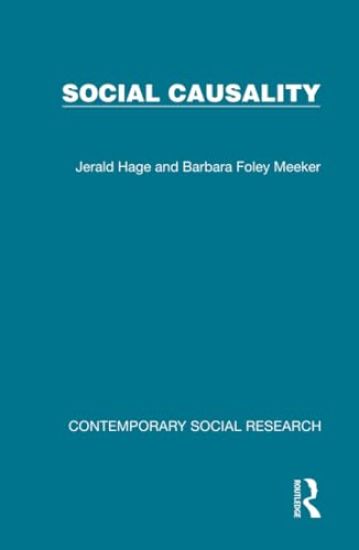
Social Causality

Social Causality

Jerald Hage; Barbara Foley Meeker

TAYLOR FRANCIS LTD
2025
sidottu
Originally published in 1988, Social Causality takes the reader through the theoretical and practical maze that has to be negotiated before definitive statements about cause and effect in social research can be made. It was designed for the undergraduate student on a first research methods course; graduate students on more advanced methods courses will also find that it addresses questions with which they are regularly confronted.The authors explore the use of the term ‘causality’ as it exists in the social methodology, social theory and philosophical literatures, explaining different usages and common misconceptions. They argue that the construction of valuable statements about causality often requires the location and exploration of complex networks of variables, and they outline techniques for doing this. They link their views to specific studies in social psychology and organizational theory – in particular, studies of innovation and change. This strategy reflects a conviction that is evident throughout the book – that the analysis and advice of social scientists can be of practical import, and demonstrably effective.
Solving Crises in Capitalism and Democracy

Solving Crises in Capitalism and Democracy

Jerald Hage; Wilbur C. Hadden

TAYLOR FRANCIS LTD
2025
sidottu
Democratic capitalism is beset with many problems producing rising inequality and growing authoritarianism. Examples include homelessness, food insecurity, child poverty, mass killings, and rising antisemitism. These problems encourage the election of authoritarian leaders. This book describes new strategies to promote inclusion and reduce inequality that do not require D.E.I. policies or affirmative action, reduce government spending without wholesale firings and in the process make government more effective, and reduce individual distrust while increasing people’s willingness to donate time and money to important causes that help others and the world.The new strategies create systematic coordinated inter-organizational networks or SCIONs to achieve the following four objectives:Increase the amount and radicalness of product or service innovationCreate a more diverse labor force with more and more varied skillsMake health and welfare programs more efficient and effectiveRestore the balance between law and freedom in community safetyAs a new mode of coordination, SCIONs provide to platforms for continued dialogue among diverse viewpoints, decentralize problem solving, and stimulate considerable organizational adaptiveness. They overcome the limitations of market and state coordination.This macro sociological theory offers policy guidelines that might lead to future jobs for sociologists, provide tools to overcome managerial satisficing, and speed responses to change. A detailed case study is provided with a discussion of the feasibility of creating SCIONs and whether or not elites will resist this new coordination mode. Given the broad range of topics, this book is relevant for many courses in the social sciences, for those interested in policy and social change, as well as the general public.
Saving Societies From Within

Saving Societies From Within

Jerald Hage; Joseph J. Valadez; Wilbur C. Hadden

TAYLOR FRANCIS LTD
2024
sidottu
Moving beyond existing models from economics and political science, this book shows how crises in capitalism and democracy can be solved with Systemic coordinated inter-organizational networks.It offers a new model of societal coordination that builds cooperation and trust while solving today’s modern and complex practical problems: Systemic coordinated inter-organizational networks (SCIONs). It details how SCIONs can quickly catalyze organizational change among interorganizational network members while providing a general framework for characterizing individual and organizational change. The chapters apply these theoretical ideas in an epic case study of the rebuilding of the health care system in rural Nicaragua after a major natural disaster (Hurricane Mitch). They provide lessons for public health program managers while contributing to the literatures on modes of coordination and on social capital.The book is a vital text for upper-division courses on management, inter-organizational collaboration, crisis management and public health.
Knowledge Evolution and Societal Transformations

Knowledge Evolution and Societal Transformations

Jerald Hage; Michael Quinn Patton

Anthem Press
2022
nidottu
Knowledge evolution punctuates the previous equilibrium of society and requires us to develop adaptive solutions. One new rule is that as the discovery of new knowledge grows more difficult, more complex organizational and institutional arrangements have to be adopted. Knowledge growth is accelerating because not only are there more creative individuals and organizations developing radical innovations, but also innovative regions are facilitating both of these trends. The discussion of four social regions and the kinds of selves produced help explain partisan divides and integrate the social psychological literature. The growth in knowledge produces two kinds of social changes: In the nature of the social structure and the kinds of institutional problems that have to be solved. The discussion of changes in the stratification system, in the choice of organizational form, and in the spread of inter-organizational networks with tight connections (heterogeneous social capital) allows us to update Marx, Weber, and Durkheim. The new adaptive problems include growing inefficiencies in labor, product, and public markets and the failure of many existing programs. The proposed solutions are the creation of coordinated systemic networks in each of these areas, which integrates the comparative institutional literature, neoclassical economics, and political science.
Knowledge Evolution and Societal Transformations

Knowledge Evolution and Societal Transformations

Jerald Hage; Michael Quinn Patton

Anthem Press
2020
sidottu
Knowledge evolution punctuates the previous equilibrium of society and requires us to develop adaptive solutions. One new rule is that as the discovery of new knowledge grows more difficult, more complex organizational and institutional arrangements have to be adopted. Knowledge growth is accelerating because not only are there more creative individuals and organizations developing radical innovations, but also innovative regions are facilitating both of these trends. The discussion of four social regions and the kinds of selves produced help explain partisan divides and integrate the social psychological literature. The growth in knowledge produces two kinds of social changes: In the nature of the social structure and the kinds of institutional problems that have to be solved. The discussion of changes in the stratification system, in the choice of organizational form, and in the spread of inter-organizational networks with tight connections (heterogeneous social capital) allows us to update Marx, Weber, and Durkheim. The new adaptive problems include growing inefficiencies in labor, product, and public markets and the failure of many existing programs. The proposed solutions are the creation of coordinated systemic networks in each of these areas, which integrates the comparative institutional literature, neoclassical economics, and political science.
Post-Industrial Lives

Post-Industrial Lives

Jerald Hage; Charles Powers

SAGE Publications Inc
1992
nidottu
The interesting contribution of this book is not just confined to capturing the role changes that a knowledge based society characterizing post-industrialism demands, but that it is able to bring about a fusion of micro individual and the macro societal role relationships..... This book makes interesting and useful reading for the serious management practitioner interested in gaining a grasp of the role alterations that are taking place in his own work domain, and comprehend its implications. The contribution of this work to sociological theory is in making predictions about the social changes which can come up with the transformation to a knowledge based society. --Vikalpa "The interesting contribution of this book is not just confined to capturing the role changes that a knowledge based society characterizing post-industrialism demands, but that it is able to bring about a fusion of micro individual and the macro societal role relationships. This book, due to its rigour, is essentially academic oriented. But the writing style is such that it can also make interesting and useful reading for the serious management practitioner interested in gaining a grasp of the role alterations that are taking place in his own work domain, and comprehend its implications." --Unnikrishnan K. Nair in Vikalpa The shift from an industrial to a post-industrial society has been documented extensively, as has its impact on the macro-level institutions of society--government, the workplace, and the economy. But how has post-industrial life impacted the individual and relationships between individuals? Hage and Powers examine this intriguing question by linking global changes in work patterns, information flow and knowledge to the practice of everyday life. They conclude that the complexities of society require a different kind of people, those with complex selves and creative minds, capable of confronting the challenges of the forthcoming century. Creativity, flexibility, and emotional astuteness will be the buzzwords of the future, as well as personality traits that will enable people to successfully adapt to the ever-changing swirl of workplace, familial, personal, and leisure roles. Based on the tenets of social theory, the authors present a window into the future and a plan for personal and interpersonal action. Their insights will shed light for social psychologists, social theorists, futurologists, organizational theorists, network analysts, and communication researchers. "It is stimulating to encounter a work of such intellectual audacity that is so solidly buttressed by sound scholarship and respect for evidence. The core argument, which is based heavily on symbolic interactionist theory, has the ring of truth. This is a thoroughly remarkable book--broad in scope, significant in its implications, and, better than any I know, making eminently good sense of the eddying social currents and bewildering social changes that characterize contemporary society. I predict that it will have a major and lasting impact on the field." --Morris Rosenberg, University of Maryland "This book is one of those rare works that courageously turns established assumptions on their heads and challenges the whole field of sociology to shift directions. It offers a version of functionalism calling for continuous change rather than stability, with functional prerequisites at the individual level. It deplores current sociology's dominant emphasis on power and money, offering in their place the unequal distribution of knowledge as the key organizing principle. Rather than formulating theory primarily at the macro or micro level, it focuses on the meso level, where micro and macro are linked through a unique revision of role theory. Hage and Powers take symbolic interaction as their starting perspective, but modify and extend the work of George Herbert Mead in imaginative ways. At the same time, they draw selectively on the work of structuralists Merton and Nadel to develop a thoughtful linkage between micro- and macro-sociological processes in a social structure in which flexible networks rather than formal organizations are the key components. Post-Industrial Lives could well become the touchstone for broad debate on the nature of sociological theory, and the paradigm that stimulates a widely ranging body of new empirical research." --Ralph Turner, University of California, Los Angeles "Hage and Powers bring their in-depth sociological analysis of the changes central to post-industrial and post-modern life home--to where we live and work. They succeed in the best sense of the sociological imagination to bridge the micro and macro, the personal and the structural. They not only build a theoretical framework for understanding the changes in society, but encourage us to appreciate that as the old role scripts and hierarchical controls give way to networks of interacting people, we have more independence to fashion our own personal connections to others." --Barbara Sherman Heyl, Illinois State University "The authors have given a remarkable, coherent theoretical outline of postindustrial society. . . . This book is written in an extraordinarily clear and understandable scientific prose." --American Journal of Sociology "Most of the books on post-industrial society, and more recently, on post-modernism are distinguished by their vagueness and imprecision. In contrast, this book examines in detail the effects of increasing societal complexity and change on the structure of roles, and vice versa. The book does a masterful job of utilizing, criticizing, and extending classic and contemporary theoretical literatures in developing a well reasoned conceptual perspective. By focusing on roles, role-sets, status-sets, person-sets, and role-relationships, the authors link changes in the macrostructural forces of modern societies in terms of increased complexity of networks and matrices to meso level changes in organizational forms and to micro level transformations in self, emotions, and styles of interaction. And, all of this fine analytical work is done in a highly readable fashion which realizes the rare goal of appealing to students, practitioners, lay persons, and academics. The authors have, therefore, made the analysis of post-industrial society theoretically sophisticated, while at the same time making it empirically and experientially relevant." --Jonathan H. Turner, University of California, Riverside