Kirjojen hintavertailu. Mukana 12 254 215 kirjaa ja 12 kauppaa.

Kirjailija

Jeremy Munday

Kirjat ja teokset yhdessä paikassa: 14 kirjaa, julkaisuja vuosilta 1995-2026, suosituimpien joukossa Introducing Translation Studies. Vertaile teosten hintoja ja tarkista saatavuus suomalaisista kirjakaupoista.

14 kirjaa

Kirjojen julkaisuhaarukka 1995-2026.

Introducing Translation Studies

Introducing Translation Studies

Jeremy Munday; Sara Ramos Pinto; Jacob Blakesley

TAYLOR FRANCIS LTD
2026
sidottu
Introducing Translation Studies has long been the definitive guide to the theories and concepts that make up the field of translation studies. Providing an accessible and up-to-date overview, it is the essential textbook, used on courses worldwide. This sixth edition has been substantially revised throughout to include important new material and it continues to provide a balanced and detailed guide to the theoretical landscape. The theories are applied to a wide range of languages, including Arabic, Bengali, Chinese, English, Punjabi, Portuguese, French and German. A broad spectrum of texts are analysed, including websites, European Union documents, travel brochures, children’s books, Buddhist sutras, literary texts and films. Each chapter comprises an introduction outlining the theories, illustrative texts with translations, case studies, a chapter summary, and discussion points and exercises. New features in this sixth edition include: ? Updated content reflecting current research and practice: every chapter of this new edition incorporates recent developments, notably in multimodal communication, cognitive approaches to translation, translation and gender, the ideology of translation, and hermeneutics. It also offers a more globally balanced representation of theoretical perspectives and includes a newly structured discussion on translation in the digital age, including the impact of machine translation and AI-powered large language models ? Revised discussion points and refreshed data: figures and tables have been updated throughout to reflect the most recent information ? New in-chapter activities, with integrated links from the interactive ebook to online resources and articles, encouraging independent research and deeper engagement ? Extensive updated online resources: features include quizzes, flashcards, specially recorded new video introductions, curated journal articles for each chapter, helpful weblinks, and downloadable PowerPoint slides to support instructors. This new edition ensures Introducing Translation Studies remains the ideal textbook for students and researchers engaged in courses in translation and translation studies worldwide.
Introducing Translation Studies

Introducing Translation Studies

Jeremy Munday; Sara Ramos Pinto; Jacob Blakesley

TAYLOR FRANCIS LTD
2026
nidottu
Introducing Translation Studies has long been the definitive guide to the theories and concepts that make up the field of translation studies. Providing an accessible and up-to-date overview, it is the essential textbook, used on courses worldwide. This sixth edition has been substantially revised throughout to include important new material and it continues to provide a balanced and detailed guide to the theoretical landscape. The theories are applied to a wide range of languages, including Arabic, Bengali, Chinese, English, Punjabi, Portuguese, French and German. A broad spectrum of texts are analysed, including websites, European Union documents, travel brochures, children’s books, Buddhist sutras, literary texts and films. Each chapter comprises an introduction outlining the theories, illustrative texts with translations, case studies, a chapter summary, and discussion points and exercises. New features in this sixth edition include: ? Updated content reflecting current research and practice: every chapter of this new edition incorporates recent developments, notably in multimodal communication, cognitive approaches to translation, translation and gender, the ideology of translation, and hermeneutics. It also offers a more globally balanced representation of theoretical perspectives and includes a newly structured discussion on translation in the digital age, including the impact of machine translation and AI-powered large language models ? Revised discussion points and refreshed data: figures and tables have been updated throughout to reflect the most recent information ? New in-chapter activities, with integrated links from the interactive ebook to online resources and articles, encouraging independent research and deeper engagement ? Extensive updated online resources: features include quizzes, flashcards, specially recorded new video introductions, curated journal articles for each chapter, helpful weblinks, and downloadable PowerPoint slides to support instructors. This new edition ensures Introducing Translation Studies remains the ideal textbook for students and researchers engaged in courses in translation and translation studies worldwide.
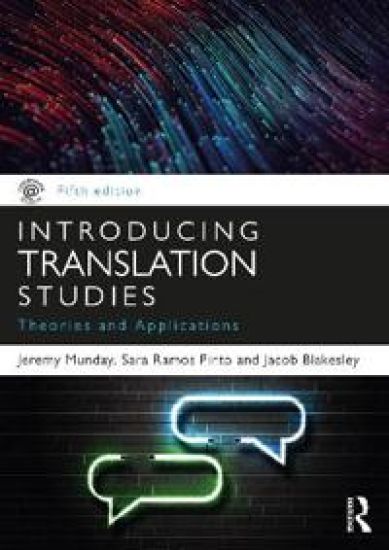
Introducing Translation Studies

Introducing Translation Studies

Jeremy Munday; Sara Ramos Pinto; Jacob Blakesley

TAYLOR FRANCIS LTD
2022
nidottu
Introducing Translation Studies remains the definitive guide to the theories and concepts that make up the field of translation studies. Providing an accessible and up-to-date overview, it has long been the essential textbook on courses worldwide. This fifth edition has been fully revised, and continues to provide a balanced and detailed guide to the theoretical landscape. Each theory is applied to a wide range of languages, including Bengali, Chinese, English, French, German, Italian, Punjabi, Portuguese and Spanish. A broad spectrum of texts is analysed, including the Bible, Buddhist sutras, Beowulf, the fiction of Proust and the theatre of Shakespeare, European Union and UNESCO documents, a range of contemporary films, a travel brochure, a children's cookery book and the translations of Harry Potter. Each chapter comprises an introduction outlining the translation theory or theories, illustrative texts with translations, case studies, a chapter summary, and discussion points and exercises. New features in this fifth edition include: New material to keep up with developments in research and practice; this includes the sociology of translation chapter, where a new case study employs a Bourdieusian approach; there is also newly structured discussion on translation in the digital age, and audiovisual and machine translation; Revised discussion points and updated figures and tables; New in-chapter activities with links in the enhanced ebook to online materials and articles to encourage independent research; An extensive updated companion website with video introductions and journal articles to accompany each chapter, online exercises, an interactive timeline, weblinks, and PowerPoint slides for teacher support. This is a practical, user-friendly textbook ideal for students and researchers on courses in translation and translation studies.
Introducing Translation Studies

Introducing Translation Studies

Jeremy Munday; Sara Ramos Pinto; Jacob Blakesley

TAYLOR FRANCIS LTD
2022
sidottu
Introducing Translation Studies remains the definitive guide to the theories and concepts that make up the field of translation studies. Providing an accessible and up-to-date overview, it has long been the essential textbook on courses worldwide. This fifth edition has been fully revised, and continues to provide a balanced and detailed guide to the theoretical landscape. Each theory is applied to a wide range of languages, including Bengali, Chinese, English, French, German, Italian, Punjabi, Portuguese and Spanish. A broad spectrum of texts is analysed, including the Bible, Buddhist sutras, Beowulf, the fiction of Proust and the theatre of Shakespeare, European Union and UNESCO documents, a range of contemporary films, a travel brochure, a children's cookery book and the translations of Harry Potter. Each chapter comprises an introduction outlining the translation theory or theories, illustrative texts with translations, case studies, a chapter summary, and discussion points and exercises. New features in this fifth edition include: New material to keep up with developments in research and practice; this includes the sociology of translation chapter, where a new case study employs a Bourdieusian approach; there is also newly structured discussion on translation in the digital age, and audiovisual and machine translation; Revised discussion points and updated figures and tables; New in-chapter activities with links in the enhanced ebook to online materials and articles to encourage independent research; An extensive updated companion website with video introductions and journal articles to accompany each chapter, online exercises, an interactive timeline, weblinks, and PowerPoint slides for teacher support. This is a practical, user-friendly textbook ideal for students and researchers on courses in translation and translation studies.
Translation

Translation

Basil Hatim; Jeremy Munday

Routledge
2019
nidottu
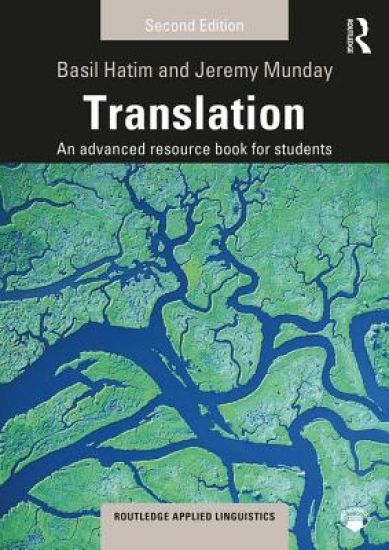
Translation, Second Edition introduces the theory and practice of translation from a variety of linguistic and cultural angles, and has been revised and updated to feature: a study of translation through the lens of key topics in linguistics such as semantics, functional linguistics, corpus and cognitive linguistics, discourse analysis, gender studies and postcolonialism; a wide range of examples from other languages, including French, Spanish, German, Italian, Russian and Arabic, with English back-translations to assist comprehension; material from a variety of sources, genres and text-types, such as advertisements, religious texts, reports for international organizations, videogames, literary and technical texts; influential readings from the key names in the discipline, including Jean-Paul Vinay and Jean Darbelnet, Eugene Nida, Werner Koller and Ernst-August Gutt, and contains new readings from Mona Baker, Michael Cronin, Kim Grego, Miguel A. Jiménez-Crespo, Kevin Gary Smith, Harald Martin Olk, Carmen Mangiron and Minako O’Hagan.Additional resources for the book can be found at www.routledge.com/9780415536141. Written by two experienced teachers, translators and researchers, Translation remains an essential resource for students and researchers of translation studies and Applied Linguistics.
Translation

Translation

Basil Hatim; Jeremy Munday

Routledge
2019
sidottu
Translation, Second Edition introduces the theory and practice of translation from a variety of linguistic and cultural angles, and has been revised and updated to feature: a study of translation through the lens of key topics in linguistics such as semantics, functional linguistics, corpus and cognitive linguistics, discourse analysis, gender studies and postcolonialism; a wide range of examples from other languages, including French, Spanish, German, Italian, Russian and Arabic, with English back-translations to assist comprehension; material from a variety of sources, genres and text-types, such as advertisements, religious texts, reports for international organizations, videogames, literary and technical texts; influential readings from the key names in the discipline, including Jean-Paul Vinay and Jean Darbelnet, Eugene Nida, Werner Koller and Ernst-August Gutt, and contains new readings from Mona Baker, Michael Cronin, Kim Grego, Miguel A. Jiménez-Crespo, Kevin Gary Smith, Harald Martin Olk, Carmen Mangiron and Minako O’Hagan.Additional resources for the book can be found at www.routledge.com/9780415536141. Written by two experienced teachers, translators and researchers, Translation remains an essential resource for students and researchers of translation studies and Applied Linguistics.
Translating Boundaries

Translating Boundaries

Jeremy Munday

ibidem-Verlag, Jessica Haunschild u Christian Schon
2018
nidottu
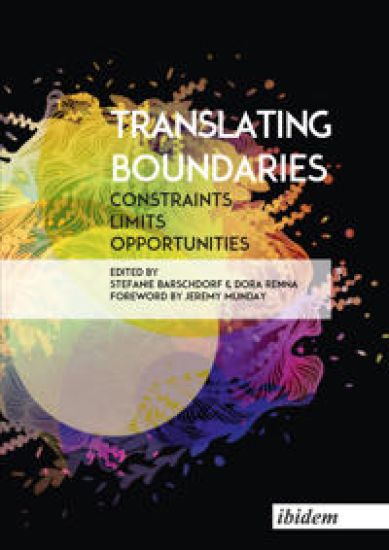
"Translation Studies have traditionally been known to be interdisciplinary. What better term to sum this up than boundaries? A term that means different things in different fields and can be applied to a multitude of topics. Political, personal, symbolic, or professional boundaries, boundaries of the mind as found in psychology, or boundaries in the sociological sense where they separate different fields of knowledge. From politics to geography, boundaries are everywhere. They need to be identified, drawn, or overcomedepending on circumstances and context. What are the boundaries translators and interpreters have to deal with? How do they relate to Translation Studies in general? Boundaries and translation go hand in hand. As the discipline grows and ever more elements of interdisciplinarity come into play, the more the question of what the boundaries of translation are needs to be asked. Some of the research topics presented in this collection may well extend the boundaries of the discipline itself, while others may look at the constraints and limits under which translators and translations operate, or showcase the role translation and interpreting play in overcoming social or political boundaries. It is with this in mind that the group of young researchers presented in this book has come together to create an overview of current research in Translation Studies. The papers offer insights into the state of the discipline in various nations, often touching on under-researched topics such as the role of translation in the creation of national as well as individual identities or the translation of popular music. They look at the role of culture and, more specifically, sociocultural influences on translation. At the same time, non-linguistic, intra- and extratextual factors are taken into account with particular attention to multimodality. What unites the papers collected is the general tendency to see translation as a means of bringing people together and enabling dialog, a means of overcoming ideological and social boundaries. By looking both to the past and the future of the discipline, the authors aim to (re)define the boundaries of Translation Studies." Authors: Jeremy Munday, Stefanie Barschdorf, Lucille Chevalier, Laura Leden, Olha Lehka-Paul, Dalia Mankauskiene, Bieke Nouws, Cristina Peligra, Elisabeth Poignant, Dora Renna, Heleen van Gerwen, Tenglong Wan. Editors: Dora Renna, Stefanie Barschdorf
Evaluation in Translation

Evaluation in Translation

Jeremy Munday

Routledge
2012
sidottu
In this book, Jeremy Munday presents advances towards a general theory of evaluation in translator decision-making that will be of high importance to translator and interpreter training and to descriptive translation analysis. By ‘evaluation’ the author refers to how a translator’s subjective stance manifests itself linguistically in a text.In a world where translation and interpreting function as a prism through which opposing personal and political views enter a target culture, it is crucial to investigate how such views are processed and sometimes subjectively altered by the translator. To this end, the book focuses on the translation process (rather than the product) and strives to identify more precisely those points where the translator is most likely to express judgment or evaluation.The translations studied cover a range of languages (Arabic, Chinese, Dutch, French, German, Indonesian, Italian, Japanese, Russian, Spanish and American Sign Language) accompanied by English glosses to facilitate comprehension by readers. This is key reading for researchers and postgraduates studying translation theory within Translation and Interpreting Studies.
Evaluation in Translation

Evaluation in Translation

Jeremy Munday

Routledge
2012
nidottu
In this book, Jeremy Munday presents advances towards a general theory of evaluation in translator decision-making that will be of high importance to translator and interpreter training and to descriptive translation analysis. By ‘evaluation’ the author refers to how a translator’s subjective stance manifests itself linguistically in a text.In a world where translation and interpreting function as a prism through which opposing personal and political views enter a target culture, it is crucial to investigate how such views are processed and sometimes subjectively altered by the translator. To this end, the book focuses on the translation process (rather than the product) and strives to identify more precisely those points where the translator is most likely to express judgment or evaluation.The translations studied cover a range of languages (Arabic, Chinese, Dutch, French, German, Indonesian, Italian, Japanese, Russian, Spanish and American Sign Language) accompanied by English glosses to facilitate comprehension by readers. This is key reading for researchers and postgraduates studying translation theory within Translation and Interpreting Studies.
Style and Ideology in Translation

Style and Ideology in Translation

Jeremy Munday

Routledge
2009
nidottu
Adopting an interdisciplinary approach, this book investigates the style, or ‘voice,’ of English language translations of twentieth-century Latin American writing, including fiction, political speeches, and film. Existing models of stylistic analysis, supported at times by computer-assisted analysis, are developed to examine a range of works and writers, selected for their literary, cultural, and ideological importance. The style of the different translators is subjected to a close linguistic investigation within their cultural and ideological framework.
The Routledge Companion to Translation Studies
The Routledge Companion to Translation Studies brings together clear, detailed essays from leading international scholars on major areas in Translation Studies today.This accessible and authoritative guide offers fresh perspectives on linguistics, context, culture, politics and ethics and contains a range of contributions on emerging areas such as cognitive theories, technology, interpreting and audiovisual translation.Supported by an extensive glossary of key concepts and a substantial bibliography, this Companion is an essential resource for undergraduates, postgraduates, researchers and professionals working in this exciting field of study.Jeremy Munday is Senior Lecturer in Spanish and Translation Studies at the University of Leeds. He is the author of Introducing Translation Studies, Translation: An Advanced Resource Book (with Basil Hatim) and Style and Ideology in Translation, all published by Routledge."An excellent all-round guide to translation studies taking in the more traditional genres and those on the cutting edge. All the contributors are known experts in their chosen areas and this gives the volume the air of authority required when dealing with a subject that is being increasingly studied in higher education institutions all over the world"- Christopher Taylor, University of Trieste, Italy
The Routledge Companion to Translation Studies
The Routledge Companion to Translation Studies brings together clear, detailed essays from leading international scholars on major areas in Translation Studies today.This accessible and authoritative guide offers fresh perspectives on linguistics, context, culture, politics and ethics and contains a range of contributions on emerging areas such as cognitive theories, technology, interpreting and audiovisual translation.Supported by an extensive glossary of key concepts and a substantial bibliography, this Companion is an essential resource for undergraduates, postgraduates, researchers and professionals working in this exciting field of study.Jeremy Munday is Senior Lecturer in Spanish and Translation Studies at the University of Leeds. He is the author of Introducing Translation Studies, Translation: An Advanced Resource Book (with Basil Hatim) and Style and Ideology in Translation, all published by Routledge."An excellent all-round guide to translation studies taking in the more traditional genres and those on the cutting edge. All the contributors are known experts in their chosen areas and this gives the volume the air of authority required when dealing with a subject that is being increasingly studied in higher education institutions all over the world"- Christopher Taylor, University of Trieste, Italy
Style and Ideology in Translation

Style and Ideology in Translation

Jeremy Munday

Routledge
2007
sidottu
Adopting an interdisciplinary approach, this book investigates the style, or ‘voice,’ of English language translations of twentieth-century Latin American writing, including fiction, political speeches, and film. Existing models of stylistic analysis, supported at times by computer-assisted analysis, are developed to examine a range of works and writers, selected for their literary, cultural, and ideological importance. The style of the different translators is subjected to a close linguistic investigation within their cultural and ideological framework.
Spanish Vocabulary Builder

Spanish Vocabulary Builder

Jeremy Munday; Harriette Lanzer; Anne Lise Gordon

Oxford University Press
1995
nidottu
The Spanish Vocabulary Builder is an excellent guide for students, helping them to build up their Spanish vocabulary, as well as preparing them for written and oral examinations.