Kirjojen hintavertailu. Mukana 12 143 255 kirjaa ja 12 kauppaa.
Kirjailija
Jeremy Waldron
Kirjat ja teokset yhdessä paikassa: 35 kirjaa, julkaisuja vuosilta 1990-2026, suosituimpien joukossa Bell Hath No Fury. Vertaile teosten hintoja ja tarkista saatavuus suomalaisista kirjakaupoista.
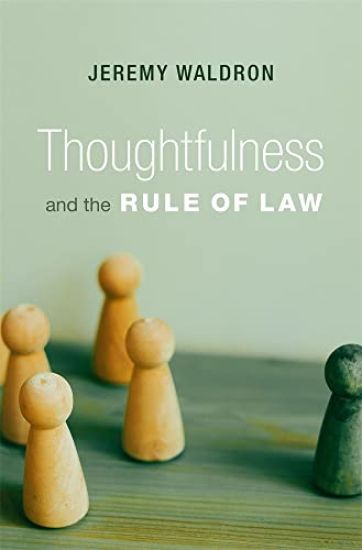
Political theorist Jeremy Waldron makes a bracing case against identifying rule of law with predictability. Seeing the rule of law as just one value to which democracies aspire, he embraces thoughtfulness rather than rote rule-following, flexibility even at the cost of vagueness, and emphasizing procedure and argument over predictable outcomes.
An essential study of the rule of law by one of the world’s leading liberal political and legal philosophers.The meaning and value of the rule of law have been debated since antiquity. For many, the rule of law has become the essence of good government. But Jeremy Waldron takes a different view, arguing that it is but one star in a constellation of ideals that define our political morality, ranking alongside democracy, human rights, economic freedom, and social justice.This timely essay collection, from one of the most respected political philosophers of his generation, is a brief on behalf of thoughtfulness: the intervention of human intelligence in the application of law. Waldron defends thoughtfulness against the claim that it threatens to replace the rule of law with the arbitrary rule of people. To the contrary, he argues, the rule of law requires thoughtfulness: it is impossible to apply a standard such as “reasonableness” on the basis of rules alone, and common legal activities like arguing in court and reasoning from precedents are poorly served by algorithmic logics. This rich compilation also addresses the place of law in protecting human dignity, the relation between rule of law and legislation, and whether vagueness in the law is at odds with law’s role in guiding action.Thoughtfulness and the Rule of Law emphasizes the value of procedures rather than the substance or outcome of legal decisions. Challenging the view that predictability and clarity are cardinal virtues, Waldron shows that real-world controversies often are best approached using a relatively thin concept of the rule of law, together with the thoughtfulness that a legal system frames and enables.
His family murdered...Homicide Detective Jackson Payne promises revenge.A GRIPPING CRIME THRILLER YOU WON'T BE ABLE TO PUT DOWN.When a deadly fire erupts inside Homicide Detective Jackson Payne's house, he never thought he'd have to investigate the murder of his own family.A MYSTERY OF HARROWING SUSPENSE.A surprise acquittal of accused murderer Raymond Frank has Jackson Payne assuming the worst. But when a crime beat reporter connects a murderer to the fire, Detective Payne is thrust into the most deadly case of his career.PAGE-TURNING TWISTS YOU'LL NEVER SEE COMING.Just when things couldn't get worse, Jackson Payne is framed for a murder he didn't commit and another cop might be behind the set up. Now on the run, it's up to him to prove his innocence. This was more than payback. It was personal.
Crime fiction at its best. Crime reporter Samantha Bell is in California for the biggest interview of her career when a missing persons case from eighteen years ago puts her directly on top of the story that could bring her national acclaim. An absorbing crime mystery that pivots energetically between subplots. When two sets of bones are found in the submerged vehicle of a local millionaire gone missing, Samantha is quick to learn the victim might be closer to her than what she thinks is possible. A masterful narrative with harrowing suspense. But when a kidnapping becomes a murder, secrets thought to have been buried in the past are quick to resurface and the small peaceful mountain town is once again haunted by a dangerous killer determined to get away with murder.
A heart-stopping murder mystery that will have you burning through the pages.Investigative reporter Samantha Bell's job has never been so dangerous. When TV actress, April Wright, falls to her death in what appears to be an accident, a video emerges from a credible source that suggests April's death might actually be murder of the first degree. Samantha Bell chases a terrifying criminal mastermind who is determined to remain anonymous and unseen, no matter the cost. Stalked by someone she cannot see, Samantha has social media influencer, Vincent Verdi, in her crosshairs. But when the chief of police blocks her pursuit of the truth at every turn, Samantha has no choice but to play dirty in order to save the man she loves. The stakes are higher than ever with twists and turns that will keep you guessing until the very end. Just when things couldn't get worse, Samantha's partner in crime, Erin Tate, is framed for a murder she didn't commit. Now it's up to Samantha and her four crime-solving friends to do whatever it takes to not be outsmarted by a criminal mastermind determined to remain one step ahead while leaving a trail of blood in his wake.
Known terrorists are often targeted for death by the governments of Israel and the United States. Several thousand have been killed by drones or by operatives on the ground in the last twenty years. Is this form of killing justified, when hundreds or thousands of lives are possibly at risk at the hands of a known terrorist? Is there anything about it that should disturb us? Ethically-sound and practical answers to these questions are more difficult to come by than it might seem. Renowned political theorists Jeremy Waldron and Tamar Meisels here defend two competing positions on the legitimacy of targeted killing as used in counterterrorism strategy in this riveting and essential for-and-against book. The volume begins with a joint introduction, briefly setting out the terms of discussion, and presenting a short historical overview of the practice: what targeted killing is, and how it has been used in which conflicts and by whom. It then hones in on killings themselves and the element of targeting. The authors tackle difficult and infinitely complex subjects, for example the similarities and differences between targeted killing of terrorists and ordinary killings in combat, and they ask whether targeted killing can be regarded as a law enforcement strategy, or as a hybrid between combat and law enforcement. They compare the practice of targeted killing with assassination and the use of death squads. And they consider the likelihood that targeted killing has been or will be abused against insurgents, criminals, or political opponents. Meisels analyzes the assassination by Israeli operatives of nuclear scientists working for regimes hostile to Israel. Meisels and Waldron carefully consider whether this sort of killing can ever be justified in terms of the danger it, in theory, averts. The conclusions drawn are at once as surprising as they are insightful, cautioning us against a world in which targeted killing is the norm as it proliferates rapidly. This is essential reading not only for students of political and war theory and military personnel, but for anyone interested in or concerned by the future of targeted killing.
Known terrorists are often targeted for death by the governments of Israel and the United States. Several thousand have been killed by drones or by operatives on the ground in the last twenty years. Is this form of killing justified, when hundreds or thousands of lives are possibly at risk at the hands of a known terrorist? Is there anything about it that should disturb us? Ethically-sound and practical answers to these questions are more difficult to come by than it might seem. Renowned political theorists Jeremy Waldron and Tamar Meisels here defend two competing positions on the legitimacy of targeted killing as used in counterterrorism strategy in this riveting and essential for-and-against book. The volume begins with a joint introduction, briefly setting out the terms of discussion, and presenting a short historical overview of the practice: what targeted killing is, and how it has been used in which conflicts and by whom. It then hones in on killings themselves and the element of targeting. The authors tackle difficult and infinitely complex subjects, for example the similarities and differences between targeted killing of terrorists and ordinary killings in combat, and they ask whether targeted killing can be regarded as a law enforcement strategy, or as a hybrid between combat and law enforcement. They compare the practice of targeted killing with assassination and the use of death squads. And they consider the likelihood that targeted killing has been or will be abused against insurgents, criminals, or political opponents. Meisels analyzes the assassination by Israeli operatives of nuclear scientists working for regimes hostile to Israel. Meisels and Waldron carefully consider whether this sort of killing can ever be justified in terms of the danger it, in theory, averts. The conclusions drawn are at once as surprising as they are insightful, cautioning us against a world in which targeted killing is the norm as it proliferates rapidly. This is essential reading not only for students of political and war theory and military personnel, but for anyone interested in or concerned by the future of targeted killing.
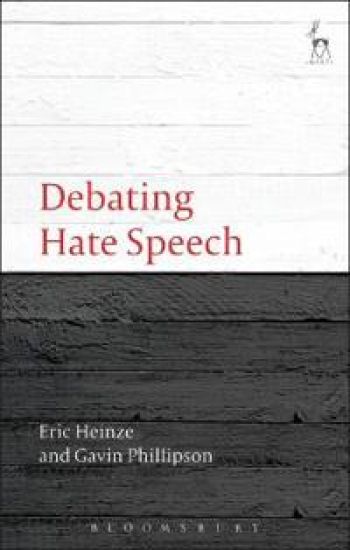
Does hate speech undermine democracy, by attacking its most vulnerable members? Does it threaten the equal dignity of all citizens? Or are democracy and equality degraded not by hateful expression, but by censorship? Do hate speech bans give governments too much control over thought and ideas, or do bans secure the conditions for ideas to be meaningfully debated? Should each society choose its own rules? Or are some principles of free expression universal? Whom should hate speech bans protect: racial and ethnic groups, religious communities, women, sexual minorities, the disabled? Should we ban hateful words and images in public spaces but not on the internet? Heinze and Phillipson draw on law, politics, philosophy and ethics to debate these questions. For Phillipson, narrowly drawn hate speech bans are essential to the social contract – a prerequisite for democratic deliberation, and a symbolic protection of every citizen’s basic dignity. Heinze replies that punitive rules imposed to silence hateful views damage democracy, and governments have more legitimate and effective means of combating harmful speech. Drawing upon European, American and Commonwealth perspectives, this book will be of interest not only to lawyers, but also to readers in philosophy, politics and journalism.
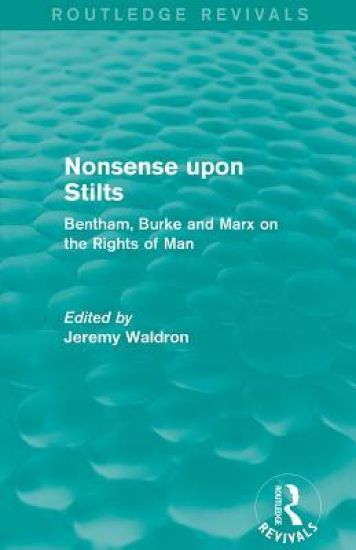
In Nonsense upon Stilts¸ first published in 1987, Waldron includes and discusses extracts from three classic critiques of the idea of natural rights embodied in the 1789 Declaration of the Rights of Man and the Citizen. Each text is prefaced by an historical introduction and an analysis of its main themes. The collection as a whole in introduced with an essay tracing the philosophical background to the three critiques as well as the eighteenth-century idea of natural rights which they attacked. But the point of reproducing these works is not merely historical. Modern attacks on ‘rights-based’ political philosophy mirror the concerns of Bentham, Burke and Marx. Jeremy Waldron has therefore added an extensive concluding essay which relates these classic texts to the modern discussion of rights and re-examines the idea of rights in the light of contemporary critiques. This text provides an invaluable teaching tool for courses in politics and philosophy.
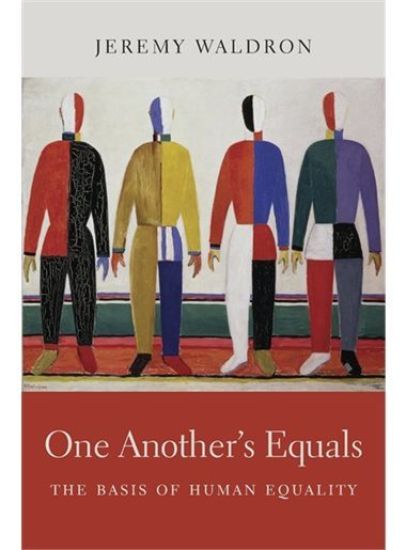
An enduring theme of Western philosophy is that we are all one another’s equals. Yet the principle of basic equality is woefully under-explored in modern moral and political philosophy. In a major new work, Jeremy Waldron attempts to remedy that shortfall with a subtle and multifaceted account of the basis for the West’s commitment to human equality.What does it mean to say we are all one another’s equals? Is this supposed to distinguish humans from other animals? What is human equality based on? Is it a religious idea, or a matter of human rights? Is there some essential feature that all human beings have in common? Waldron argues that there is no single characteristic that serves as the basis of equality. He says the case for moral equality rests on four capacities that all humans have the potential to possess in some degree: reason, autonomy, moral agency, and the ability to love. But how should we regard the differences that people display on these various dimensions? And what are we to say about those who suffer from profound disability—people whose claim to humanity seems to outstrip any particular capacities they have along these lines?Waldron, who has worked on the nature of equality for many years, confronts these questions and others fully and unflinchingly. Based on the Gifford Lectures that he delivered at the University of Edinburgh in 2015, One Another’s Equals takes Waldron’s thinking further and deeper than ever before.
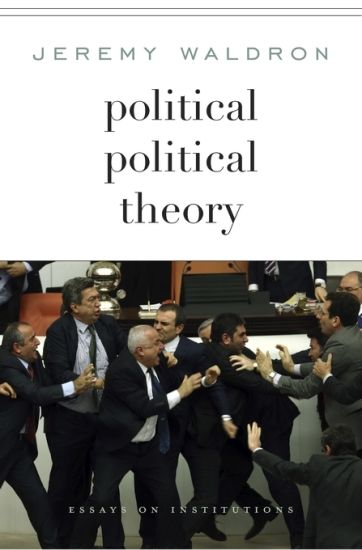
Political institutions are the main subject of political theory—or they ought to be. Making the case with his trademark forcefulness and intellectual aplomb, Jeremy Waldron argues in favor of reorienting the theory of politics toward the institutions and institutional principles of modern democracy and the mechanisms through which democratic ideals are achieved.Too many political theorists are preoccupied with analyzing the nature and importance of justice, liberty, and equality, at the cost of ignoring the governmental institutions needed to achieve them. By contrast, political scientists have kept institutions in view, but they deploy a meager set of value-conceptions in evaluating them. Reflecting on an array of issues about constitutional structure, Waldron considers the uses and abuses of diverse institutions and traditions, from separation of powers and bicameralism to judicial review of legislation, the principle of loyal opposition, the nature of representation, political accountability, and the rule of law. He refines his well-known argument about the undemocratic character of judicial review, providing a capacious perspective on the proper role of courts in a constitutional democracy, and he offers an illuminating critique of the contrasting political philosophies of Hannah Arendt and Isaiah Berlin.Even if political theorists remain fixated on expounding the philosophical foundations of democracy, they need to complement their work with a firmer grasp of the structures through which democracy is realized. This is what political political theory means: theory addressing itself to the way political institutions frame political disagreements and orchestrate resolutions to our disputes over social ideals.
First published in 1990. The Law brings issues of legal theory to life by relating them to real problems in British politics. Questions about human rights, the rule of law, the unwritten constitution, the role of judges, law and politics, and civil disobedience are often discussed as purely abstract issues. Jeremy Waldon, however, considers them in the context of incidents such as the GLC's `Fare's Fair' case, the choice of Prime Minister, interrogation techniques in Northern Ireland, and the 1984-85 Miners' Strike. He shows that the role of law is not a dry conceptual study, but instead raises issues that lie at the very heart of British politics, and maintains that many political controversies in turn cannot be understood without looking at the issues of legal philosophy at stake.This lively text is intended for students of politics as well as law, but it will also interest anyone who is concerned about the rule of law in Britain. In particular, it asks the crucial question, 'How can the people of Britain reclaim the law as their own?' The rule of law should not be regarded simply as an obligation that people have to live with; it is also a responsibility that the government owes to the people to formulate legislation and to operate a legal system that is worthy of our respect.
Writers on human dignity roughly divide between those who stress the social origins of this concept and its role in marking rank and hierarchy, and those who follow Kant in grounding dignity in an abstract and idealized philosophical conception of human beings. In these lectures, Jeremy Waldron contrives to combine attractive features of both strands. In the first lecture, Waldron presents a conception of dignity that preserves its ancient association with rank and station, thus allowing him to tap rich historical resources while avoiding what many perceive as the excessive abstraction and dubious metaphysics of the Kantian strand. At the same time he argues for a conception of human dignity that amounts to a generalization of high status across all human beings, and so attains the appealing universality of the Kantian position. The second lecture focuses particularly on the importance of dignity - understood in this way - as a status defining persons' relation to law: their presentation as persons capable of self-applying the law, capable of presenting and arguing a point of view, and capable of responding to law's demands without brute coercion. Together the two lectures illuminate the relation between dignity conceived as the ground of rights and dignity conceived as the content of rights; they also illuminate important ideas about dignity as noble bearing and dignity as the subject of a right against degrading treatment; and they help us understand the sense in which dignity is better conceived as a status than as a kind of value.
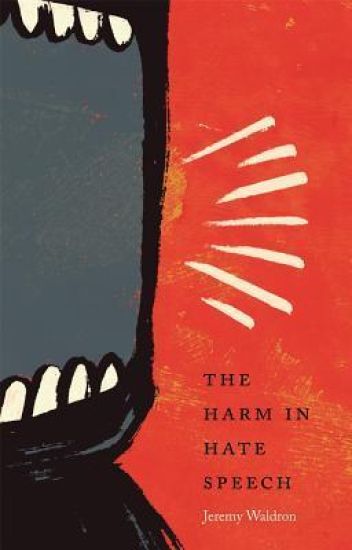
Every liberal democracy has laws or codes against hate speech—except the United States. For constitutionalists, regulation of hate speech violates the First Amendment and damages a free society. Against this absolutist view, Jeremy Waldron argues powerfully that hate speech should be regulated as part of our commitment to human dignity and to inclusion and respect for members of vulnerable minorities.Causing offense—by depicting a religious leader as a terrorist in a newspaper cartoon, for example—is not the same as launching a libelous attack on a group’s dignity, according to Waldron, and it lies outside the reach of law. But defamation of a minority group, through hate speech, undermines a public good that can and should be protected: the basic assurance of inclusion in society for all members. A social environment polluted by anti-gay leaflets, Nazi banners, and burning crosses sends an implicit message to the targets of such hatred: your security is uncertain and you can expect to face humiliation and discrimination when you leave your home.Free-speech advocates boast of despising what racists say but defending to the death their right to say it. Waldron finds this emphasis on intellectual resilience misguided and points instead to the threat hate speech poses to the lives, dignity, and reputations of minority members. Finding support for his view among philosophers of the Enlightenment, Waldron asks us to move beyond knee-jerk American exceptionalism in our debates over the serious consequences of hateful speech.