Kirjojen hintavertailu. Mukana 12 390 323 kirjaa ja 12 kauppaa.

Kirjailija

Jeremy Wood

Kirjat ja teokset yhdessä paikassa: 6 kirjaa, julkaisuja vuosilta 2010-2023, suosituimpien joukossa Rubens : Copies and Adaptations from Renaissance and Later Artists. Italian Artists. Vertaile teosten hintoja ja tarkista saatavuus suomalaisista kirjakaupoista.

6 kirjaa

Kirjojen julkaisuhaarukka 2010-2023.

The Dynamics of Small Solar System Bodies

The Dynamics of Small Solar System Bodies

Jeremy Wood

Springer Nature Switzerland AG
2019
nidottu
This SpringerBrief summarizes the latest relevant research and discoveries that have been made in the area of ringed small bodies and small body taxonomy, including those that lay the groundwork for future discoveries. Before 2013, ringed small bodies were only theoretical. Thus, there are very limited publications available on this relatively new subfield of astronomy. With the introduction of the GAIA catalogue, star positions are now known better than ever before. Since rings are discovered through the use of starlight occultation, we could very well be looking at an explosion of discoveries of ringed small bodies in the near future. Each chapter is accompanied by exercises, and an end-of-book answer key is provided. As such, this brief will benefit students and researchers alike who wish to have a single document and quick access to the latest information on ringed small bodies and small body taxonomy.
Practical Deployment of Cisco Identity Services Engine (ISE)

Practical Deployment of Cisco Identity Services Engine (ISE)

Andy Richter; Jeremy Wood

Syngress Media,U.S.
2015
nidottu
With the proliferation of mobile devices and bring-your-own-devices (BYOD) within enterprise networks, the boundaries of where the network begins and ends have been blurred. Cisco Identity Services Engine (ISE) is the leading security policy management platform that unifies and automates access control to proactively enforce role-based access to enterprise networks. In Practical Deployment of Cisco Identity Services Engine (ISE), Andy Richter and Jeremy Wood share their expertise from dozens of real-world implementations of ISE and the methods they have used for optimizing ISE in a wide range of environments. ISE can be difficult, requiring a team of security and network professionals, with the knowledge of many different specialties. Practical Deployment of Cisco Identity Services Engine (ISE) shows you how to deploy ISE with the necessary integration across multiple different technologies required to make ISE work like a system. Andy Richter and Jeremy Wood explain end-to-end how to make the system work in the real world, giving you the benefit of their ISE expertise, as well as all the required ancillary technologies and configurations to make ISE work.
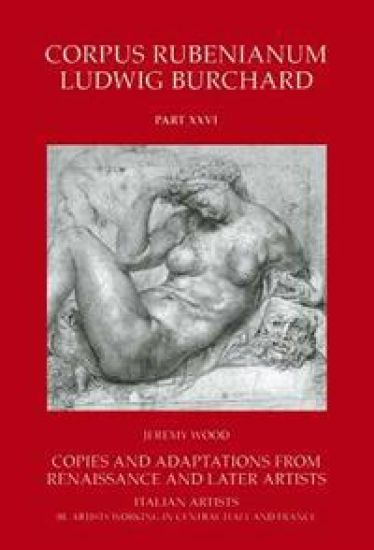
Rubens : Copies and Adaptations from Renaissance and Later Artists. Italian Artists
This section of the Corpus Rubenianum is concerned with Rubens's remarkable study of past art as revealed by his numerous copies and adaptations from Italian sources. The material is so extensive that it has been divided into three separate volumes covering (I) Raphael and his School, (II) Titian and North Italian artists, and (III) artists who worked in Central Italy as well as in France. Rubens's study of the Cinquecento lasted throughout his life and was not just the focus of his early years in Antwerp when he learned his craft and often used prints and copy drawings as models. Perhaps surprisingly, Rubens made relatively few drawings directly from paintings while in Italy between 1600 and 1608, although some survive after frescoes that he saw on his travels. Instead, Rubens was a rapacious collector of Italian drawings, both working studies and journeyman records. He kept them in his cabinet in Antwerp, and took them out from time to time to retouch and rework them so that they became his own. By this means he was able to return to the art of Italy long after he had left that country. Ruben's most important painted copies were also made late in his career, in 1628-30 when he had travelled to Madrid and London and was in his fifties, a point when many artists would have thought they no longer needed to study. These replicas may have been made because he could not buy the originals for his collection, but they also reveal the thoroughness of his dialogue with Italian art. In total, this material amounts to the largest group of painted and drawn copies by any late Renaissance painter.
Rubens : Copies and Adaptations from Renaissance and Later Artists. Italian Artists
The present volume is the second of three devoted to the many copies and adaptations that Rubens made from Italian art, and it is dominated by his interest in the work of artists active in Venice during the sixteenth century. Rubens, when a mature master, decided to make a number of full-size painted replicas of works by Titian that he saw on his travels to Madrid and London. Perhaps surprisingly, he made far fewer copies after the works of Titian's contemporaries, Tintoretto and Veronese, but, in addition, the volume examines his interest in the work of other masters active in North Italy at this time, notably Andrea Mantegna, Antonio da Correggio, and Girolamo Francesco Parmigianino. It is Rubens's interest in Titian, however, that has been seen as crucial for art in the Early Modern period, a topic that has attracted the attention of critics and art historians from the seventeenth century to the present day.
Rubens : Copies and Adaptations from Renaissance and Later Artists. Italian Artists
This section of the Corpus Rubenianum is concerned with Rubens's remarkable study of Italian sixteenth-century art as shown through his numerous copies and adaptations. Rubens's study of the Cinquecento lasted throughout his life and was not just the focus of his early years in Antwerp when he learned his craft. At that time he used secondary copies as models for pen drawings or as a basis for enlarged painted adaptations such as his famous version in Dresden after Michelangelo's Leda. Rubens's most important full-size painted copies, however, were made as late as 1628-30 when he had travelled to Madrid and London and was in his fifties, a point when many artists would have thought they no longer needed to study. He may have made these copies because he could not buy the originals for his collection, but the act of creating such detailed visual records shows how attentive he was to the art of the past. This process culminated in his large and very free adaptations of the 1630s, now in Stockholm, after Titian's Andrians and Worship of Venus which are among the most famous copies in the history of art. Rubens made relatively few drawings from paintings while in Italy between 1600 and 1608, although some survive after frescoes by Pordenone that he saw in Treviso and there are also a number that record Michelangelo's paintings in the Sistine Chapel in Rome. Most of the catalogue entries, however, discuss the Italian copy drawings that Rubens bought during his travels and brought home to Antwerp. It will be argued that these sheets were taken out and retouched by him throughout his career. In total, this material amounts to one of the largest collections of graphic art assembled by a late Renaissance painter, and as a result it reveals Rubens's sophisticated and complex dialogue with Italian art.