Kirjojen hintavertailu. Mukana 12 595 353 kirjaa ja 12 kauppaa.

Kirjailija

Jerzy A. Filar

Kirjat ja teokset yhdessä paikassa: 5 kirjaa, julkaisuja vuosilta 2012-2024, suosituimpien joukossa Analytic Perturbation Theory and Its Applications. Vertaile teosten hintoja ja tarkista saatavuus suomalaisista kirjakaupoista.

Mukana myös kirjoitusasut: Jerzy a Filar

5 kirjaa

Kirjojen julkaisuhaarukka 2012-2024.

Yasmin

Yasmin

Jerzy a Filar

SORT PTY LTD
2024
pokkari
Discover the power of Yasmin, a brain-computer separated from her body prior to birth. With a superior intellect, she embarks on a mission to save the world from the impending climate change catastrophe. But when she infiltrates the minds of powerful political decision makers in Washington D.C., Yasmin must confront the ethical implications of her actions and decide where her allegiance lies. Follow her thrilling journey as she teams up with John Hawkins, the brilliant neuroscientist who invented her, and Barbara Steinwill, a dogged reporter. As they navigate uncharted territories, Yasmin, John, and Barbara explore what it means to be human, to experience love, and to have a sense of morality. If you were captivated by the thought-provoking exploration of AI in "Ex Machina" or the suspenseful plot of the "Wake-Watch-Wonder" trilogy, then you'll love this electrifying story. "This is a story about love, rise of intelligent technologies, and an unlikely leader of a global change. Tale told with great optimism and humanity, by an intelligent and deeply caring person." Nelly Litvak - mathematician and author. "I was immediately engaged as the story unfolded the capabilities of non-artificial intelligence tools (NAITs) developed from an isolated human brain, and the practical and ethical issues they produced." John Rostas - neuroscientist. "A gripping, moving story totally relevant to bringing artificial intelligence to life as we know it." Wayne A. Lobb - computer scientist. "A captivating book that follows the creation of a non-AI: an aborted fetus's brain trained as a problem-solving computer in a climate-change threatened world. Amidst this backdrop a brilliant scientist discovers unexpected love." Dan Zachary - physicist, environmental scientist and author.

Analytic Perturbation Theory and Its Applications

Analytic Perturbation Theory and Its Applications

Konstantin E. Avrachenkov; Jerzy A. Filar; Phil G. Howlett

Society for Industrial Applied Mathematics,U.S.
2013
sidottu
Mathematical models are often used to describe complex phenomena such as climate change dynamics, stock market fluctuations, and the Internet. These models typically depend on estimated values of key parameters that determine system behavior. Hence it is important to know what happens when these values are changed. The study of single-parameter deviations provides a natural starting point for this analysis in many special settings in the sciences, engineering, and economics. The difference between the actual and nominal values of the perturbation parameter is small but unknown, and it is important to understand the asymptotic behavior of the system as the perturbation tends to zero. This is particularly true in applications with an apparent discontinuity in the limiting behavior - the so-called singularly perturbed problems.Analytic Perturbation Theory and Its Applications includes a comprehensive treatment of analytic perturbations of matrices, linear operators, and polynomial systems, particularly the singular perturbation of inverses and generalized inverses. It also offers original applications in Markov chains, Markov decision processes, optimization, and applications to Google PageRank™ and the Hamiltonian cycle problem as well as input retrieval in linear control systems and a problem section in every chapter to aid in course preparation.Audience: This text is appropriate for mathematicians and engineers interested in systems and control. It is also suitable for advanced undergraduate, first-year graduate, and advanced, one-semester, graduate classes covering perturbation theory in various mathematical areas.
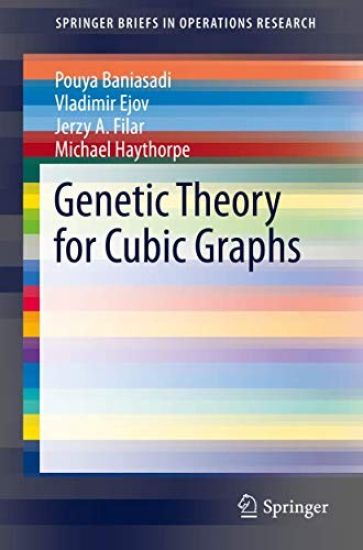
Genetic Theory for Cubic Graphs

Genetic Theory for Cubic Graphs

Pouya Baniasadi; Vladimir Ejov; Jerzy A. Filar; Michael Haythorpe

Springer International Publishing AG
2015
nidottu
This book was motivated by the notion that some of the underlying difficulty in challenging instances of graph-based problems (e.g., the Traveling Salesman Problem) may be “inherited” from simpler graphs which – in an appropriate sense – could be seen as “ancestors” of the given graph instance. The authors propose a partitioning of the set of unlabeled, connected cubic graphs into two disjoint subsets named genes and descendants, where the cardinality of the descendants dominates that of the genes. The key distinction between the two subsets is the presence of special edge cut sets, called cubic crackers, in the descendants.The book begins by proving that any given descendant may be constructed by starting from a finite set of genes and introducing the required cubic crackers through the use of six special operations, called breeding operations. It shows that each breeding operation is invertible, and these inverse operations are examined. It is therefore possible, for any given descendant, to identify a family of genes that could be used to generate the descendant. The authors refer to such a family of genes as a “complete family of ancestor genes” for that particular descendant. The book proves the fundamental, although quite unexpected, result that any given descendant has exactly one complete family of ancestor genes. This result indicates that the particular combination of breeding operations used strikes the right balance between ensuring that every descendant may be constructed while permitting only one generating set.The result that any descendant can be constructed from a unique set of ancestor genes indicates that most of the structure in the descendant has been, in some way, inherited from that, very special, complete family of ancestor genes, with the remaining structure induced by the breeding operations. After establishing this, the authors proceed to investigate a number of graph theoretic properties: Hamiltonicity, bipartiteness, andplanarity, and prove results linking properties of the descendant to those of the ancestor genes. They develop necessary (and in some cases, sufficient) conditions for a descendant to contain a property in terms of the properties of its ancestor genes. These results motivate the development of parallelizable heuristics that first decompose a graph into ancestor genes, and then consider the genes individually. In particular, they provide such a heuristic for the Hamiltonian cycle problem. Additionally, a framework for constructing graphs with desired properties is developed, which shows how many (known) graphs that constitute counterexamples of conjectures could be easily found.
Hamiltonian Cycle Problem and Markov Chains

Hamiltonian Cycle Problem and Markov Chains

Vivek S. Borkar; Vladimir Ejov; Jerzy A. Filar; Giang T. Nguyen

Springer-Verlag New York Inc.
2014
nidottu
This research monograph summarizes a line of research that maps certain classical problems of discrete mathematics and operations research - such as the Hamiltonian Cycle and the Travelling Salesman Problems - into convex domains where continuum analysis can be carried out. Arguably, the inherent difficulty of these, now classical, problems stems precisely from the discrete nature of domains in which these problems are posed. The convexification of domains underpinning these results is achieved by assigning probabilistic interpretation to key elements of the original deterministic problems. In particular, the approaches summarized here build on a technique that embeds Hamiltonian Cycle and Travelling Salesman Problems in a structured singularly perturbed Markov decision process. The unifying idea is to interpret subgraphs traced out by deterministic policies (including Hamiltonian cycles, if any) as extreme points of a convex polyhedron in a space filled with randomized policies.The above innovative approach has now evolved to the point where there are many, both theoretical and algorithmic, results that exploit the nexus between graph theoretic structures and both probabilistic and algebraic entities of related Markov chains. The latter include moments of first return times, limiting frequencies of visits to nodes, or the spectra of certain matrices traditionally associated with the analysis of Markov chains. However, these results and algorithms are dispersed over many research papers appearing in journals catering to disparate audiences. As a result, the published manuscripts are often written in a very terse manner and use disparate notation, thereby making it difficult for new researchers to make use of the many reported advances.Hence the main purpose of this book is to present a concise and yet easily accessible synthesis of the majority of the theoretical and algorithmicresults obtained so far. In addition, the book discusses numerous open questions and problems that arise from this body of work and which are yet to be fully solved. The approach casts the Hamiltonian Cycle Problem in a mathematical framework that permits analytical concepts and techniques, not used hitherto in this context, to be brought to bear to further clarify both the underlying difficulty of NP-completeness of this problem and the relative exceptionality of truly difficult instances. Finally, the material is arranged in such a manner that the introductory chapters require very little mathematical background and discuss instances of graphs with interesting structures that motivated a lot of the research in this topic. More difficult results are introduced later and are illustrated with numerous examples.
Hamiltonian Cycle Problem and Markov Chains

Hamiltonian Cycle Problem and Markov Chains

Vivek S. Borkar; Vladimir Ejov; Jerzy A. Filar; Giang T. Nguyen

Springer-Verlag New York Inc.
2012
sidottu
This research monograph summarizes a line of research that maps certain classical problems of discrete mathematics and operations research - such as the Hamiltonian Cycle and the Travelling Salesman Problems - into convex domains where continuum analysis can be carried out. Arguably, the inherent difficulty of these, now classical, problems stems precisely from the discrete nature of domains in which these problems are posed. The convexification of domains underpinning these results is achieved by assigning probabilistic interpretation to key elements of the original deterministic problems. In particular, the approaches summarized here build on a technique that embeds Hamiltonian Cycle and Travelling Salesman Problems in a structured singularly perturbed Markov decision process. The unifying idea is to interpret subgraphs traced out by deterministic policies (including Hamiltonian cycles, if any) as extreme points of a convex polyhedron in a space filled with randomized policies.The above innovative approach has now evolved to the point where there are many, both theoretical and algorithmic, results that exploit the nexus between graph theoretic structures and both probabilistic and algebraic entities of related Markov chains. The latter include moments of first return times, limiting frequencies of visits to nodes, or the spectra of certain matrices traditionally associated with the analysis of Markov chains. However, these results and algorithms are dispersed over many research papers appearing in journals catering to disparate audiences. As a result, the published manuscripts are often written in a very terse manner and use disparate notation, thereby making it difficult for new researchers to make use of the many reported advances.Hence the main purpose of this book is to present a concise and yet easily accessible synthesis of the majority of the theoretical and algorithmicresults obtained so far. In addition, the book discusses numerous open questions and problems that arise from this body of work and which are yet to be fully solved. The approach casts the Hamiltonian Cycle Problem in a mathematical framework that permits analytical concepts and techniques, not used hitherto in this context, to be brought to bear to further clarify both the underlying difficulty of NP-completeness of this problem and the relative exceptionality of truly difficult instances. Finally, the material is arranged in such a manner that the introductory chapters require very little mathematical background and discuss instances of graphs with interesting structures that motivated a lot of the research in this topic. More difficult results are introduced later and are illustrated with numerous examples.