Kirjojen hintavertailu. Mukana 12 390 323 kirjaa ja 12 kauppaa.

Kirjailija

Jessie H Lee

Kirjat ja teokset yhdessä paikassa: 4 kirjaa, julkaisuja vuosilta 2023-2024, suosituimpien joukossa Cognitive Hack and Cognitive Risk Set. Vertaile teosten hintoja ja tarkista saatavuus suomalaisista kirjakaupoista.

4 kirjaa

Kirjojen julkaisuhaarukka 2023-2024.

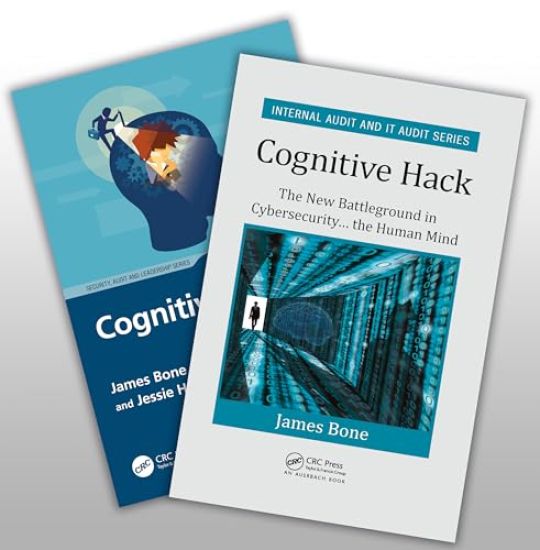
Cognitive Hack and Cognitive Risk Set

Cognitive Hack and Cognitive Risk Set

James Bone; Jessie H Lee

TAYLOR FRANCIS LTD
2024
muu
Cognitive Hack explores a broad cross section of research and actual case studies to draw out new insights that may be used to build a benchmark for IT security professionals. This research takes a deeper dive beneath the surface of the analysis to uncover novel ways to mitigate data security vulnerabilities, connect the dots and identify patterns in the data on breaches. This analysis will assist security professionals not only in benchmarking their risk management programs but also in identifying forward looking security measures to narrow the path of future vulnerabilities.Cognitive Risk is a book about the least understood but most pervasive risk to mankind – human decision-making. Cognitive risks are subconscious and unconscious influence factors on human decision-making: heuristics and biases. To understand the scope of cognitive risk, we look at case studies, corporate and organizational failure, and the science that explains why we systemically make errors in judgment and repeat the same errors.The book takes a multidisciplinary and pedestrian stroll through behavioral science with a light touch, using stories to explain why we consistently make cognitive errors that not only increase risks but also simultaneously fail to recognize these errors in ourselves or our organizations. This science has deep roots in organizational behavior, psychology, human factors, cognitive science, and behavioral science all influenced by classic philosophers and enabled through advanced analytics and artificial intelligence. The point of the book is simple. Humans persist with bounded rationality, but as the speed of information, data, money, and life in general accelerates, we will need the right tools to not only keep pace but to survive and thrive.In light of all these factors that complicate risk, the book offers a foundational solution. A cognitive risk framework for enterprise risk management and cyber security. There are five pillars in a cognitive risk framework with five levels of maturity, yet there is no universally prescribed maturity level. It is more a journey of different paths. Each organization will pursue its own path, but the goal is the same – to minimize the errors that could have been avoided. We explain why risks are hard to discuss and why we systematically ignore the aggregation of these risks hidden in collective decision-making in an organization.The cognitive risk framework is a framework designed to explore the two most complex risks organizations face: uncertainty and decision-making under uncertainty. The first pillar is cognitive governance, which is a structured approach for institutionalizing rational decision-making across the enterprise. Each pillar is complimentary and builds on the next in a succession of continuous learning. There is no endpoint because the pillars evolve with technology. Enterprise risk is a team effort in risk intelligence grounded in a framework for good decision-making. We close with a call to become designers of risk solutions enabled by the right technology and nurtured by collaboration.We hope you enjoy the book with this context.
Cognitive Risk

Cognitive Risk

James Bone; Jessie H Lee

TAYLOR FRANCIS LTD
2023
sidottu
Cognitive Risk is a book about the least understood but most pervasive risk to mankind – human decision-making. Cognitive risks are subconscious and unconscious influence factors on human decision-making: heuristics and biases. To understand the scope of cognitive risk, we look at case studies, corporate and organizational failure, and the science that explains why we systemically make errors in judgment and repeat the same errors.The book takes a multidisciplinary and pedestrian stroll through behavioral science with a light touch, using stories to explain why we consistently make cognitive errors that not only increase risks but also simultaneously fail to recognize these errors in ourselves or our organizations. This science has deep roots in organizational behavior, psychology, human factors, cognitive science, and behavioral science all influenced by classic philosophers and enabled through advanced analytics and artificial intelligence. The point of the book is simple. Humans persist with bounded rationality, but as the speed of information, data, money, and life in general accelerates, we will need the right tools to not only keep pace but to survive and thrive.In light of all these factors that complicate risk, the book offers a foundational solution. A cognitive risk framework for enterprise risk management and cyber security. There are five pillars in a cognitive risk framework with five levels of maturity, yet there is no universally prescribed maturity level. It is more a journey of different paths. Each organization will pursue its own path, but the goal is the same – to minimize the errors that could have been avoided. We explain why risks are hard to discuss and why we systematically ignore the aggregation of these risks hidden in collective decision-making in an organization.The cognitive risk framework is a framework designed to explore the two most complex risks organizations face: uncertainty and decision-making under uncertainty. The first pillar is cognitive governance, which is a structured approach for institutionalizing rational decision-making across the enterprise. Each pillar is complimentary and builds on the next in a succession of continuous learning. There is no endpoint because the pillars evolve with technology. Enterprise risk is a team effort in risk intelligence grounded in a framework for good decision-making. We close with a call to become designers of risk solutions enabled by the right technology and nurtured by collaboration.We hope you enjoy the book with this context.
Four-Book Set on Risk Management

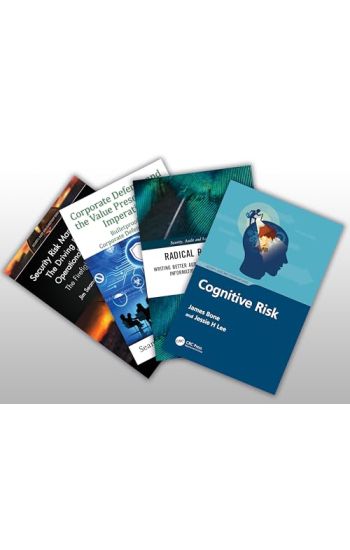
Four-Book Set on Risk Management

Sean Lyons; Sara I. James; James Bone; Jessie H Lee; Jim Seaman; Michael Gioia

TAYLOR FRANCIS LTD
2024
muu
Corporate Defense and the Value Preservation Imperative is the first book to finally address the umbrella term corporate defense, and to explain how an integrated corporate defense program can help an organization address both value creation and preservation. The book explores the value preservation imperative, which represents an organization’s obligation to implement a comprehensive corporate defense program in order to deliver long-term sustainable value to its stakeholders. For the first time the reader is provided with a complete picture of how corporate defense operates all the way from the boardroom to the front-lines, and vice versa. It provides comprehensive guidance on how to implement a robust corporate defense program by addressing this challenge from strategic, tactical, and operational perspectives. This arrangement provides readers with a holistic view of corporate defense and incorporates the management of the eight critical corporate defense components. It includes how an organization needs to integrate its governance, risk, compliance, intelligence, security, resilience, controls and assurance activities within its corporate defense program.Radical Reporting, this small volume provides the tools and techniques needed to improve reports. It does so through addressing crucial concepts all too often overlooked in the familiar rush to perform tasks, complete projects, and meet deadlines.These concepts – the role of culture in communication; the link between logic and language; the importance of organizing thoughts before writing; and how to achieve clarity – may seem academic or theoretical. They’re not. Unless writers understand their own thoughts, actions, and objectives, they cannot hope to communicate them at all – let alone clearly.Cognitive Risk is a book about the least understood but most pervasive risk to mankind – human decision-making. Cognitive risks are subconscious and unconscious influence factors on human decision-making: heuristics and biases. To understand the scope of cognitive risk, we look at case studies, corporate and organizational failure, and the science that explains why we systemically make errors in judgment and repeat the same errors.In Security Risk Management - The Driving Force for Operational Resilience, we change the perspective on an organization’s operational resilience capabilities so that it shifts from being a reactive (tick box) approach to being proactive. The perspectives of every chapter in this book focus on risk profiles and how your business can reduce these profiles using effective mitigation measures.The book is divided into two sections:1. Security Risk Management (SRM).All the components of security risk management contribute to your organization’s operational resilience capabilities, to help reduce your risks.• Reduce the probability/ likelihood.2. Survive to Operate.If your SRM capabilities fail your organization, these are the components that are needed to allow you to quickly ‘bounce back.’• Reduce the severity/ impact.
Cognitive Risk

Cognitive Risk

James Bone; Jessie H Lee

TAYLOR FRANCIS LTD
2023
nidottu
Cognitive Risk is a book about the least understood but most pervasive risk to mankind – human decision-making. Cognitive risks are subconscious and unconscious influence factors on human decision-making: heuristics and biases. To understand the scope of cognitive risk, we look at case studies, corporate and organizational failure, and the science that explains why we systemically make errors in judgment and repeat the same errors.The book takes a multidisciplinary and pedestrian stroll through behavioral science with a light touch, using stories to explain why we consistently make cognitive errors that not only increase risks but also simultaneously fail to recognize these errors in ourselves or our organizations. This science has deep roots in organizational behavior, psychology, human factors, cognitive science, and behavioral science all influenced by classic philosophers and enabled through advanced analytics and artificial intelligence. The point of the book is simple. Humans persist with bounded rationality, but as the speed of information, data, money, and life in general accelerates, we will need the right tools to not only keep pace but to survive and thrive.In light of all these factors that complicate risk, the book offers a foundational solution. A cognitive risk framework for enterprise risk management and cyber security. There are five pillars in a cognitive risk framework with five levels of maturity, yet there is no universally prescribed maturity level. It is more a journey of different paths. Each organization will pursue its own path, but the goal is the same – to minimize the errors that could have been avoided. We explain why risks are hard to discuss and why we systematically ignore the aggregation of these risks hidden in collective decision-making in an organization.The cognitive risk framework is a framework designed to explore the two most complex risks organizations face: uncertainty and decision-making under uncertainty. The first pillar is cognitive governance, which is a structured approach for institutionalizing rational decision-making across the enterprise. Each pillar is complimentary and builds on the next in a succession of continuous learning. There is no endpoint because the pillars evolve with technology. Enterprise risk is a team effort in risk intelligence grounded in a framework for good decision-making. We close with a call to become designers of risk solutions enabled by the right technology and nurtured by collaboration.We hope you enjoy the book with this context.