

Kirjailija
Jessie Riposo
Kirjat ja teokset yhdessä paikassa: 22 kirjaa, julkaisuja vuosilta 1995-2020, suosituimpien joukossa Australia's Submarine Design Capabilities and Capacities. Vertaile teosten hintoja ja tarkista saatavuus suomalaisista kirjakaupoista.
22 kirjaa
Kirjojen julkaisuhaarukka 1995-2020.

Issues with Access to Acquisition Data and Information in the Department of Defense
Megan McKernan; Jessie Riposo; Geoffrey McGovern
RAND
2018
nidottu
This report provides a closer look at the current state of the Controlled Unclassified Information (CUI) program as well as how new CUI rules might affect DoD acquisition data management. We found a high degree of overlap in the content of past and present CUI labels used for acquisition data, but the problem going forward is translating new policy into practice.

A Strategic Assessment of the Future of U.S. Navy Ship Maintenance
Bradley Martin; Michael E McMahon; Jessie Riposo; James G Kallimani; Angelena Bohman; Alyssa Ramos; Abby Schendt
RAND
2017
nidottu
The U.S. Navy's ship inventory and the shipbuilding and repair industrial base that supports these ships have experienced significant changes. In the next 30 years, additional significant changes to the fleet composition and the maintenance requirements of the fleet are likely. This report assesses possible supply and demand capabilities in the ship maintenance workload for the Navy and notes long-term challenges facing mitigation efforts.

Current and Future Challenges to Resourcing U.S. Navy Public Shipyards
Jessie Riposo; Michael E McMahon; James G Kallimani
RAND
2017
nidottu
To better understand why the rising number of civilians employed at the U.S. Navy's public shipyards has outpaced increases in workload, RAND researchers explore how shipyard work is changing, whether more personnel are now required to perform it, and what risks shipyards may wish to address through additional hiring.

Issues with Access to Acquisition Data and Information in the Department of Defense
Megan McKErnan; Jessie Riposo; Jeffrey A. Drezner; Geoffrey McGovern; Douglas Shontz; Clifford A. Grammich
RAND
2017
pokkari
Acquisition data play a critical role in the management of the U.S. Department of Defense s portfolio of weapon systems, but identifying which unclassified but potentially sensitive data require protection as Controlled Unclassified Information (CUI) and how to label them appropriately is a challenge. The authors evaluated current CUI labeling procedures, practices, and security policies and recommend improvements."

Issues with Access to Acquisition Data and Information in the Department of Defense
Jessie Riposo; Megan McKErnan; Jeffrey A. Drezner; Geoffrey McGovern; Daniel Tremblay; Jason Kumar; Jerry M. Sollinger
RAND
2015
pokkari
Acquisition data underpin the management and oversight of the U.S. defense acquisition portfolio. However, balancing security and transparency has been an ongoing challenge. This report identifies the problems and challenges associated with sharing unclassified information within the U.S. Department of Defense and investigates the role of policies and practices associated with such sharing.

Prolonged Cycle Times and Schedule Growth in Defense Acquisition
Jessie Riposo; Megan McKErnan; Chelsea Kaihoi Duran
RAND
2014
pokkari
This report summarizes a selection of the defense acquisition literature from the 1960s to the present on potential sources of prolonged acquisition cycle times and schedule growth, as well as potential opportunities for improvement. It presents the range of possible causes of schedule-related problems and various recommendations cited for improving schedules by various authors and organizations.
Improving Air Force Enterprise Resource Planning-Enabled Business Transformation
Jessie Riposo; Guy Weichenberg; Chelsea Kaihoi Duran; Bernard Fox; William Shelton; Andreas Thorsen
RAND
2013
pokkari

Canes Contracting Strategies for Full Deployment
Jessie Riposo; John Gordon; Robert Murphy; Bradley Wilson; Isaac R. Porche
RAND
2012
pokkari

Australia's Submarine Design Capabilities and Capacities
John Birkler; John F. Schank; Jessie Riposo; Mark V. Arena; Robert W. Button
RAND
2012
pokkari
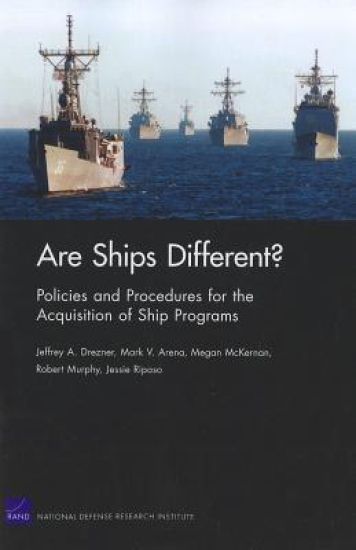
Are Ships Different? Policies and Procedures for the Acquisition Ofship Programs
Jeffrey A. Drezner; Mark V. Arena; Megan McKErnan; Robert Murphy; Jessie Riposo
RAND
2011
pokkari
Department of Defense policies, procedures, and organizations for program management and oversight of defense acquisition programs do not align well with shipbuilding. Ship acquisition programs have characteristics that deviate from the normal framework in significant ways, resulting in disconnects and some confusion. The authors examine these differences and suggest policies that can better account for them.
A Methodology for Implementing the Department of Defense's Current in-Sourcing Policy
Jessie Riposo; Irv Blickstein; Stephanie Young; Geoffrey McGovern; Brian McInnis
RAND
2011
pokkari

Maritime Prepositioning Force (Future) Capability Assessment
Robert W. Button; John Gordon; Dick Hoffmann; Jessie Riposo; Peter A. Wilson
RAND
2010
pokkari
Navy and Marine Corps Sea Basing concepts envision the rapid deployment, assembly, command, projection, reconstitution, and re-employment of expeditionary forces from the sea. RAND researchers assessed alternative structures for the proposed Maritime Prepositioning Force (Future), or MPF(F), squadron and their effects on operational support. For example, eliminating large-deck ships could be offset by substituting CH-53K helicopters for MV-22s.
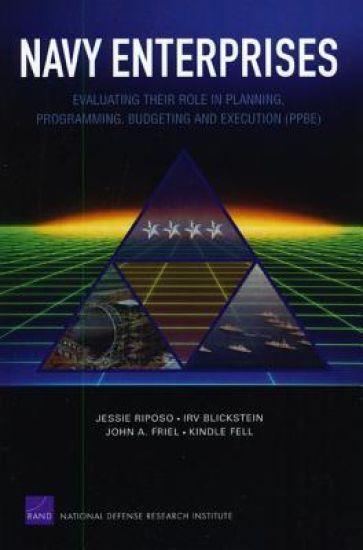
This evaluation of the participation of organizations within the Navy Enterprise in the Planning, Programming, Budgeting and Execution (PPBE) system (1) identifies and describes the current participation of Navy Enterprise organizations in PPBE and (2) identifies and assesses potential alternatives for Navy Enterprise participation.

U.S. Navy Shipyards
Jessie Riposo; Brien Alkire; John F Schank; Mark V Arena; James G Kallimani
RAND
2009
pokkari
RAND investigated cost-effective workforce-management strategies, alternative workload allocations, and the relevant best practices of comparable organizations to assist the Navy in managing the public shipyards. The Navy uses many practices common in other organizations, but reducing planned levels of overtime and increasing the permanent journeyman staff at the public shipyards could cost-effectively hedge against future workload growth.

Warfighting and Logistic Support of Joint Forces from the Joint Sea Base
Robert W Button; John Gordon; Jessie Riposo; Irv Blickstein; Peter A Wilson
RAND
2007
pokkari
Sea Basing, a concept fundamental to the U.S. Navy's operational vision for the 21st century, is intended to use the flexibility and protection provided by the sea base while minimizing the presence of forces ashore. This study analyzed the feasibility of simultaneously sustaining Marine Corps and Army elements ashore from a sea base or of moving an Army element in a reasonable period while sustaining a Marine Corps ground element already ashore.

Sustaining U.S. Nuclear Submarine Design Capabilities
John Schank; Mark Arena; Paul DeLuca; Jessie Riposo; Kimberly Curry
RAND
2007
pokkari
Nuclear submarine design resources at the shipyards, their suppliers, and the Navy may erode for lack of demand. Analysis of alternative workforce and workload management options suggests that the U.S. Navy should stretch out the design of the next submarine class and start it early or sustain design resources above the current demand, so that the next class may be designed on time, on budget, and with low risk.

Impacts of the Fleet Response Plan on Surface Combatant Maintenance
Roland J Yardley; Raj Raman; Jessie Riposo; James Chiesa; John F Schank
RAND
2006
pokkari
To achieve a more responsive and more readily deployable fleet of surface combatants, the Navy adopted the Fleet Response Plan (FRP) in 2003 to replace its traditional two-year ship maintenance cycle. The authors of this report look at the effects the FRP has had thus far and determine whether maintenance resources are meeting maintenance demands and whether related industry resources have been coordinated effectively.

The United Kingdom's Naval Shipbuilding Industrial Base
Mark V. Arena; Hans Pung; Cynthia R. Cook; Jefferson P. Marquis; Jessie Riposo; Gordon T. Lee
RAND
2005
pokkari
Assesses whether shipyards, other naval firms, and suppliers in the United Kingdom have sufficient capacity to meet the demands of the Ministry of Defence's construction of new ships and submarines over the next 15 years. The United Kingdom has many contracted and prospective shipbuilding programmes on the horizon over the next two decades. The UK Ministry of Defence wants to know whether its country's diminishing industrial base will be able to meet the requirements of this shipbuilding plan. Using extensive surveys and a breadth of data, RAND researchers look at the capacity of the UK shipbuilding industrial base and how alternative acquisition requirements, programmes, and schedules might affect this capability.

A Preliminary Investigation of Ship Acquisition Options for Joint Forcible Entry Operations
Robert Button; Irv Blickstein; John Gordon; Peter Wilson; Jessie Riposo
RAND
2005
pokkari
Describes the global environment in which joint forcible entry; operations might occur and the role of naval power in that environment; In the global security environment of the future, sea basing (loosely; speaking, the ability to assemble, equip, and support forces from sea; platforms without relying on land bases) will be critical to the Navy and; Marine Corps' ability to project-and sustain-forces ashore. Sea basing; clearly will be useful in the event of joint forcible entry operations; (JEFOs). This monograph describes the global environment in which JEFOs; might occur and the role of naval power in that environment.