Kirjojen hintavertailu. Mukana 12 297 379 kirjaa ja 12 kauppaa.

Kirjailija

Jiahu Qin

Kirjat ja teokset yhdessä paikassa: 4 kirjaa, julkaisuja vuosilta 2021-2024, suosituimpien joukossa Distributed Economic Operation in Smart Grid: Model-Based and Model-Free Perspectives. Vertaile teosten hintoja ja tarkista saatavuus suomalaisista kirjakaupoista.

4 kirjaa

Kirjojen julkaisuhaarukka 2021-2024.

Distributed Economic Operation in Smart Grid: Model-Based and Model-Free Perspectives

Distributed Economic Operation in Smart Grid: Model-Based and Model-Free Perspectives

Jiahu Qin; Yanni Wan; Fangyuan Li; Yu Kang; Weiming Fu

SPRINGER VERLAG, SINGAPORE
2023
sidottu
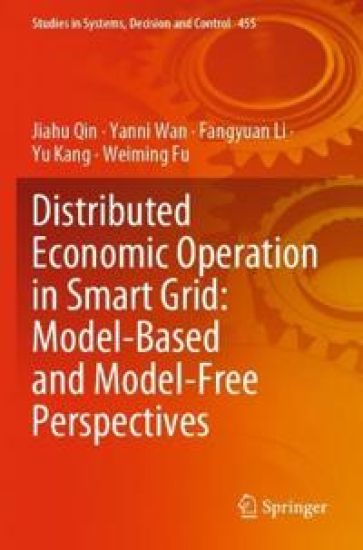
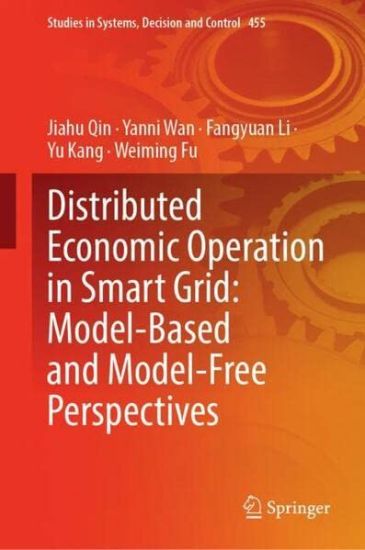
This book aims to work out the distributed economic operation in smart grids in a systematic way, which ranges from model-based to model-free perspectives. The main contributions of this book can be summarized into three folds. First, we investigate the fundamental economic operation problems in smart grids from model-based perspective. Specifically, these problems can be modeled as deterministic optimization models, and we propose some distributed optimization algorithms by integrating the multi-agent consensus theory and optimization techniques to achieve the distributed coordination of various generation units and loads. Second, due to the randomness of the large-scale renewable energies and the flexibility of the loads, we further address these economic operation problems from a model-free perspective, and we propose learning-based approaches to address the uncertainty and randomness. At last, we extend the idea of model-based and model-free algorithms to plug-in electric vehicles(PEVs) charging/discharging scheduling problem, the key challenge of which involves multiple objectives simultaneously while the behavior of PEVs and the electricity price are intrinsically random. This book presents several recent theoretical findings on distributed economic operation in smart grids from model-based and model-free perspectives. By systematically integrating novel ideas, fresh insights, and rigorous results, this book provides a base for further theoretical research on distributed economic operation in smart grids. It can be a reference for graduates and researchers to study the operation and management in smart grids. Some prerequisites for reading this book include optimization theory, matrix theory, game theory, reinforcement learning, etc.
Consensus Over Switching Network Topology: Characterizing System Parameters and Joint Connectivity

Consensus Over Switching Network Topology: Characterizing System Parameters and Joint Connectivity

Jiahu Qin; Qichao Ma; Huijun Gao; Wei Xing Zheng; Yu Kang

Springer Nature Switzerland AG
2022
nidottu
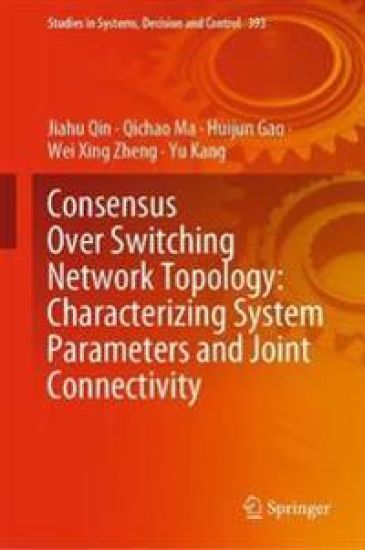
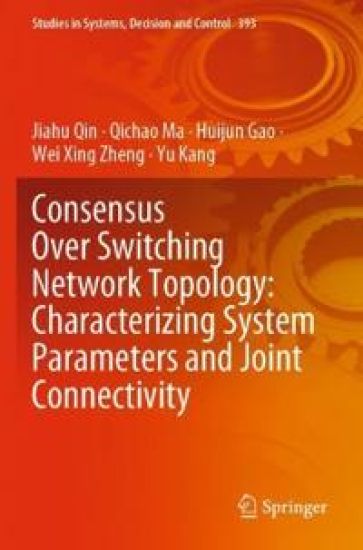
This book aims to extend existing works on consensus of multi-agent systems systematically. The agents to be considered range from double integrators to generic linear systems. The primary goal is to explicitly characterize how agent parameters, which reflect both self-dynamics and inner coupling of each agent, and switching network topologies jointly influence the collective behaviors. A series of necessary and/or sufficient conditions for exponential consensus are derived. The contents of this book are as follows. Chapter 1 provides the background and briefly reviews the advances of consensus of multi-agent systems. Chapter 2 addresses the consensus problem of double integrators over directed switching network topologies. It is proven that exponential consensus can be secured under very mild conditions incorporating the damping gain and network topology. Chapter 3 considers generic linear systems with undirected switching network topologies. Necessary and sufficient conditions on agent parameters and connectivity of the communication graph for exponential consensus are provided. Chapter 4 furthers the study of consensus for multiple generic linear systems by considering directed switching network topologies. How agent parameters and joint connectivity work together for reaching consensus is characterized from an algebraic and geometric view. Chapter 5 extends the design and analysis methodology to containment control problem, where there exist multiple leaders. A novel analysis framework from the perspective of state transition matrix is developed. This framework relates containment to consensus and overcomes the difficulty of construction of a containment error.This book serves as a reference to the main research issues and results on consensus of multi-agent systems. Some prerequisites for reading this book include linear system theory, matrix theory, mathematics, and so on.
Consensus Over Switching Network Topology: Characterizing System Parameters and Joint Connectivity

Consensus Over Switching Network Topology: Characterizing System Parameters and Joint Connectivity

Jiahu Qin; Qichao Ma; Huijun Gao; Wei Xing Zheng; Yu Kang

Springer Nature Switzerland AG
2021
sidottu
This book aims to extend existing works on consensus of multi-agent systems systematically. The agents to be considered range from double integrators to generic linear systems. The primary goal is to explicitly characterize how agent parameters, which reflect both self-dynamics and inner coupling of each agent, and switching network topologies jointly influence the collective behaviors. A series of necessary and/or sufficient conditions for exponential consensus are derived. The contents of this book are as follows. Chapter 1 provides the background and briefly reviews the advances of consensus of multi-agent systems. Chapter 2 addresses the consensus problem of double integrators over directed switching network topologies. It is proven that exponential consensus can be secured under very mild conditions incorporating the damping gain and network topology. Chapter 3 considers generic linear systems with undirected switching network topologies. Necessary and sufficient conditions on agent parameters and connectivity of the communication graph for exponential consensus are provided. Chapter 4 furthers the study of consensus for multiple generic linear systems by considering directed switching network topologies. How agent parameters and joint connectivity work together for reaching consensus is characterized from an algebraic and geometric view. Chapter 5 extends the design and analysis methodology to containment control problem, where there exist multiple leaders. A novel analysis framework from the perspective of state transition matrix is developed. This framework relates containment to consensus and overcomes the difficulty of construction of a containment error.This book serves as a reference to the main research issues and results on consensus of multi-agent systems. Some prerequisites for reading this book include linear system theory, matrix theory, mathematics, and so on.
Distributed Economic Operation in Smart Grid: Model-Based and Model-Free Perspectives

Distributed Economic Operation in Smart Grid: Model-Based and Model-Free Perspectives

Jiahu Qin; Yanni Wan; Fangyuan Li; Yu Kang; Weiming Fu

SPRINGER VERLAG, SINGAPORE
2024
nidottu
This book aims to work out the distributed economic operation in smart grids in a systematic way, which ranges from model-based to model-free perspectives. The main contributions of this book can be summarized into three folds. First, we investigate the fundamental economic operation problems in smart grids from model-based perspective. Specifically, these problems can be modeled as deterministic optimization models, and we propose some distributed optimization algorithms by integrating the multi-agent consensus theory and optimization techniques to achieve the distributed coordination of various generation units and loads. Second, due to the randomness of the large-scale renewable energies and the flexibility of the loads, we further address these economic operation problems from a model-free perspective, and we propose learning-based approaches to address the uncertainty and randomness. At last, we extend the idea of model-based and model-free algorithms to plug-in electric vehicles(PEVs) charging/discharging scheduling problem, the key challenge of which involves multiple objectives simultaneously while the behavior of PEVs and the electricity price are intrinsically random. This book presents several recent theoretical findings on distributed economic operation in smart grids from model-based and model-free perspectives. By systematically integrating novel ideas, fresh insights, and rigorous results, this book provides a base for further theoretical research on distributed economic operation in smart grids. It can be a reference for graduates and researchers to study the operation and management in smart grids. Some prerequisites for reading this book include optimization theory, matrix theory, game theory, reinforcement learning, etc.