Kirjojen hintavertailu. Mukana 12 239 174 kirjaa ja 12 kauppaa.

Kirjailija

Jill Lepore

Kirjat ja teokset yhdessä paikassa: 51 kirjaa, julkaisuja vuosilta 1999-2026, suosituimpien joukossa January 6 and the Politics of History. Vertaile teosten hintoja ja tarkista saatavuus suomalaisista kirjakaupoista.

51 kirjaa

Kirjojen julkaisuhaarukka 1999-2026.

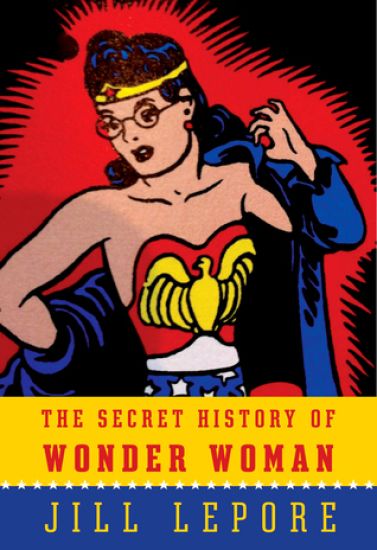
The Secret History of Wonder Woman
NATIONAL BESTSELLER - Within the origin of one of the world's most iconic superheroes hides a fascinating family story--and a crucial history of feminism in the twentieth-century. "Everything you might want in a page-turner...skeletons in the closet, a believe-it-or-not weirdness in its biographical details, and something else that secretly powers even the most "serious" feminist history--fun." --Entertainment Weekly The Secret History of Wonder Woman is a tour de force of intellectual and cultural history. Wonder Woman, Jill Lepore argues, is the missing link in the history of the struggle for women's rights--a chain of events that begins with the women's suffrage campaigns of the early 1900s and ends with the troubled place of feminism a century later. Lepore, a Harvard historian and New Yorker staff writer, has uncovered an astonishing trove of documents, including the never-before-seen private papers of Wonder Woman's creator, William Moulton Marston. The Marston family story is a tale of drama, intrigue, and irony. In the 1920s, Marston and his wife brought into their home Olive Byrne, the niece of Margaret Sanger, one of the most influential feminists of the twentieth century. Even while celebrating conventional family life in a regular column that Marston and Byrne wrote for Family Circle, they themselves pursued lives of extraordinary nonconformity. Marston, internationally known as an expert on truth--he invented the lie detector test--lived a life of secrets, only to spill them on the pages of Wonder Woman. Includes a new afterword with fresh revelations based on never before seen letters and photographs from the Marston family's papers, and 161 illustrations and 16 pages in full color.
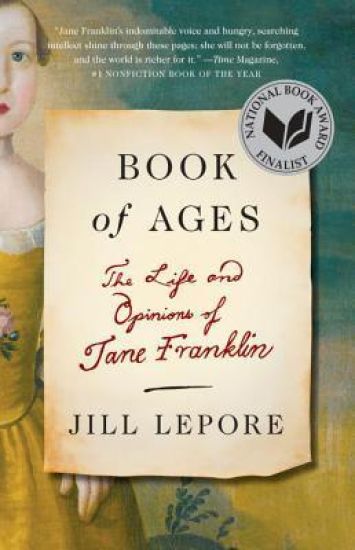
Book of Ages: The Life and Opinions of Jane Franklin
NATIONAL BOOK AWARD FINALIST ONE OF THE BEST BOOKS OF THE YEAR NPR - Time Magazine - The Washington Post - Entertainment Weekly - The Boston Globe A NEW YORK TIMES NOTABLE BOOK From one of our most accomplished and widely admired historians--a revelatory portrait of Benjamin Franklin's youngest sister, Jane, whose obscurity and poverty were matched only by her brother's fame and wealth but who, like him, was a passionate reader, a gifted writer, and an astonishingly shrewd political commentator. Making use of an astonishing cache of little-studied material, including documents, objects, and portraits only just discovered, Jill Lepore brings Jane Franklin to life in a way that illuminates not only this one extraordinary woman but an entire world.
The Story of America

The Story of America

Jill Lepore

Princeton University Press
2013
pokkari
In The Story of America, Harvard historian and New Yorker staff writer Jill Lepore investigates American origin stories--from John Smith's account of the founding of Jamestown in 1607 to Barack Obama's 2009 inaugural address--to show how American democracy is bound up with the history of print. Over the centuries, Americans have read and written their way into a political culture of ink and type. Part civics primer, part cultural history, The Story of America excavates the origins of everything from the paper ballot and the Constitution to the I.O.U. and the dictionary. Along the way it presents fresh readings of Benjamin Franklin's Way to Wealth, Thomas Paine's Common Sense, "The Raven" by Edgar Allan Poe, and "Paul Revere's Ride" by Henry Wadsworth Longfellow, as well as histories of lesser-known genres, including biographies of presidents, novels of immigrants, and accounts of the Depression. From past to present, Lepore argues, Americans have wrestled with the idea of democracy by telling stories. In this thoughtful and provocative book, Lepore offers at once a history of origin stories and a meditation on storytelling itself.
The Mansion of Happiness: A History of Life and Death
Renowned Harvard scholar and New Yorker staff writer Jill Lepore has written a strikingly original, ingeniously conceived, and beautifully crafted history of American ideas about life and death from before the cradle to beyond the grave. How does life begin? What does it mean? What happens when we die? "All anyone can do is ask," Lepore writes. "That's why any history of ideas about life and death has to be, like this book, a history of curiosity." Lepore starts that history with the story of a seventeenth-century Englishman who had the idea that all life begins with an egg, and ends it with an American who, in the 1970s, began freezing the dead. In between, life got longer, the stages of life multiplied, and matters of life and death moved from the library to the laboratory, from the humanities to the sciences. Lately, debates about life and death have determined the course of American politics. Each of these debates has a history. Investigating the surprising origins of the stuff of everyday life--from board games to breast pumps--Lepore argues that the age of discovery, Darwin, and the Space Age turned ideas about life on earth topsy-turvy. "New worlds were found," she writes, and "old paradises were lost." As much a meditation on the present as an excavation of the past, The Mansion of Happiness is delightful, learned, and altogether beguiling.
The Story of America

The Story of America

Jill Lepore

Princeton University Press
2012
sidottu
In The Story of America, Harvard historian and New Yorker staff writer Jill Lepore investigates American origin stories--from John Smith's account of the founding of Jamestown in 1607 to Barack Obama's 2009 inaugural address--to show how American democracy is bound up with the history of print. Over the centuries, Americans have read and written their way into a political culture of ink and type. Part civics primer, part cultural history, The Story of America excavates the origins of everything from the paper ballot and the Constitution to the I.O.U. and the dictionary. Along the way it presents fresh readings of Benjamin Franklin's Way to Wealth, Thomas Paine's Common Sense, "The Raven" by Edgar Allan Poe, and "Paul Revere's Ride" by Henry Wadsworth Longfellow, as well as histories of lesser-known genres, including biographies of presidents, novels of immigrants, and accounts of the Depression. From past to present, Lepore argues, Americans have wrestled with the idea of democracy by telling stories. In this thoughtful and provocative book, Lepore offers at once a history of origin stories and a meditation on storytelling itself.
The Whites of Their Eyes

The Whites of Their Eyes

Jill Lepore

Princeton University Press
2011
pokkari
Americans have always put the past to political ends. The Union laid claim to the Revolution--so did the Confederacy. Civil rights leaders said they were the true sons of liberty--so did Southern segregationists. This book tells the story of the centuries-long struggle over the meaning of the nation's founding, including the battle waged by the Tea Party, Glenn Beck, Sarah Palin, and evangelical Christians to "take back America." Jill Lepore, Harvard historian and New Yorker staff writer, offers a careful and concerned look at American history according to the far right, from the "rant heard round the world," which launched the Tea Party, to the Texas School Board's adoption of a social-studies curriculum that teaches that the United States was established as a Christian nation. Along the way, she provides rare insight into the eighteenth-century struggle for independence--a history of the Revolution, from the archives. Lepore traces the roots of the far right's reactionary history to the bicentennial in the 1970s, when no one could agree on what story a divided nation should tell about its unruly beginnings. Behind the Tea Party's Revolution, she argues, lies a nostalgic and even heartbreaking yearning for an imagined past--a time less troubled by ambiguity, strife, and uncertainty--a yearning for an America that never was. The Whites of Their Eyes reveals that the far right has embraced a narrative about America's founding that is not only a fable but is also, finally, a variety of fundamentalism--anti-intellectual, antihistorical, and dangerously antipluralist. In a new afterword, Lepore addresses both the recent shift in Tea Party rhetoric from the Revolution to the Constitution and the diminished role of scholars as political commentators over the last half century of public debate.
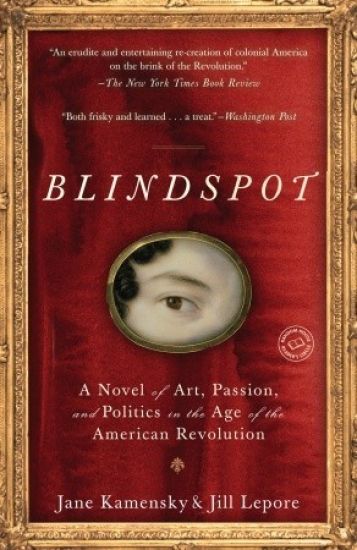
Blindspot

Blindspot

Jane Kamensky; Jill Lepore

Random House
2009
nidottu
Stewart Jameson, a Scottish portrait painter fleeing his debtors in Edinburgh, has washed up on the British Empire's far shores--in the city of Boston, lately seized with the spirit of liberty. Eager to begin anew, he advertises for an apprentice, but the lad who comes knocking is no lad at all. Fanny Easton is a fallen woman from Boston's most prominent family who has disguised herself as a boy to become Jameson's defiant and seductive apprentice. Written with wit and exuberance by accomplished historians, Blindspot is an affectionate send-up of the best of eighteenth-century fiction. It celebrates the art of the Enlightenment and the passion of the American Revolution by telling stories of ordinary people caught up in an extraordinary time.
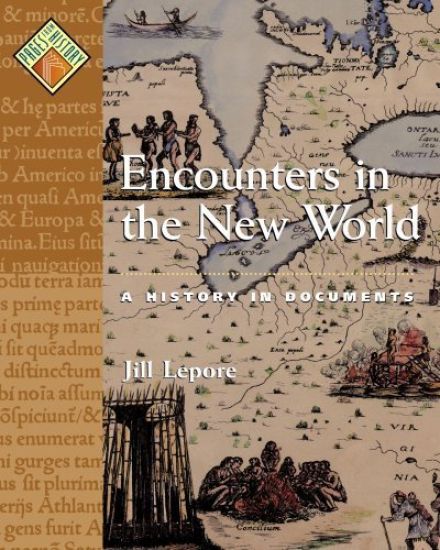
Encounters in the New World

Encounters in the New World

Jill Lepore

Oxford University Press Inc
2009
nidottu
From Columbus's voyage in 1492 to the publication of the autobiography of Olaudah Equiano, a former slave, in 1789, Jill Lepore, winner of the distinguished Bancroft Prize for history, brings to life in exciting, first-person detail some of the earliest events in American history in Encounters in the New World. Providing fascinating commentary along the way, Lepore seamlessly links together primary sources that illustrate the powerful clash of cultures in the Americas. Through emotional eyewitness accounts -- memoirs, petitions, diaries, captivity narratives, private correspondence -- formal documents, official reports, and journalistic reportage, dramatic stories of the New World are revealed, including: * A Jesuit priest's chronicle of life among his Iroquois captors * Aztec records of forbidding omens * John Smith's account of cannibalism among the British residents of Jamestown * Memoirs by members of Cortes's expedition * Reminiscences of an escaped slave A special 16-page color cartographic section, including maps from both Europe and North America, provides a fascinating look at how the maps' creators saw themselves and the world around them.
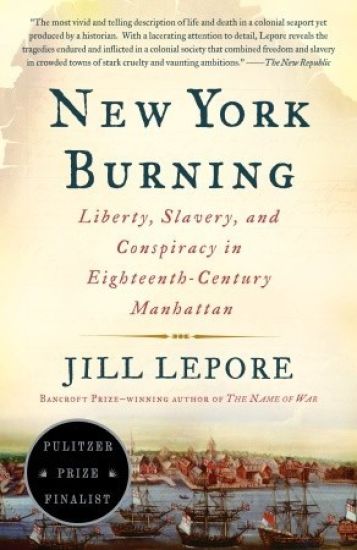
New York Burning: Liberty, Slavery, and Conspiracy in Eighteenth-Century Manhattan
PULITZER PRIZE FINALIST - ANISFIELD-WOLF AWARD WINNER - A revelatory study of the ways in which slavery both destabilized and created American politics. "Vivid and provocative; Lepore] evokes eighteenth-century New York in all its moral and physical messiness." --The New Yorker "A historical study that is both intellectually rigorous and broadly accessible. . . . The type of book that we need to read and historians need to write, more often." --Newsday In New York Burning, Bancroft Prize-winning historian Jill Lepore recounts these dramatic events of 1741, when ten fires blazed across Manhattan and panicked whites suspecting it to be the work a slave uprising went on a rampage. In the end, thirteen black men were burned at the stake, seventeen were hanged and more than one hundred black men and women were thrown into a dungeon beneath City Hall. Even back in the seventeenth century, the city was a rich mosaic of cultures, communities and colors, with slaves making up a full one-fifth of the population. Exploring the political and social climate of the times, Lepore dramatically shows how, in a city rife with state intrigue and terror, the threat of black rebellion united the white political pluralities in a frenzy of racial fear and violence.
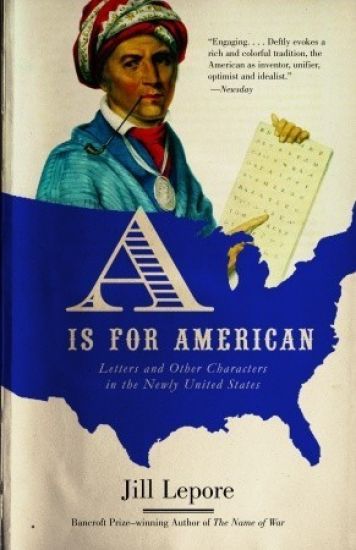
A Is for American

A Is for American

Jill Lepore

Vintage Books
2003
pokkari
What ties Americans to one another? What unifies a nation of citizens with different racial, religious and ethnic backgrounds? These were the dilemmas faced by Americans in the eighteenth and nineteenth centuries as they sought ways to bind the newly United States together. In A is for American, award-winning historian Jill Lepore portrays seven men who turned to language to help shape a new nation's character and boundaries. From Noah Webster's attempts to standardize American spelling, to Alexander Graham Bell's use of "Visible Speech" to help teach the deaf to talk, to Sequoyah's development of a Cherokee syllabary as a means of preserving his people's independence, these stories form a compelling portrait of a developing nation's struggles. Lepore brilliantly explores the personalities, work, and influence of these figures, seven men driven by radically different aims and temperaments. Through these superbly told stories, she chronicles the challenges faced by a young country trying to unify its diverse people.
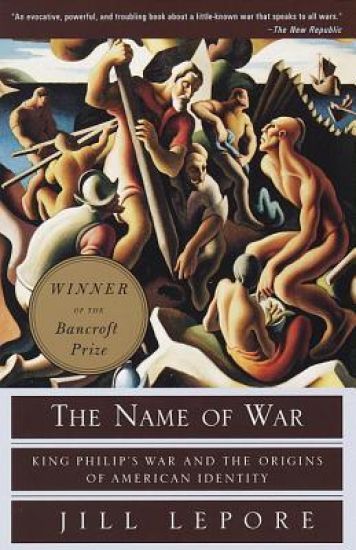
The Name of War

The Name of War

Jill Lepore

Vintage Books
1999
pokkari
King Philip's War, the excruciating racial war--colonists against Indians--that erupted in New England in 1675, was, in proportion to population, the bloodiest in American history. Some even argued that the massacres and outrages on both sides were too horrific to "deserve the name of a war."It all began when Philip (called Metacom by his own people), the leader of the Wampanoag Indians, led attacks against English towns in the colony of Plymouth. The war spread quickly, pitting a loose confederation of southeastern Algonquians against a coalition of English colonists. While it raged, colonial armies pursued enemy Indians through the swamps and woods of New England, and Indians attacked English farms and towns from Narragansett Bay to the Connecticut River Valley. Both sides, in fact, had pursued the war seemingly without restraint, killing women and children, torturing captives, and mutilating the dead. The fighting ended after Philip was shot, quartered, and beheaded in August 1676.The war's brutality compelled the colonists to defend themselves against accusations that they had become savages. But Jill Lepore makes clear that it was after the war--and because of it--that the boundaries between cultures, hitherto blurred, turned into rigid ones. King Philip's War became one of the most written-about wars in our history, and Lepore argues that the words strengthened and hardened feelings that, in turn, strengthened and hardened the enmity between Indians and Anglos. She shows how, as late as the nineteenth century, memories of the war were instrumental in justifying Indian removals--and how in our own century that same war has inspired Indian attempts to preserve "Indianness" as fiercely as the early settlers once struggled to preserve their Englishness.Telling the story of what may have been the bitterest of American conflicts, and its reverberations over the centuries, Lepore has enabled us to see how the ways in which we remember past events are as important in their effect on our history as were the events themselves.