Kirjojen hintavertailu. Mukana 12 595 353 kirjaa ja 12 kauppaa.

Kirjailija

Jinho Choi

Kirjat ja teokset yhdessä paikassa: 7 kirjaa, julkaisuja vuosilta 2006-2022, suosituimpien joukossa Low Complexity MIMO Receivers. Vertaile teosten hintoja ja tarkista saatavuus suomalaisista kirjakaupoista.

7 kirjaa

Kirjojen julkaisuhaarukka 2006-2022.

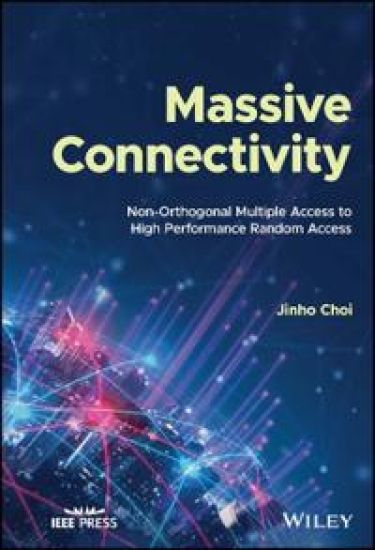
Massive Connectivity

Massive Connectivity

Jinho Choi

JOHN WILEY SONS INC
2022
sidottu
Massive Connectivity Learn to support more devices and sensors in Internet of Things applications through NOMA and machine-type communication Non-orthogonal multiple access (NOMA) has held much interest due to its ability to provide a higher spectral efficiency—such as more bits per unit bandwidth in Hertz—than other, orthogonal multiple access schemes. The majority of this research focuses on the application of NOMA to downlink channels (from base station to users) in cellular systems as its use for uplink (users to base station) is somewhat circumscribed. However, NOMA has recently been employed in contention-based uplink access, which has shown an improvement in performance that allows an increase in the number of users that can be supported. As a result, NOMA is promising for machine-type communication (MTC) in 5G systems and beyond, making it a key enabler of the Internet of Things (IoT). Massive Connectivity provides an in-depth, comprehensive view of the benefits and drawbacks of uplink NOMA random access (RA) systems. This text offers a basic introduction and description of uplink NOMA RA systems before considering the possibilities for evolution of the scheme as attempts are made to derive the most benefits and overcome any weaknesses. The book further presents key performance analysis while also highlighting game-theoretic views. In essence, by describing the essential properties of stable and high-throughput yielding RA systems, the book demonstrates that uplink NOMA can fulfill these required properties. Massive Connectivity readers will also find: An extensive literature survey on RA systems and their applications since the 1970sRecent advances in random access for massive connectivityRetransmission control algorithms for NOMA random accessDiscussion of how uplink NOMA random access systems can be integrated into the existing long-term evolution (LTE) or upcoming 5G cellular networks Massive Connectivity is a useful reference for field engineers and academics, as well as experts for random access systems for IoT applications.
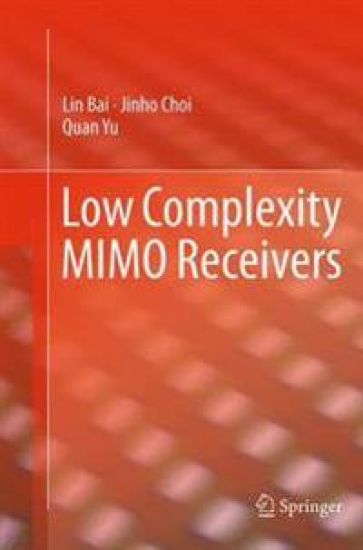
Low Complexity MIMO Receivers

Low Complexity MIMO Receivers

Lin Bai; Jinho Choi; Quan Yu

Springer International Publishing AG
2016
nidottu
Multiple-input multiple-output (MIMO) systems can increase the spectral efficiency in wireless communications. However, the interference becomes the major drawback that leads to high computational complexity at both transmitter and receiver. In particular, the complexity of MIMO receivers can be prohibitively high. As an efficient mathematical tool to devise low complexity approaches that mitigate the interference in MIMO systems, lattice reduction (LR) has been widely studied and employed over the last decade. The co-authors of this book are world's leading experts on MIMO receivers, and here they share the key findings of their research over years. They detail a range of key techniques for receiver design as multiple transmitted and received signals are available. The authors first introduce the principle of signal detection and the LR in mathematical aspects. They then move on to discuss the use of LR in low complexity MIMO receiver design with respect to different aspects, including uncoded MIMO detection, MIMO iterative receivers, receivers in multiuser scenarios, and multicell MIMO systems.
Low Complexity MIMO Receivers

Low Complexity MIMO Receivers

Lin Bai; Jinho Choi; Quan Yu

Springer International Publishing AG
2014
sidottu
Multiple-input multiple-output (MIMO) systems can increase the spectral efficiency in wireless communications. However, the interference becomes the major drawback that leads to high computational complexity at both transmitter and receiver. In particular, the complexity of MIMO receivers can be prohibitively high. As an efficient mathematical tool to devise low complexity approaches that mitigate the interference in MIMO systems, lattice reduction (LR) has been widely studied and employed over the last decade. The co-authors of this book are world's leading experts on MIMO receivers, and here they share the key findings of their research over years. They detail a range of key techniques for receiver design as multiple transmitted and received signals are available. The authors first introduce the principle of signal detection and the LR in mathematical aspects. They then move on to discuss the use of LR in low complexity MIMO receiver design with respect to different aspects, including uncoded MIMO detection, MIMO iterative receivers, receivers in multiuser scenarios, and multicell MIMO systems.
Low Complexity MIMO Detection

Low Complexity MIMO Detection

Lin Bai; Jinho Choi

Springer-Verlag New York Inc.
2014
nidottu
Low Complexity MIMO Detection introduces the principle of MIMO systems and signal detection via MIMO channels. This book systematically introduces the symbol detection in MIMO systems. Includes the fundamental knowledge of MIMO detection and recent research outcomes for low complexity MIMO detection.
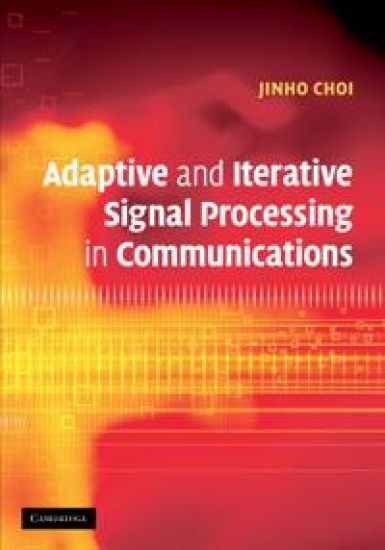
Adaptive and Iterative Signal Processing in Communications
Adaptive signal processing (ASP) and iterative signal processing (ISP) are important techniques in improving receiver performance in communication systems. Using examples from practical transceiver designs, this 2006 book describes the fundamental theory and practical aspects of both methods, providing a link between the two where possible. The first two parts of the book deal with ASP and ISP respectively, each in the context of receiver design over intersymbol interference (ISI) channels. In the third part, the applications of ASP and ISP to receiver design in other interference-limited channels, including CDMA and MIMO, are considered; the author attempts to illustrate how the two techniques can be used to solve problems in channels that have inherent uncertainty. Containing illustrations and worked examples, this book is suitable for graduate students and researchers in electrical engineering, as well as practitioners in the telecommunications industry.
Low Complexity MIMO Detection

Low Complexity MIMO Detection

Lin Bai; Jinho Choi

Springer-Verlag New York Inc.
2012
sidottu
Low Complexity MIMO Detection introduces the principle of MIMO systems and signal detection via MIMO channels. This book systematically introduces the symbol detection in MIMO systems. Includes the fundamental knowledge of MIMO detection and recent research outcomes for low complexity MIMO detection.
Adaptive and Iterative Signal Processing in Communications
Adaptive signal processing (ASP) and iterative signal processing (ISP) are important techniques in improving receiver performance in communication systems. Using examples from practical transceiver designs, this 2006 book describes the fundamental theory and practical aspects of both methods, providing a link between the two where possible. The first two parts of the book deal with ASP and ISP respectively, each in the context of receiver design over intersymbol interference (ISI) channels. In the third part, the applications of ASP and ISP to receiver design in other interference-limited channels, including CDMA and MIMO, are considered; the author attempts to illustrate how the two techniques can be used to solve problems in channels that have inherent uncertainty. Containing illustrations and worked examples, this book is suitable for graduate students and researchers in electrical engineering, as well as practitioners in the telecommunications industry.