Kirjojen hintavertailu. Mukana 12 657 676 kirjaa ja 12 kauppaa.

Kirjailija

Jinjun Chen

Kirjat ja teokset yhdessä paikassa: 6 kirjaa, julkaisuja vuosilta 2009-2017, suosituimpien joukossa The Design of Cloud Workflow Systems. Vertaile teosten hintoja ja tarkista saatavuus suomalaisista kirjakaupoista.

6 kirjaa

Kirjojen julkaisuhaarukka 2009-2017.

The Design of Cloud Workflow Systems

The Design of Cloud Workflow Systems

Xiao Liu; Dong Yuan; Gaofeng Zhang; Wenhao Li; Dahai Cao; Qiang He; Jinjun Chen; Yun Yang

Springer-Verlag New York Inc.
2011
nidottu
Cloud computing is the latest market-oriented computing paradigm which brings software design and development into a new era characterized by “XaaS”, i.e. everything as a service. Cloud workflows, as typical software applications in the cloud, are composed of a set of partially ordered cloud software services to achieve specific goals. However, due to the low QoS (quality of service) nature of the cloud environment, the design of workflow systems in the cloud becomes a challenging issue for the delivery of high quality cloud workflow applications. To address such an issue, this book presents a systematic investigation to the three critical aspects for the design of a cloud workflow system, viz. system architecture, system functionality and quality of service. Specifically, the system architecture for a cloud workflow system is designed based on the general four-layer cloud architecture, viz. application layer, platform layer, unified resources layer and fabric layer. The system functionality for a cloud workflow system is designed based on the general workflow reference model but with significant extensions to accommodate software services in the cloud. The support of QoS is critical for the quality of cloud workflow applications. This book presents a generic framework to facilitate a unified design and development process for software components that deliver lifecycle support for different QoS requirements. While the general QoS requirements for cloud workflow applications can have many dimensions, this book mainly focuses on three of the most important ones, viz. performance, reliability and security. In this book, the architecture, functionality and QoS management of our SwinDeW-C prototype cloud workflow system are demonstrated in detail as a case study to evaluate our generic design for cloud workflow systems. To conclude, this book offers a general overview of cloud workflow systems and provides comprehensive introductions to the design of thesystem architecture, system functionality and QoS management.
Grid Computing

Grid Computing

Lizhe Wang; Wei Jie; Jinjun Chen

CRC Press
2017
nidottu
Identifies Recent Technological Developments WorldwideThe field of grid computing has made rapid progress in the past few years, evolving and developing in almost all areas, including concepts, philosophy, methodology, and usages. Grid Computing: Infrastructure, Service, and Applications reflects the recent advances in this field, covering the research aspects that involve infrastructure, middleware, architecture, services, and applications.Grid Systems Across the GlobeThe first section of the book focuses on infrastructure and middleware and presents several national and international grid systems. The text highlights China Research and Development environment Over Wide-area Network (CROWN), several ongoing cyberinfrastructure efforts in New York State, and Enabling Grids for E-sciencE (EGEE), which is co-funded by the European Commission and the world’s largest multidisciplinary grid infrastructure today.The second part of the book discusses recent grid service advances. The authors examine the UK National Grid Service (NGS), the concept of resource allocation in a grid environment, OMIIBPEL, and the possibility of treating scientific workflow issues using techniques from the data stream community. The book describes an SLA model, reviews portal and workflow technologies, presents an overview of PKIs and their limitations, and introduces PIndex, a peer-to-peer model for grid information services.New Projects and InitiativesThe third section includes an analysis of innovative grid applications. Topics covered include the WISDOM initiative, incorporating flow-level networking models into grid simulators, system-level virtualization, grid usage in the high-energy physics environment in the LHC project, and the Service Oriented HLA RTI (SOHR) framework.With a comprehensive summary of past advances, this text is a window into the future of this nascent technology, forging a path for the next generation of cyberinfrastructure developers.
Computation and Storage in the Cloud

Computation and Storage in the Cloud

Dong Yuan; Yun Yang; Jinjun Chen

Elsevier Science Publishing Co Inc
2013
nidottu
Computation and Storage in the Cloud is the first comprehensive and systematic work investigating the issue of computation and storage trade-off in the cloud in order to reduce the overall application cost. Scientific applications are usually computation and data intensive, where complex computation tasks take a long time for execution and the generated datasets are often terabytes or petabytes in size. Storing valuable generated application datasets can save their regeneration cost when they are reused, not to mention the waiting time caused by regeneration. However, the large size of the scientific datasets is a big challenge for their storage. By proposing innovative concepts, theorems and algorithms, this book will help bring the cost down dramatically for both cloud users and service providers to run computation and data intensive scientific applications in the cloud. Covers cost models and benchmarking that explain the necessary tradeoffs for both cloud providers and users Describes several novel strategies for storing application datasets in the cloud Includes real-world case studies of scientific research applications
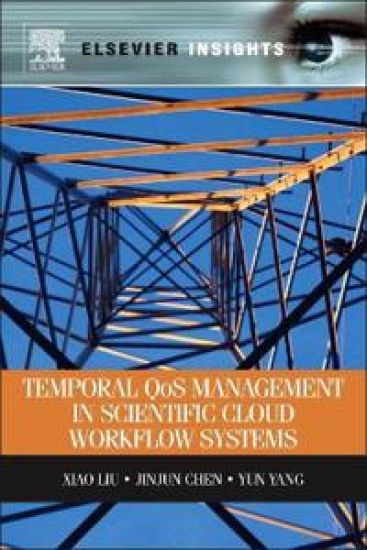
Temporal QOS Management in Scientific Cloud Workflow Systems

Temporal QOS Management in Scientific Cloud Workflow Systems

Xiao Liu; Jinjun Chen; Yun Yang

Elsevier Science Publishing Co Inc
2012
nidottu
Cloud computing can provide virtually unlimited scalable high performance computing resources. Cloud workflows often underlie many large scale data/computation intensive e-science applications such as earthquake modelling, weather forecasting and astrophysics. During application modelling, these sophisticated processes are redesigned as cloud workflows, and at runtime, the models are executed by employing the supercomputing and data sharing ability of the underlying cloud computing infrastructures. Temporal QOS Management in Scientific Cloud Workflow Systems focuses on real world scientific applications which often must be completed by satisfying a set of temporal constraints such as milestones and deadlines. Meanwhile, activity duration, as a measurement of system performance, often needs to be monitored and controlled. This book demonstrates how to guarantee on-time completion of most, if not all, workflow applications. Offering a comprehensive framework to support the lifecycle of time-constrained workflow applications, this book will enhance the overall performance and usability of scientific cloud workflow systems.
Grid Computing

Grid Computing

Lizhe Wang; Wei Jie; Jinjun Chen

CRC Press Inc
2009
sidottu
Identifies Recent Technological Developments WorldwideThe field of grid computing has made rapid progress in the past few years, evolving and developing in almost all areas, including concepts, philosophy, methodology, and usages. Grid Computing: Infrastructure, Service, and Applications reflects the recent advances in this field, covering the research aspects that involve infrastructure, middleware, architecture, services, and applications.Grid Systems Across the GlobeThe first section of the book focuses on infrastructure and middleware and presents several national and international grid systems. The text highlights China Research and Development environment Over Wide-area Network (CROWN), several ongoing cyberinfrastructure efforts in New York State, and Enabling Grids for E-sciencE (EGEE), which is co-funded by the European Commission and the world’s largest multidisciplinary grid infrastructure today.The second part of the book discusses recent grid service advances. The authors examine the UK National Grid Service (NGS), the concept of resource allocation in a grid environment, OMIIBPEL, and the possibility of treating scientific workflow issues using techniques from the data stream community. The book describes an SLA model, reviews portal and workflow technologies, presents an overview of PKIs and their limitations, and introduces PIndex, a peer-to-peer model for grid information services.New Projects and InitiativesThe third section includes an analysis of innovative grid applications. Topics covered include the WISDOM initiative, incorporating flow-level networking models into grid simulators, system-level virtualization, grid usage in the high-energy physics environment in the LHC project, and the Service Oriented HLA RTI (SOHR) framework.With a comprehensive summary of past advances, this text is a window into the future of this nascent technology, forging a path for the next generation of cyberinfrastructure developers.