Kirjojen hintavertailu. Mukana 12 289 220 kirjaa ja 12 kauppaa.

Kirjailija

Jinli Qiao

Kirjat ja teokset yhdessä paikassa: 3 kirjaa, julkaisuja vuosilta 2008-2019, suosituimpien joukossa Electrolytes for Electrochemical Supercapacitors. Vertaile teosten hintoja ja tarkista saatavuus suomalaisista kirjakaupoista.

3 kirjaa

Kirjojen julkaisuhaarukka 2008-2019.

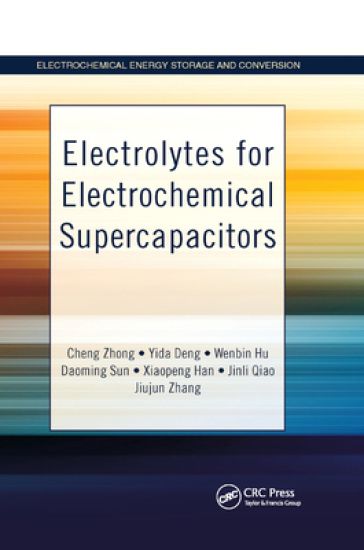
Electrolytes for Electrochemical Supercapacitors

Electrolytes for Electrochemical Supercapacitors

Cheng Zhong; Yida Deng; Wenbin Hu; Daoming Sun; Xiaopeng Han; Jinli Qiao; Jiujun Zhang

CRC Press
2019
nidottu
Electrolytes for Electrochemical Supercapacitors provides a state-of-the-art overview of the research and development of novel electrolytes and electrolyte configurations and systems to increase the energy density of electrochemical supercapacitors. Comprised of chapters written by leading international scientists active in supercapacitor research and manufacturing, this authoritative text: Describes a variety of electrochemical supercapacitor electrolytes and their properties, compositions, and systemsCompares different electrolytes in terms of their effects on electrochemical supercapacitor performanceExamines the interplay between the electrolytes, active electrode materials, and inactive components of the supercapacitorsDiscusses the design and optimization of electrolyte systems for improving electrochemical supercapacitor performanceExplores the challenges electrochemical supercapacitors currently face, offering unique insight into next-generation supercapacitor applications Thus, Electrolytes for Electrochemical Supercapacitors is a valuable resource for the research and development activities of academic researchers, graduate/undergraduate students, industry professionals, and manufacturers of electrode/electrolyte systems and electrochemical energy devices such as batteries, as well as for end users of the technology.
Electrolytes for Electrochemical Supercapacitors

Electrolytes for Electrochemical Supercapacitors

Cheng Zhong; Yida Deng; Wenbin Hu; Daoming Sun; Xiaopeng Han; Jinli Qiao; Jiujun Zhang

Productivity Press
2016
sidottu
Electrolytes for Electrochemical Supercapacitors provides a state-of-the-art overview of the research and development of novel electrolytes and electrolyte configurations and systems to increase the energy density of electrochemical supercapacitors. Comprised of chapters written by leading international scientists active in supercapacitor research and manufacturing, this authoritative text: Describes a variety of electrochemical supercapacitor electrolytes and their properties, compositions, and systemsCompares different electrolytes in terms of their effects on electrochemical supercapacitor performanceExamines the interplay between the electrolytes, active electrode materials, and inactive components of the supercapacitorsDiscusses the design and optimization of electrolyte systems for improving electrochemical supercapacitor performanceExplores the challenges electrochemical supercapacitors currently face, offering unique insight into next-generation supercapacitor applicationsThus, Electrolytes for Electrochemical Supercapacitors is a valuable resource for the research and development activities of academic researchers, graduate/undergraduate students, industry professionals, and manufacturers of electrode/electrolyte systems and electrochemical energy devices such as batteries, as well as for end users of the technology.

Hydrocarbon Polymer Electrolytes for Fuel Cell Applications

Hydrocarbon Polymer Electrolytes for Fuel Cell Applications

Jinli Qiao; Tatsuhiro Okada

Nova Science Publishers Inc
2008
nidottu
Direct methanol fuel cells (DMFCs), employing liquid methanol as a fuel, offer an attractive option in portable devices due to their simplicity in the system structure (easy storage and supply), no need for fuel reforming or humidification. For obtaining a higher power density, the membranes that show high proton conductivity, and at the same time, low methanol permeability are strongly desired. However, there is achieved only a little progress because of trade-off relations between these parameters. Also the membrane stability, particular to hydrolytic and chemical stability is recognised as a key factor that affects fuel cell performances. In the authors' recent work, they have been working on the design and the development of new families of cost-effective, readily prepared proton-conducting membranes based on chemically cross-linked PVA-PAMPS [poly(vinyl alcohol) and poly(2-acrylamido-2-methyl-1-propanesulfonic acid)] composites. The authors have first introduced new concepts of secondary polymer chains such as "binary chemical cross-linking" or "hydrophobiciser" and the "stabiliser"effect. Also, the authors have established a new concept of PVA-PAMPS based semi-interpenetrating polymer networks (semi-IPNs) by incorporating plasticizer variants R (R = poly(ethylene glycol)(PEG), poly(ethylene glycol) methyl ether (PEGME), poly(ethylene glycol) dimethyl ether (PEGDE), poly(ethylene glycol) diglycidyl ether (PEGDCE)) and poly(ethylene glycol)bis(carboxymethyl)ether (PEGBCME) as the third components. Incorporation of the above concepts promoted not only the high proton conductivity , flexibility with low methanol permeability (1/3 - 1/2 of Nafion 117 membrane), but also the excellent hydrolytic and the oxidative stability of PVA-PAMPS composites. The membrane electrode assembly (MEA) fabricated with PVA-PAMPS composites has been successfully established, which showed the similar open circuit voltage (OCV) to that of Nafion 115, and a power density 52 mW cm-2 at 80oC. A striking feature of the long-term test was that no appreciable decay of the current density was observed during the whole operation time longer than 130 hours at 50oC, and so was the power density. This book is the first time that such long-term operation of DMFC was reported since PVA-PAMPS composite are all hydrocarbon membranes made simply of aliphatic skeletons. They are very different from the perfluorosulfonic membranes such as Nafion, or other reported membranes with aromatic skeletons. Therefore this affords the PVA-PAMPS composites unique structure compared to most of the proposed membranes, which suggests the good candidacy of PVA-PAMPS composites when they are intended for use in low temperature DMFCs.