Kirjojen hintavertailu. Mukana 12 595 353 kirjaa ja 12 kauppaa.

Kirjailija

Joachim Wambsganss

Kirjat ja teokset yhdessä paikassa: 4 kirjaa, julkaisuja vuosilta 2001-2012, suosituimpien joukossa Gravitational Lensing: Strong, Weak and Micro. Vertaile teosten hintoja ja tarkista saatavuus suomalaisista kirjakaupoista.

4 kirjaa

Kirjojen julkaisuhaarukka 2001-2012.

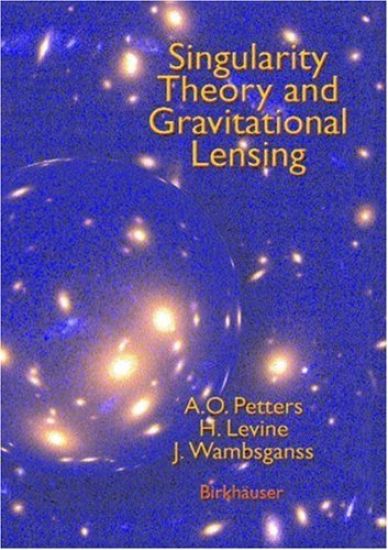
Singularity Theory and Gravitational Lensing

Singularity Theory and Gravitational Lensing

Arlie O. Petters; Harold Levine; Joachim Wambsganss

Springer-Verlag New York Inc.
2012
nidottu
Astronomers do not do experiments. They observe the universe primarily through detect­ ing light emitted by stars and other luminous objects. Since this light must travel through space to reach us, variations in the metric of space affects the appearance of astronomical objects. These variations lead to dramatic changes in the shape and brightness of astronom­ ical sources. Because these variations are sensitive to mass rather than to light, observations of gravitational lensing enable astronomers to probe the mass distribution of the universe. With gravitational lensing observations, astronomers are addressing many of the most important scientific questions in astronomy and physics: • What is the universe made of? Most of the energy and mass in the universe is not in the form of luminous objects. Stars account for less than 1 % of the energy density of the universe. Perhaps, as much as another 3% of the energy density of the universe is in the form of warm gas that fills the space between galaxies. The remaining 96% of the energy density is in some yet unidentified form. Roughly one third of this energy density of the universe is "dark matter," matter that clusters gravitationally but does not emit light. Most cosmologists suspect that this dark matter is composed of weakly interacting subatomic particles. However, most of the energy density of the universe appears to be in an even stranger form: energy associated with empty space.
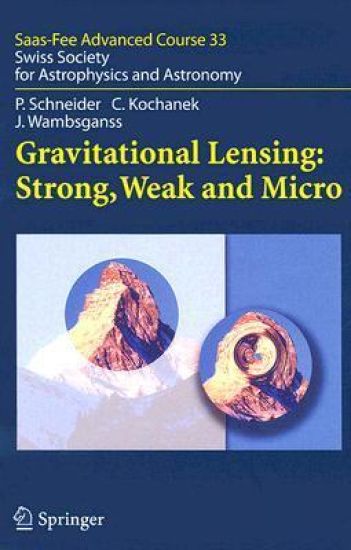
Gravitational Lensing: Strong, Weak and Micro

Gravitational Lensing: Strong, Weak and Micro

Peter Schneider; Christopher Kochanek; Joachim Wambsganss

Springer-Verlag Berlin and Heidelberg GmbH Co. K
2010
nidottu
The observation, in 1919 by A.S. Eddington and collaborators, of the gra- tational de?ection of light by the Sun proved one of the many predictions of Einstein’s Theory of General Relativity: The Sun was the ?rst example of a gravitational lens. In 1936, Albert Einstein published an article in which he suggested - ing stars as gravitational lenses. A year later, Fritz Zwicky pointed out that galaxies would act as lenses much more likely than stars, and also gave a list of possible applications, as a means to determine the dark matter content of galaxies and clusters of galaxies. It was only in 1979 that the ?rst example of an extragalactic gravitational lens was provided by the observation of the distant quasar QSO 0957+0561, by D. Walsh, R.F. Carswell, and R.J. Weymann. A few years later, the ?rst lens showing images in the form of arcs was detected. The theory, observations, and applications of gravitational lensing cons- tute one of the most rapidly growing branches of astrophysics. The gravi- tional de?ection of light generated by mass concentrations along a light path producesmagni?cation,multiplicity,anddistortionofimages,anddelaysp- ton propagation from one line of sight relative to another. The huge amount of scienti?c work produced over the last decade on gravitational lensing has clearly revealed its already substantial and wide impact, and its potential for future astrophysical applications.
Gravitational Lensing: Strong, Weak and Micro

Gravitational Lensing: Strong, Weak and Micro

Peter Schneider; Christopher Kochanek; Joachim Wambsganss

Springer-Verlag Berlin and Heidelberg GmbH Co. K
2006
sidottu
The observation, in 1919 by A.S. Eddington and collaborators, of the gra- tational de?ection of light by the Sun proved one of the many predictions of Einstein’s Theory of General Relativity: The Sun was the ?rst example of a gravitational lens. In 1936, Albert Einstein published an article in which he suggested - ing stars as gravitational lenses. A year later, Fritz Zwicky pointed out that galaxies would act as lenses much more likely than stars, and also gave a list of possible applications, as a means to determine the dark matter content of galaxies and clusters of galaxies. It was only in 1979 that the ?rst example of an extragalactic gravitational lens was provided by the observation of the distant quasar QSO 0957+0561, by D. Walsh, R.F. Carswell, and R.J. Weymann. A few years later, the ?rst lens showing images in the form of arcs was detected. The theory, observations, and applications of gravitational lensing cons- tute one of the most rapidly growing branches of astrophysics. The gravi- tional de?ection of light generated by mass concentrations along a light path producesmagni?cation,multiplicity,anddistortionofimages,anddelaysp- ton propagation from one line of sight relative to another. The huge amount of scienti?c work produced over the last decade on gravitational lensing has clearly revealed its already substantial and wide impact, and its potential for future astrophysical applications.
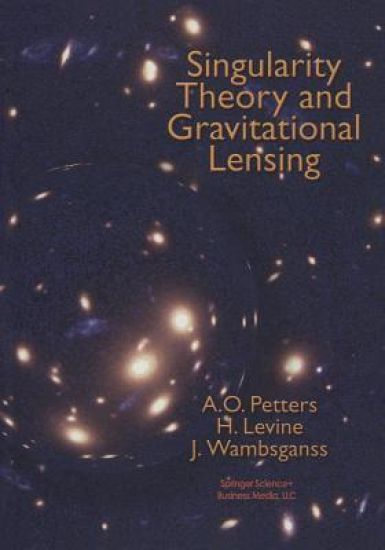
Singularity Theory and Gravitational Lensing

Singularity Theory and Gravitational Lensing

Arlie O. Petters; Harold Levine; Joachim Wambsganss

Birkhauser Boston Inc
2001
sidottu
Astronomers do not do experiments. They observe the universe primarily through detect­ ing light emitted by stars and other luminous objects. Since this light must travel through space to reach us, variations in the metric of space affects the appearance of astronomical objects. These variations lead to dramatic changes in the shape and brightness of astronom­ ical sources. Because these variations are sensitive to mass rather than to light, observations of gravitational lensing enable astronomers to probe the mass distribution of the universe. With gravitational lensing observations, astronomers are addressing many of the most important scientific questions in astronomy and physics: • What is the universe made of? Most of the energy and mass in the universe is not in the form of luminous objects. Stars account for less than 1 % of the energy density of the universe. Perhaps, as much as another 3% of the energy density of the universe is in the form of warm gas that fills the space between galaxies. The remaining 96% of the energy density is in some yet unidentified form. Roughly one third of this energy density of the universe is "dark matter," matter that clusters gravitationally but does not emit light. Most cosmologists suspect that this dark matter is composed of weakly interacting subatomic particles. However, most of the energy density of the universe appears to be in an even stranger form: energy associated with empty space.